


The arrival of United States troops on September 8, 1945, marked the beginning of a new era in Korean history – an era of division, of North and South, of conflicting ideologies and uncertain futures. This pivotal event, sparked by the Soviet Union's occupation of the northern peninsula, would shape the destiny of the Korean people and have far-reaching consequences for global politics.
In the aftermath of World War II, Korea, once a unified nation, found itself at the mercy of world powers. Following Japan's defeat, the Soviet Union and the United States agreed to temporarily occupy the peninsula, with the 38th parallel serving as the dividing line. However, as the Soviet Union consolidated its grip on the north, the United States responded by deploying its troops to the south, effectively creating a buffer zone between the two.
The division of Korea had far-reaching consequences, leading to the establishment of two separate governments, economies, and societies. The partition would also spark a decades-long standoff, marked by tension, propaganda, and occasional outbreaks of violence. The fate of the Korean people was forever changed, as families were torn apart and a nation was divided.
The partition of Korea was not just a political event but also a deeply personal one. Families were separated, communities were torn apart, and a nation's identity was forever altered. The division would also shape the cultural and social fabric of both North and South Korea, influencing everything from education to art to daily life.
Despite the darkness of division, there are stories of hope and resilience. The partition of Korea would inspire individuals to work towards reunification, to bridge the gap between North and South. It would also spark a sense of national pride, as Koreans from both sides of the 38th parallel worked towards a common goal – a unified Korea.
The story of Korea's partition serves as a powerful reminder of the importance of unity, of the devastating consequences of division, and of the human spirit's capacity to persevere in the face of adversity.
General Douglas MacArthur, the Supreme Commander of the Allied Powers in Japan, played a crucial role in shaping the US response to the Soviet occupation of Korea. Born on January 26, 1880, MacArthur was a decorated war hero who had served in World War I and later became the Chief of Staff of the US Army. His experience and strategic thinking made him a key figure in the decision to deploy US troops to Korea.
MacArthur's leadership style was marked by a strong sense of authority and a willingness to take bold action. He believed that the Soviet Union's occupation of the northern part of the peninsula was a threat to US interests and security in the region. As a result, he advocated for a strong US presence in Korea to counterbalance Soviet influence.
MacArthur's role in the partition of Korea extended beyond his military leadership. He also played a key role in shaping the political landscape of the region. He worked closely with Syngman Rhee, the first president of South Korea, to establish a stable government and economy in the south. MacArthur's influence helped to solidify the division between North and South Korea, paving the way for the establishment of two separate states.

In August 1945, the Soviet Union's occupation of the northern part of the Korean peninsula marked the beginning of a new era in Korean history. The Soviet Union's Red Army had been advancing through Manchuria and into Korea, driven by a desire to expand Soviet influence in the region.
The Soviet occupation was characterized by a series of brutal crackdowns on dissent and opposition. The Soviet authorities established a network of informants and secret police to monitor and control the population. Any opposition to Soviet rule was swiftly crushed, and thousands of Koreans were arrested, imprisoned, or executed.
The Soviet Union's occupation also had a profound impact on the economy and infrastructure of the north. The Soviet authorities nationalized key industries, such as mining and manufacturing, and established a command economy. They also invested heavily in infrastructure, including roads, bridges, and communication networks.
The division of Korea had a profound impact on the cultural and social fabric of the Korean people. The establishment of two separate states led to the development of distinct cultural identities in the north and south.
In the south, the cultural landscape was shaped by the influence of the United States and other Western countries. American-style education, music, and film became increasingly popular, leading to a fusion of traditional Korean culture with modern Western influences.
In the north, the cultural landscape was shaped by the influence of the Soviet Union and communist ideology. The state played a central role in promoting socialist art, literature, and music, and the cult of personality surrounding Kim Il-sung, the leader of North Korea, became a dominant feature of North Korean culture.
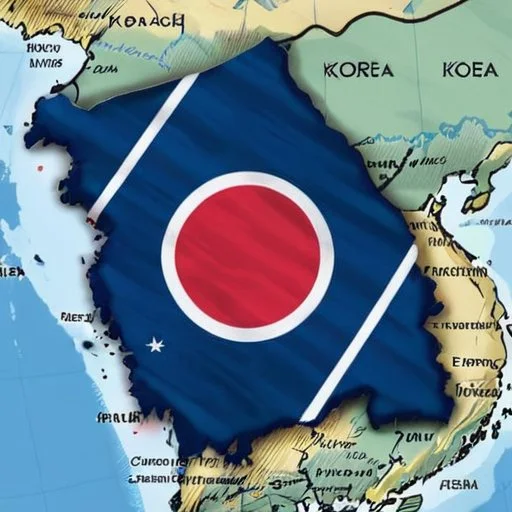
The division of Korea had far-reaching political consequences for the Korean people and the global community. The establishment of two separate states led to a decades-long standoff between North and South Korea, marked by tension, propaganda, and occasional outbreaks of violence.
The division also had significant implications for the global balance of power. The Soviet Union's occupation of the north and the United States' occupation of the south drew the two superpowers into a Cold War rivalry in Korea, with each side seeking to expand its influence in the region.
The division of Korea also led to the establishment of a Demilitarized Zone (DMZ) along the 38th parallel, which became one of the most heavily militarized borders in the world. The DMZ has remained in place to this day, a symbol of the ongoing tensions between North and South Korea.
The division of Korea had significant economic consequences for the Korean people and the global community. The establishment of two separate states led to the development of distinct economic systems in the north and south.
In the south, the economy was characterized by a free-market system, with close ties to the United States and other Western countries. South Korea became a major trading partner with the United States and a key player in the global economy.
In the north, the economy was characterized by a command economy, with the state playing a central role in the production and distribution of goods and services. North Korea became increasingly isolated from the global economy, with limited trade ties with other countries.