


On June 2, 1995, U.S. Air Force Captain Scott O'Grady's F-16C Fighting Falcon was blasted out of the sky by a Bosnian Serb missile, leaving him to survive against all odds in hostile territory. But it was his daring rescue by a team of U.S. Marines, led by Captain Chris Kappler, six days later that etched this operation into the annals of military history.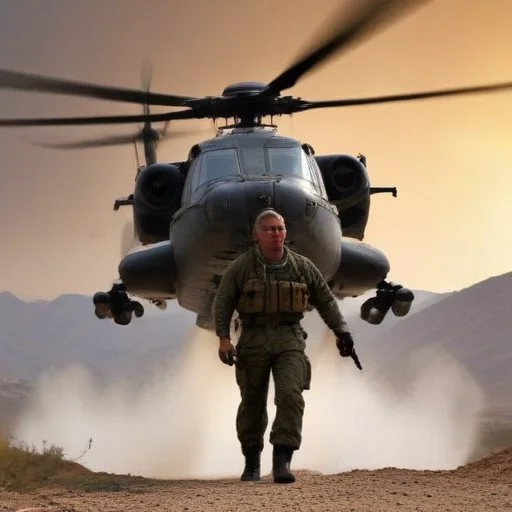
The early 1990s saw the former Yugoslavian region of Bosnia-Herzegovina embroiled in a brutal ethnic conflict between Bosnian Muslims, Croats, and Serbs. The international community, led by the United States, intervened in 1992, imposing a no-fly zone over Bosnia to protect civilians from aerial attacks.
Captain Scott O'Grady, a seasoned F-16C pilot, was on a routine patrol mission over Bosnia on June 2, 1995, when his aircraft was hit by a Bosnian Serb missile. O'Grady ejected safely, but found himself in the midst of a war zone, with minimal supplies and no means of communication.
With only his wits to rely on, O'Grady began a six-day ordeal of survival, scavenging for berries and rainwater to sustain himself. He evaded capture by the enemy, using his training to stay one step ahead of his pursuers. The U.S. military, meanwhile, launched an extensive search-and-rescue operation, involving Navy and Marine Corps assets.
In a heart-pumping display of bravery and precision, a team of U.S. Marines, led by Captain Chris Kappler, executed a daring dawn raid to extract O'Grady from the clutches of the enemy. As the Marines' CH-53 Sea Stallion helicopter hovered above, O'Grady sprinted to safety, sparking jubilation among his rescuers.
In his memoir,
Meanwhile, Captain Chris Kappler, leader of the Marine rescue team, later revealed that the mission had been fraught with uncertainty, with his team facing adverse weather conditions and enemy fire during the extraction.
For their heroic actions, Captain Scott O'Grady was awarded the Bronze Star Medal with Valor, while Captain Chris Kappler received the Legion of Merit with Combat "V" device.
The dramatic rescue operation, coupled with Captain O'Grady's harrowing survival tale, captivated the American public, inspiring numerous books, films, and documentaries. The event also highlighted the importance of teamwork, sacrifice, and bravery in the face of overwhelming adversity.
Today, the legacy of Captain Scott O'Grady's rescue serves as a beacon of hope and inspiration, reminding us of the unwavering commitment and valor of our military personnel.
Born on June 8, 1965, in Brooklyn, New York, Captain Scott O'Grady grew up with a passion for flying. He earned his commission from the U.S. Air Force Academy in 1989 and went on to become a distinguished F-16C pilot.
O'Grady's early years in the Air Force saw him serve in various capacities, including as a pilot with the 17th Fighter Squadron at Shaw Air Force Base in South Carolina. His exceptional skills and bravery earned him numerous awards and commendations, including the Air Force Commendation Medal and the Combat Action Medal.
Following his miraculous rescue, O'Grady continued to serve in the Air Force, retiring as a Major in 2001. He has since become a sought-after motivational speaker and author, inspiring millions with his tale of survival and resilience.

The Balkan conflict, which ravaged the former Yugoslavian region in the early 1990s, was marked by brutal ethnic violence and humanitarian crises. While the O'Grady rescue mission was a beacon of hope, it is essential to compare it to other notable events of the conflict.
One such event was the Srebrenica massacre, where over 8,000 Bosnian Muslims were killed by Bosnian Serb forces. This atrocity, unlike O'Grady's rescue, highlights the devastating human cost of the conflict.
In contrast, the O'Grady rescue showcases the military prowess and humanitarian efforts of the international community, led by the United States. This dichotomy underscores the complexities of the Balkan conflict, where moments of heroism and tragedy coexisted.
The daring dawn rescue of Captain Scott O'Grady captivated the American public, transcending the realm of military operations to become a cultural phenomenon. The event inspired a plethora of books, films, and documentaries, cementing its place in the collective American consciousness.
The rescue's cultural impact can be gauged by the numerous adaptations of O'Grady's story, from the book RETURN WITH HONOR to the film Behind Enemy Lines. These works not only paid tribute to O'Grady's bravery but also sparked a national conversation about patriotism, duty, and sacrifice.
The O'Grady rescue has also been immortalized in popular culture, with references in TV shows and films, such as The Simpsons and Entourage. This permeation of popular culture underscores the enduring appeal of the rescue mission, symbolizing American values and the unwavering commitment of its military personnel.
The Balkan conflict, which ravaged the former Yugoslavian region in the early 1990s, was a complex web of ethnic, political, and religious tensions. The O'Grady rescue mission was set against the backdrop of this turmoil, with the international community struggling to contain the violence.
The conflict saw the emergence of various factions, including the Bosnian Muslims, Croats, and Serbs, each vying for power and control. The international community, led by the United States, intervened in 1992, imposing a no-fly zone over Bosnia to protect civilians from aerial attacks.
The O'Grady rescue mission, while a minor episode in the larger conflict, highlights the challenges faced by military personnel operating in such a volatile environment. The geopolitical context of the Balkan conflict underscores the importance of strategic planning, coordination, and bravery in the face of uncertainty and danger.
The O'Grady rescue mission raises fundamental questions about the nature of heroism, duty, and sacrifice. At its core, the event represents a clash of philosophical and ideological perspectives.
From a utilitarian perspective, the rescue mission can be seen as a pragmatic response to a humanitarian crisis, where the ends justify the means. Conversely, from a deontological standpoint, the mission embodies a moral imperative to protect human life, regardless of the costs.
The O'Grady rescue also touches on the concept of patriotism, highlighting the tension between individual sacrifice and national interest. Ultimately, the event serves as a powerful testament to the human spirit, inspiring introspection and debate about the values that underpin our actions.