


In the early 20th century, the Dutch East Indies' Northern Sumatra region was forever changed when General G.C.E. van Daalen's Marechaussee regiment unleashed a devastating military campaign, resulting in the tragic loss of thousands of civilian lives. This dark chapter in history remains a painful reminder of the devastating consequences of colonialism and the pursuit of control.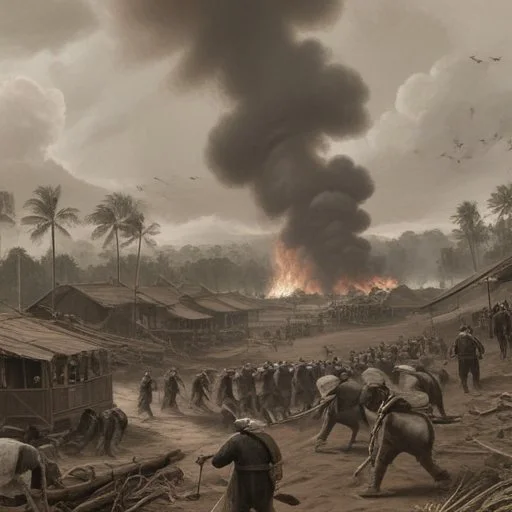
The Dutch East Indies, a colonial empire that spanned across present-day Indonesia, was a hotbed of tension and resistance in the early 20th century. As the indigenous population grew increasingly dissatisfied with the Dutch colonial rule, localized uprisings and rebellions began to sprout. The Marechaussee regiment, an elite military unit, was tasked with quelling the growing unrest and maintaining Dutch control over the region.
At the helm of the Marechaussee regiment stood General G.C.E. van Daalen, a seasoned military leader with a reputation for ruthless efficiency. Van Daalen's tactical prowess was matched only by his unyielding commitment to maintaining Dutch dominance in the region. His campaign would become synonymous with brutality and terror, earning him the moniker "the Butcher of Aceh."
1904: General van Daalen's Marechaussee regiment launches a large-scale military campaign in Northern Sumatra, with the aim of crushing local resistance and solidifying Dutch control.
1905: The Marechaussee regiment engages in a series of brutal battles, razing villages and displacing thousands of civilians.
1906: The campaign reaches its peak, with reports of widespread human rights abuses, massacres, and destruction of entire villages.
The consequences of General van Daalen's campaign were devastating: thousands of civilians lost their lives, countless more were displaced, and the region was left scarred by the trauma of violence and destruction. The campaign also fueled anti-Dutch sentiment, galvanizing local resistance movements and paving the way for Indonesia's future struggle for independence.
Despite the campaign's profound impact on the region, the events surrounding General van Daalen's Marechaussee regiment remain shrouded in silence. The Dutch East Indies' colonial legacy has been subject to a collective amnesia, with few acknowledging the atrocities committed during this period. This silence has allowed the wounds of the past to fester, making it essential to revisit and learn from this dark chapter in history.
In recent years, there has been a growing effort to confront the Dutch East Indies' troubled past, acknowledging the suffering inflicted upon the indigenous population. This shift in public perception has sparked a renewed interest in the legacy of General van Daalen's campaign, recognizing the importance of remembering the forgotten and honoring the victims of colonialism.
General van Daalen's campaign was initially hailed as a military success, earning him accolades and recognition within the Dutch colonial establishment. However, in the face of mounting criticism and scrutiny, his legacy has become increasingly tainted by the atrocities committed during his tenure.
As we delve deeper into the shadows of history, we are reminded of the importance of confronting the darker aspects of our collective past. The story of General van Daalen's campaign serves as a poignant reminder of the devastating consequences of colonialism and the pursuit of control, urging us to learn from the past and strive towards a more equitable and just future.
The rise of indigenous opposition to Dutch colonial rule in Northern Sumatra was a complex phenomenon, driven by a deep-seated desire for self-determination and autonomy. As the Dutch East Indies expanded its territorial control, local communities rallied around traditional leaders, who spearheaded the resistance movement. The 1890s saw a surge in localized uprisings, with groups like the Acehnese, Gayonese, and Alas peoples fiercely resisting Dutch incursions into their lands.
These early resistance movements laid the groundwork for the broader anti-colonial struggle that would unfold in the early 20th century. The harsh treatment of indigenous peoples, forced labor, and cultural suppression all contributed to the growing sense of discontent among the population.
As General van Daalen's campaign swept across Northern Sumatra, the indigenous population found themselves caught in the crossfire of a brutal conflict. While the Marechaussee regiment was determined to crush the resistance, local communities continued to mobilize, using guerrilla warfare and other tactics to challenge Dutch authority.

General G.C.E. van Daalen remains an enigmatic figure, shrouded in mystery and controversy. Born in 1863, van Daalen rose through the ranks of the Dutch colonial army, earning a reputation for his tactical prowess and unwavering commitment to the colonial project.
Little is known about van Daalen's personal life, but his military career is marked by a series of brutal campaigns aimed at quelling indigenous resistance. His appointment as commander of the Marechaussee regiment in 1903 set the stage for the devastating campaign that would soon follow.
While van Daalen's actions were widely condemned by human rights advocates and critics of colonialism, he remained a decorated hero within the Dutch colonial establishment. His legacy continues to spark debate, with some hailing him as a military genius and others denouncing him as a callous butcher.
The Dutch colonial era in Northern Sumatra was marked by a systematic erasure of indigenous culture and identity. The imposition of Western values, languages, and customs sought to supplant traditional practices and ways of life.
The Marechaussee regiment's campaign accelerated this process, as local communities were forced to adapt to the brutal realities of colonial rule. Traditional leaders were co-opted or silenced, and indigenous cultural practices were suppressed or forbidden.
Today, the legacy of colonialism continues to resonate, as indigenous communities struggle to reclaim their cultural heritage. Efforts to preserve traditional languages, customs, and practices are underway, but the scars of colonialism remain a painful reminder of the past.

The economic impact of General van Daalen's campaign was devastating, as the region's fragile infrastructure and economy were ravaged by war. The destruction of villages, crops, and livestock led to widespread poverty and displacement.
The campaign also disrupted the region's lucrative trade networks, further exacerbating the economic crisis. The Dutch colonial administration's focus on resource extraction and exploitation of natural resources deepened the economic woes, as the region's wealth was siphoned off to benefit colonial interests.
The economic legacy of colonialism continues to shape the region's development, with many communities still struggling to recover from the devastation of the early 20th century.
The late 19th and early 20th centuries saw a significant shift in the geopolitics of Southeast Asia, as European powers jostled for dominance in the region. The Dutch East Indies, seeking to expand its territorial control, viewed Northern Sumatra as a vital strategic prize.
The region's proximity to the Strait of Malacca, a vital trade route, made it an attractive target for colonial powers. The Dutch colonial administration, driven by a desire to secure its interests and protect its trade networks, launched a series of military campaigns to solidify its control over the region.
General van Daalen's campaign must be seen within this broader geopolitical context, as a brutal but calculated move to assert Dutch dominance in the region.