


In the early hours of May 5, 1821, the once-mighty Emperor Napoleon Bonaparte breathed his last on the remote island of Saint Helena, a British outpost in the South Atlantic Ocean. This marked the end of an era, as the man who had reshaped the European landscape and left an indelible mark on history finally succumbed to illness and isolation.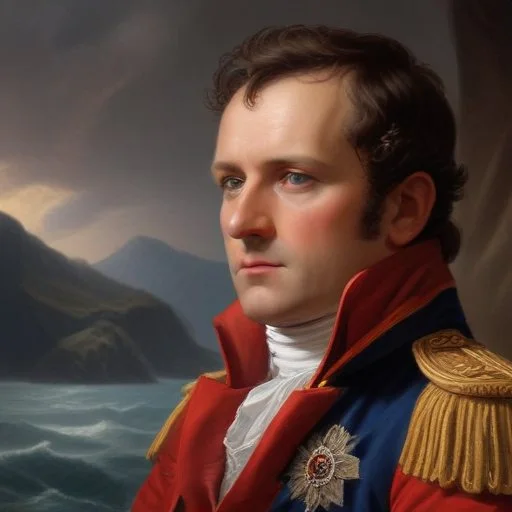
Napoleon's rise to power was nothing short of meteoric. He rose through the ranks of the French military, eventually seizing control of the French government and declaring himself Emperor in 1804. His military campaigns and conquests would go on to shape the face of Europe, as he redrew borders, established new kingdoms, and brought about a period of relative stability and prosperity.
However, Napoleon's ambition and aggressive expansion eventually led to his downfall. The disastrous Russian campaign of 1812 and the subsequent collapse of his empire marked the beginning of the end. The coalition of European powers, led by Britain, Prussia, and Austria, eventually defeated Napoleon at the Battle of Waterloo in 1815. He was exiled to Saint Helena, where he would spend the remainder of his days under close British supervision.
Saint Helena, a small, volcanic island in the South Atlantic, was chosen for its remoteness and inaccessibility. Napoleon was confined to Longwood House, a damp, chilly residence that would become his prison for the next six years. The island's isolation and harsh climate took a toll on Napoleon's health, as he struggled with stomach problems, rheumatism, and eventually, the arsenic poisoning that would contribute to his demise.
Despite his confinement, Napoleon lived a life of relative luxury on the island. He was attended to by a retinue of servants, cooks, and doctors, and was allowed to maintain a degree of autonomy over his daily routine. He continued to dictate his memoirs, wrote letters to his loved ones, and even maintained a small garden.
Napoleon's impact on European history cannot be overstated. He introduced the Napoleonic Code, which reformed and standardized French law, and his military campaigns spread the ideals of the French Revolution throughout Europe. His legacy would go on to influence generations of leaders, from Abraham Lincoln to Charles de Gaulle.
Despite his flaws and controversies, Napoleon remains an enigmatic figure, a symbol of both military genius and imperial hubris. His exile and demise on Saint Helena serve as a poignant reminder of the fleeting nature of power and the impermanence of human achievement.
In the end, Napoleon's death marked the end of an era, but his legacy would live on, inspiring generations to come. His final stand on Saint Helena serves as a testament to the indomitable human spirit, even in the face of adversity and isolation.
Napoleon's rise to power was not solely due to his military prowess, but also his exceptional leadership skills. He possessed a unique ability to inspire loyalty and devotion in his troops, often referring to them as "my children."
Despite his authoritarian nature, Napoleon was a shrewd politician who knew how to manipulate public opinion. He was a master of propaganda, using his control of the media to shape public perception and garner support for his policies.
Napoleon's personal life was marked by turmoil and tragedy. His marriage to Joséphine was a passionate and tumultuous one, and her death in 1814 was a devastating blow. He would later marry Marie-Louise of Austria, with whom he had a son, but the marriage was largely a pragmatic one.

In the early 19th century, Europe was a complex web of alliances and rivalries. The French Revolution had created a power vacuum, and Napoleon's rise to power was seen as a threat by many European monarchies.
The British, in particular, were wary of Napoleon's expansionist policies and saw him as a threat to their colonial empire. The Austrians, Prussians, and Russians also viewed him with suspicion, and the coalition of European powers that eventually defeated him at Waterloo was a testament to their collective concern.
The environmental impact of Napoleon's military campaigns was significant. The widespread destruction of crops, forests, and infrastructure during his conquests led to widespread famine and displacement.
The Peninsular War, fought between 1807 and 1814, was particularly devastating, with widespread desertification and soil degradation resulting from the conflict.

Napoleon's domestic policies were marked by a strong centralized government and a strict control over the media and opposition. He was a shrewd politician who knew how to maintain power and suppress dissent.
Despite his authoritarian nature, Napoleon introduced several progressive reforms, including the Napoleonic Code, which reformed and standardized French law.
His economic policies, however, were often authoritarian and interventionist, leading to widespread discontent among the French people.
Historians have long debated the legacy of Napoleon, with some viewing him as a progressive reformer and others seeing him as a power-hungry dictator.
Marxist historians, such as Georges Lefebvre, have seen Napoleon as a representative of the bourgeoisie, who used his power to maintain the status quo and suppress the working class.
Other historians, such as Georges Duby, have viewed Napoleon as a modernizer who brought about significant reforms and transformed the face of Europe.