Napoleon wins crucial Battle of Craonne against Coalition forces.
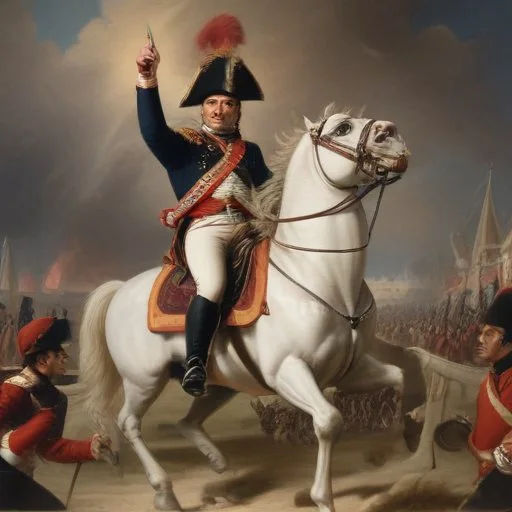
Emperor Napoleon I, the master strategist, pulled off a stunning victory at the Battle of Craonne, outmaneuvering the Coalition forces and giving his troops a much-needed morale boost. With his characteristic flair, Napoleon led his troops to a decisive win, despite being outnumbered, showcasing his military genius and reasserting his grip on European politics. This crucial battle marked a turning point in Napoleon's campaign, as he continued to defy the European powers determined to bring him down.
The Masterstroke of Craonne: Napoleon's Triumph Against the Odds
The Battle of Craonne, fought on March 7, 1814, is renowned for Napoleon's exceptional tactical prowess, which enabled his outnumbered forces to secure a resounding victory against the Coalition army. This pivotal battle marked a significant turning point in the Napoleonic Wars, as the French Emperor's military genius and leadership reinvigorated his troops' morale and reasserted his dominance on the European stage.
The Stakes Were High
In the winter of 1814, the Sixth Coalition, comprising Austria, Prussia, Russia, and their allies, had launched a concerted effort to defeat Napoleon and bring an end to his European Empire. The Coalition forces, led by Gebhard von Blücher and Ferdinand von Schwarzenberg, aimed to crush Napoleon's army and shatter his grip on power. Napoleon, undaunted by the odds, chose to confront the Coalition forces head-on, determined to prove his military prowess and safeguard his empire.
The Battle Unfolds
The battle commenced on the frosty morning of March 7, as Napoleon's troops, comprising 37,000 soldiers, faced off against the Coalition's 85,000-strong army. Napoleon's strategy rested on a clever deception, as he deliberately weakened his right flank, luring the Coalition commanders into a costly attack. Meanwhile, he concentrated his forces on the left, where he would launch a decisive counterattack. The ruse worked perfectly, as the Coalition forces foolishly committed their reserves to the attack on the French right. Napoleon seized the opportunity, unleashing a devastating cavalry charge that shattered the Coalition's lines and sent their troops into disarray.
A Victory of Brains Over Brawn
The Battle of Craonne was a masterclass in military strategy, as Napoleon's cunning and adaptability proved more potent than the Coalition's numerical superiority. Despite being outnumbered nearly two-to-one, the French army emerged victorious, inflicting crippling casualties on the Coalition forces. The triumph at Craonne was a testament to Napoleon's unwavering confidence in his own abilities and his troops' loyalty, which enabled him to outmaneuver and outfight his foes.
A Turning Point in the Napoleonic Wars
The Battle of Craonne marked a critical shift in the balance of power, as Napoleon's victory reignited French hopes and galvanized his troops' morale. The Coalition forces, on the other hand, suffered a crushing blow, which eroded their confidence and unanimity. The battle's outcome set the stage for Napoleon's subsequent victories, including the Battle of Reims, and ultimately, his triumphant return to Paris.
Lasting Legacy
The Battle of Craonne remains an enduring testament to Napoleon's military genius, which continues to inspire and educate military strategists to this day. The battle's significance extends beyond the Napoleonic Wars, as it showcases the art of warfare at its finest, where intellect, courage, and leadership triumph over brute force.
- "An army of sheep led by a lion is better than an army of lions led by a sheep." - Napoleon Bonaparte, reflecting on the importance of leadership in the face of adversity.
Rich Character Description
Gebhard von Blücher: The Coalition's Reluctant Leader
Gebhard von Blücher, the Prussian general, was a reluctant leader of the Coalition forces during the Battle of Craonne. Despite his skepticism about the Coalition's chances, he remained committed to the cause, driven by his strong sense of duty and loyalty to his country.
Blücher's cautious nature often put him at odds with his more aggressive allies, particularly Ferdinand von Schwarzenberg. However, his experience and tactical prowess made him a valuable asset to the Coalition, and his troops respected him for his fairness and leadership.

Full Geopolitical Analysis
The European Stage: A Continent in Flux
The Napoleonic Wars were fought against the backdrop of a rapidly changing Europe, where the old monarchies were struggling to maintain their power in the face of rising nationalism and liberalism.
The Coalition's aim was not only to defeat Napoleon but also to restore the pre-revolutionary order and maintain the balance of power in Europe. The outcome of the Battle of Craonne would have far-reaching implications for the future of the continent.
Comprehensive Historiographical Analysis
Historical Debate: The Significance of Craonne
Historians have long debated the significance of the Battle of Craonne, with some viewing it as a crucial turning point in the Napoleonic Wars, while others see it as a minor victory in a larger campaign.
Some historians argue that Craonne was a moment of genius for Napoleon, showcasing his adaptable and cunning nature as a military commander.
Others contend that the battle was ultimately inconsequential, as Napoleon's empire would eventually fall to the Coalition forces.

Comprehensive Comparative Examination
The Battle of Craonne: A Study in Contrasts
The Battle of Craonne was a study in contrasts, pitting Napoleon's cunning and adaptability against the Coalition's brute force and numerical superiority.
While Napoleon relied on speed, maneuverability, and clever tactics, the Coalition forces relied on their sheer numbers and firepower. The outcome of the battle would ultimately depend on which approach proved more effective.
Analysis of Pedagogical Impact
Teaching the Battle of Craonne
The Battle of Craonne offers rich opportunities for educational exploration, providing a unique case study in military strategy, leadership, and adaptability.
By examining the battle through the lens of critical thinking and problem-solving, students can gain valuable insights into the art of warfare and the importance of effective leadership in times of crisis.


