


On a fateful day in August 1521, the majestic Aztec capital of Tenochtitlan fell to the forces led by Spanish conquistador Hernán Cortés, marking a pivotal moment in history. The capture of Tlatoani Cuauhtmoc, the last ruler of the Aztecs, brought an end to the long and brutal siege, and with it, the downfall of a civilization.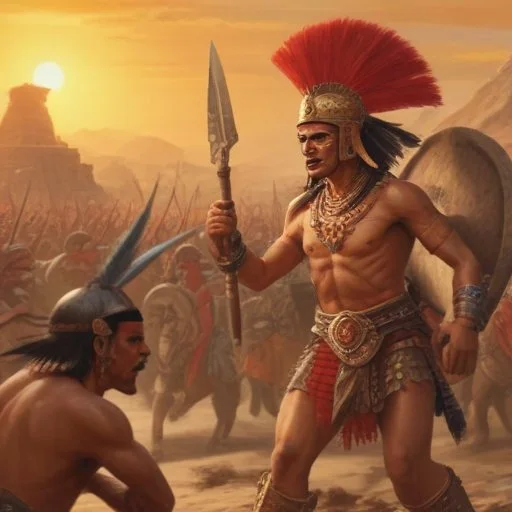
As the siege raged on, the Aztecs, renowned for their rich culinary traditions, found themselves struggling to maintain their food supplies. The once-thriving markets, where vibrant colors and enticing aromas filled the air, lay barren and empty. The people, accustomed to feasting on exotic delicacies like turkey, huauzontles, and tlaxcalli, were forced to survive on meager rations.
In November 1519, Cortés and his men, accompanied by a contingent of Tlaxcaltec warriors, arrived at the gates of Tenochtitlan. Initially, they were received with open arms by Moctezuma II, the previous Tlatoani. However, as tensions escalated, Cortés and his men were forced to flee the city. The siege began in May 1521, and after a brutal and lengthy campaign, the city fell on August 13, 1521.
The conquest of Tenochtitlan had far-reaching consequences, including the devastation of the Aztec empire, the imposition of Spanish rule, and the introduction of European diseases that decimated the native population. The event also marked the beginning of a new era of cultural exchange, as Spanish and indigenous traditions blended together to form a unique Mestizo identity.
As the city was plundered, the Aztecs' precious culinary heritage was also ravaged. Many of their traditional ingredients, like the revered maguey plant, were replaced by European staples like wheat and cattle. The once-thriving markets, where the aromas of chili, cilantro, and achiote filled the air, were gradually replaced by Spanish-style cuisine.
The fall of Tenochtitlan not only shaped the course of Mexican history but also left an indelible mark on the country's culinary landscape. The synthesis of indigenous and European flavors gave birth to a unique fusion cuisine, characterized by the likes of tacos al pastor, chiles rellenos, and pozole.
Today, as we savor the bold flavors and vibrant colors of Mexican cuisine, we pay homage to the rich cultural heritage of the Aztecs, whose bravery and resilience in the face of adversity continue to inspire us.
La Malinche, the indigenous interpreter who played a crucial role in facilitating communication between the Spanish and the Aztecs, remains an enigmatic figure shrouded in mystery. While her exact motivations and allegiances are unclear, her impact on the conquest of Tenochtitlan cannot be overstated.
Some historians have portrayed her as a traitor, willing to betray her own people for personal gain. Others see her as a pragmatist, recognizing the inevitability of Spanish dominance and seeking to mitigate its effects.
Despite the ambiguities surrounding her character, La Malinche's legacy as a cultural mediator and linguistic bridge-builder is undeniable.

The fall of Tenochtitlan marked not only the end of an empire but also the beginning of a new culinary era. As Spanish ingredients and cooking techniques flooded the region, the Aztecs' rich gastronomic traditions were gradually adapted and transformed.
The introduction of livestock, for example, led to the development of new dishes like carne asada and al pastor, while the arrival of European spices like cinnamon and cloves influenced the flavor profiles of traditional Aztec recipes.
This blending of culinary cultures has resulted in the vibrant, flavorful, and deeply complex Mexican cuisine we know and love today.
The siege of Tenochtitlan was a brutal and devastating campaign that lasted for months, leaving a trail of destruction and despair in its wake. Cortés' forces, bolstered by their superior firepower and Tlaxcaltec allies, laid waste to the city's defenses, slowly but surely suffocating the Aztecs' stronghold.
As the siege raged on, the Aztecs, desperate to survive, resorted to increasingly drastic measures, including cannibalism and human sacrifice. The once-majestic city was reduced to ruins, its people starving, diseased, and demoralized.
The siege's brutal climax came on August 13, 1521, when Cuauhtmoc, the last Tlatoani, was captured, marking the definitive end of the Aztec empire.

The rivalry between Tenochtitlan and Tlaxcala, two powerful Mesoamerican city-states, played a crucial role in the events leading up to the conquest. For years, the two cities had vied for dominance, engaging in a series of brutal wars and proxy battles.
Cortés, shrewdly exploiting this rivalry, formed an alliance with the Tlaxcaltecs, capitalizing on their shared animosity towards the Aztecs. This strategic partnership proved decisive in the Spanish conquest of Tenochtitlan.
The Tlaxcaltecs' support not only provided Cortés with a crucial military advantage but also lent legitimacy to the Spanish claim to the Aztec throne.
Hernán Cortés' conquest of Tenochtitlan marked a pivotal moment in the history of Spanish colonization. While the event is often viewed in isolation, it is instructive to consider it within the broader context of Spanish imperial ambitions.
Comparing Cortés' campaign to other notable conquests, such as Pizarro's defeat of the Inca Empire, reveals striking similarities in tactics, motivations, and outcomes. In each case, the Spanish exploited divisions among indigenous populations, leveraged superior military technology, and imposed their own systems of governance and culture.
These parallels underscore the systemic nature of Spanish colonialism, highlighting the broader patterns of conquest, domination, and cultural erasure that characterized the expansion of the Spanish Empire.