


Known for its brutal suppression of civilian protests, the February 28 Incident in Taiwan left an indelible mark on the nation's conscience, claiming the lives of an estimated 28,000 people. This tragic event, which took place on February 28, 1947, remains a painful memory for the Taiwanese people, serving as a stark reminder of the government's heavy-handed approach to dissent during the post-World War II era.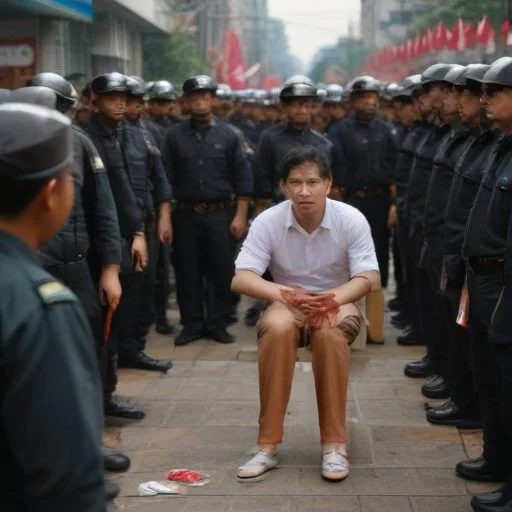
The February 28 Incident was a culmination of years of tension between the ruling Kuomintang (KMT) government and the Taiwanese people. Following the end of World War II, Taiwan was returned to Chinese rule, and the KMT, led by Chiang Kai-shek, sought to consolidate its power and suppress any opposition. The Taiwanese, who had grown accustomed to Japanese rule during the war, resented the KMT's authoritarian approach and sought greater autonomy.
The incident was sparked by a minor altercation between a cigarette vendor and a monk in Taipei, but it was the government's response that escalated the situation. Chen Yi, the governor of Taiwan, and Chiang Kai-shek, the leader of the KMT, were the key figures responsible for the brutal crackdown on civilians.
The incident began on February 27, 1947, when a cigarette vendor was shot and killed by a monk in Taipei. Protests erupted the following day, with crowds gathering in front of the Taipei City Hall demanding justice. The government responded with force, deploying troops and police to quell the protests. Over the next few weeks, the crackdown continued, with security forces firing indiscriminately into crowds and arresting thousands of people.
The February 28 Incident had far-reaching consequences for Taiwan's political landscape and social fabric. The incident led to the imposition of martial law, which lasted for nearly four decades, and the suppression of dissent and opposition. It also led to the formation of the Democratic Progressive Party, which would later become a major force in Taiwanese politics.
The incident has had a profound impact on Taiwanese culture and society. It has been the subject of numerous literary and artistic works, including films, novels, and plays. The incident has also become a symbol of resistance against authoritarian rule and a testament to the Taiwanese people's struggle for democracy and human rights.
"The February 28 Incident was a turning point in Taiwan's history. It marked the beginning of a long and difficult journey towards democracy and human rights." - Chen Shui-bian, former President of Taiwan
The February 28 Incident bears some resemblance to other incidents of state-sponsored violence, such as the Tiananmen Square Massacre in China and the Gwangju Uprising in South Korea. However, the incident's unique historical context and cultural significance set it apart from other similar events.
One of the most poignant accounts of the incident comes from a survivor who was just 10 years old at the time. "I remember seeing people running and screaming, and hearing the sound of gunfire and explosions. I was so scared, I didn't know what was happening." - anonymous survivor
The February 28 Incident has had a lasting impact on Taiwan's political trajectory. It led to the formation of opposition parties and the eventual democratization of Taiwan in the 1980s and 1990s. It has also influenced Taiwan's foreign policy, with the country seeking to promote democracy and human rights regionally and globally.
The February 28 Incident is often referred to as the "228 Incident" in Taiwanese media and popular culture.
The incident has inspired generations of Taiwanese to fight for democracy and human rights. It has also served as a reminder of the importance of vigilance and activism in the face of authoritarian rule.
The February 28 Incident has had a profound impact on Taiwanese literature and arts. Many writers, poets, and artists have drawn inspiration from the event, creating works that reflect the struggles and sacrifices of the Taiwanese people.
One of the most notable examples is the novel "City of Sadness" by Wu Nien-jen, which explores the experiences of a family during the incident. The novel has been widely acclaimed for its nuanced portrayal of the event and its aftermath.
The incident has also been the subject of numerous films, including the award-winning "A City of Sadness" directed by Hou Hsiao-hsien. The film is a powerful exploration of the human cost of the incident and its impact on Taiwanese society.

Chen Yi, the governor of Taiwan, was a key figure responsible for the brutal crackdown on civilians during the February 28 Incident. Born in 1883, Chen was a high-ranking official in the Kuomintang government and was known for his authoritarian approach to governance.
Chen's role in the incident has been widely criticized, with many accusing him of ordering the massacre of innocent civilians. Despite his controversial legacy, Chen remains a significant figure in Taiwanese history, serving as a symbol of the government's heavy-handed approach to dissent.
The February 28 Incident bears some resemblance to other incidents of state-sponsored violence, such as the Tiananmen Square Massacre in China and the Gwangju Uprising in South Korea. However, the incident's unique historical context and cultural significance set it apart from other similar events.
One key difference is the role of the international community, which played a significant role in condemning the Taiwanese government's actions during the incident. This international pressure contributed to the eventual lifting of martial law and the democratization of Taiwan.

The February 28 Incident had significant economic implications for Taiwan, leading to a decline in foreign investment and a decrease in economic growth. The incident also led to a brain drain, as many Taiwanese intellectuals and professionals fled the country in search of greater freedoms.
However, the incident also led to increased international pressure on the Taiwanese government to implement economic reforms, which ultimately contributed to Taiwan's rapid economic growth in the 1960s and 1970s.
Historians have long debated the significance of the February 28 Incident, with some viewing it as a turning point in Taiwan's struggle for democracy and others seeing it as a brutal suppression of dissent.
One school of thought views the incident as a key moment in the development of Taiwanese identity, marking a shift away from Chinese dominance and towards a more autonomous Taiwanese identity. Others argue that the incident was a brutal reminder of the government's willingness to use force to maintain its power.