


October 25, 1945, marks a pivotal moment in Taiwan's history, as the island nation bid farewell to 50 years of Japanese colonization and welcomed the Republic of China (ROC) back into power. This monumental handover ceremony, held in Taipei, marked the beginning of a new chapter in Taiwan's complex and tumultuous history.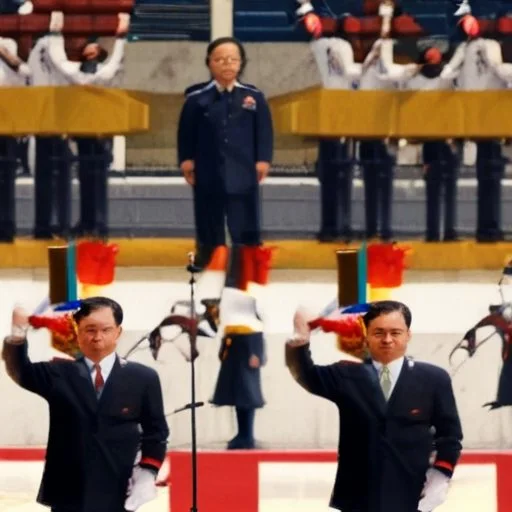
The Japanese had occupied Taiwan since 1895, following the first Sino-Japanese War. For five decades, the Taiwanese people lived under the yoke of Japanese rule, enduring forced assimilation, cultural suppression, and economic exploitation. As World War II drew to a close, Taiwan's fate hung in the balance, as the Allies pressured Japan to surrender.
Chen Yi, the ROC's Chief Executive, played a crucial role in Taiwan's liberation. A seasoned politician and military leader, Chen had fought against the Japanese during the war and was instrumental in negotiating the terms of the handover. Rikichi Andō, the Japanese Governor-General, represented the defeated Japanese Empire, reluctantly ceding control of Taiwan to the ROC.
The ceremony, held at the Taipei City Hall, was a poignant symbol of Taiwan's transition from colonial rule to self-governance. Chen Yi received the instruments of surrender from Andō, marking the formal end of Japanese administration and the beginning of ROC rule. This momentous occasion was attended by dignitaries from the ROC, Japan, and the Allied Powers, underscoring the significance of Taiwan's liberation.
The handover had far-reaching consequences for Taiwan:
The transition from Japanese to ROC rule had a profound impact on Taiwanese culture and society:
The handover ceremony was not without controversy, as some Taiwanese people felt the ROC's return to power was a retrograde step, imperiling their hard-won autonomy. Nevertheless, the event remains a significant milestone in Taiwan's struggle for self-determination and national sovereignty.
As Taiwan emerged from the shadows of Japanese colonialism, the island nation embarked on a journey of self-discovery and nation-building. The handover ceremony of 1945 marked the beginning of a new chapter in Taiwan's complex history, one marked by struggle, resilience, and a deep desire for autonomy and self-determination.
Chen Yi: The Unyielding Patriot
Chen Yi's role in Taiwan's liberation was instrumental, but his life story is a testament to his unwavering dedication to the Chinese people. Born in 1883, Chen was a product of the late Qing dynasty, and his early life was shaped by the tumultuous period of Chinese history. He joined the Tongmenghui, a revolutionary party, and later became a key figure in the ROC government. Chen's experiences during World War II, including a stint in a Japanese prison camp, only strengthened his resolve to free Taiwan from Japanese rule.
Chen's leadership during the handover ceremony was a culmination of his life's work, and his commitment to Taiwan's autonomy and self-determination remained unwavering until his death in 1950.
The Geopolitical Context of Taiwan's Liberation
The surrender of Japan in 1945 marked a significant shift in the global balance of power, with the United States and the Soviet Union emerging as superpowers. The ROC's return to Taiwan was seen as a strategic move to contain the spread of communism in East Asia. The Allies, particularly the United States, viewed Taiwan as a crucial outpost in the region, and its liberation was seen as a vital step in maintaining stability and security.
The Cold War dynamics played a significant role in shaping Taiwan's post-war development, as the island became a key battleground in the ideological struggle between the ROC and the Communist Party of China.
Taiwanese Culture: A Renaissance
The end of Japanese colonial rule marked a cultural renaissance in Taiwan, as the island's indigenous traditions and customs began to flourish once more. The ROC's promotion of Mandarin Chinese as the official language led to a resurgence of interest in Taiwanese literature, art, and music.
The liberation of Taiwan also led to a renewed sense of national identity, as Taiwanese people began to assert their distinct cultural heritage, separate from both Japanese and Chinese influences. This cultural awakening paved the way for Taiwan's development into a vibrant, multicultural society.

Historiographical Perspectives on Taiwan's Liberation
Taiwan's liberation has been subject to various historiographical interpretations, with some scholars viewing the event as a moment of triumphalism, while others see it as a complex, multifaceted process. Some historians have emphasized the agency of Taiwanese people in the liberation struggle, while others have highlighted the role of external powers, such as the United States and the ROC, in shaping the island's fate.
Recent scholarship has also explored the complexities of Taiwanese identity and the tensions between Taiwanese and Chinese nationalisms in the post-war period. These diverse perspectives have enriched our understanding of Taiwan's liberation and its ongoing struggles for autonomy and self-determination.
The Economic Consequences of Liberation
The handover of Taiwan from Japanese to ROC rule had significant economic implications for the island. The ROC inherited a war-torn economy, with infrastructure and industries ravaged by the conflict. However, Taiwan's strategic location and natural resources made it an attractive destination for foreign investment.
The post-war period saw a rapid growth in Taiwan's economy, driven by agricultural development, industrialization, and exports. The ROC's economic policies, including land reform and state-led development initiatives, helped to lay the foundation for Taiwan's economic miracle in the 1960s and 1970s.