


The Siege of Antioch, a formidable stronghold in the heart of the Levant, remains an iconic episode in the First Crusade, distinguished by the unwavering resolve of its leaders, Godfrey of Bouillon, Bohemund of Taranto, and Raymond IV, Count of Toulouse, as they led the Crusader army in a relentless assault against the entrenched Muslim defenses.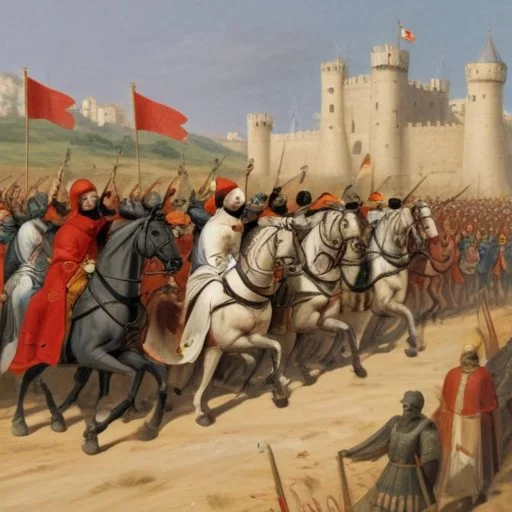
From October 1097 to June 1098, the Crusaders laid siege to the city, driven by an unyielding determination to reclaim the Holy Land and vanquish the perceived infidels, thereby cementing their place in the annals of history as champions of Christendom.
As the First Crusade unfolded, the triumvirate of Godfrey, Bohemund, and Raymond IV converged upon Antioch, a strategic location situated at the confluence of the Orontes River and the Mediterranean Sea. This erstwhile capital of the Byzantine Empire had fallen to the Seljuk Turks in 1085, precipitating a grave threat to Christian domination in the region.
The leaders of the Crusader army, each with their distinct background and motivations, formed an unlikely alliance to conquer Antioch. Godfrey of Bouillon, the Duke of Lower Lorraine, was driven by a deep sense of piety and a desire to establish a Christian kingdom in the East. Bohemund of Taranto, a seasoned Norman warlord, was lured by the promise of territorial expansion and riches. Raymond IV, Count of Toulouse, a seasoned military commander, was fueled by a burning ambition to dominate the Mediterranean trade routes.
The successful capture of Antioch marked a watershed moment in the First Crusade, as the Crusaders secured a critical stronghold in the heart of the Levant, paving the way for future conquests.
The siege and subsequent capture of Antioch also spawned a chain reaction of events, including the eventual capture of Jerusalem in 1099 and the establishment of the Kingdom of Jerusalem, which would endure for nearly two centuries.
The Siege of Antioch had far-reaching cultural and social implications, as it instilled a sense of Christian triumphalism and galvanized the notion of a unified Christian front against the perceived Muslim threat.
The crusading movement, which gained momentum in the wake of the Antioch campaign, would inspire countless works of art, literature, and architecture, perpetuating the myth of a Christian Reconquista.
The Siege of Antioch has long been shrouded in controversy, with critics accusing the Crusaders of brutal tactics, pillage, and massacre. The infamous massacre of the city's Muslim and Jewish populations has stained the legacy of the Crusaders, fostering an enduring perception of them as brutal and intolerant.
Despite this controversy, the Siege of Antioch remains an integral chapter in the narrative of the First Crusade, a testament to the unwavering resolve and unrelenting assault of the Crusaders against the perceived enemies of Christendom.
The Siege of Antioch, a pivotal episode in the First Crusade, stands as a testament to the unyielding determination of its leaders and the enduring legacy of the crusading movement. As we reflect upon this watershed moment in history, we are reminded of the complexities and contradictions of human nature, driven by both noble ideals and base impulses.
The Siege of Antioch has been subject to diverse historiographical interpretations, with various scholars offering distinct perspectives on the event's significance and meaning.
One school of thought, exemplified by historians such as Steven Runciman, views the siege as a triumph of Christian zeal and military prowess, highlighting the Crusaders' unyielding resolve and strategic brilliance.
In contrast, revisionist historians, like Christopher Tyerman, have challenged this traditional narrative, arguing that the siege was marked by brutal violence, pillage, and massacres, thereby nuancing our understanding of the Crusaders' actions.
More recently, scholars have sought to contextualize the siege within the broader framework of medieval geopolitics, examining the complex web of alliances and rivalries between the Byzantine Empire, the Seljuk Turks, and the Crusader states.

Godfrey of Bouillon, a key leader of the First Crusade, was a complex figure driven by a deep sense of piety and a desire to reclaim the Holy Land for Christendom.
Early Life and CareerGodfrey was born circa 1060 in Boulogne, France, and inherited the dukedom of Lower Lorraine in 1087.
He was known for his military prowess, having fought in various campaigns against the Normans and the Holy Roman Empire.
Godfrey's piety and sense of sacred duty led him to take the cross in 1095, committing himself to the Crusade and the liberation of Jerusalem.
The Siege of Antioch unfolded against the backdrop of a complex and fluid geopolitical landscape, marked by shifting alliances and rivalries between the Byzantine Empire, the Seljuk Turks, and the Crusader states.
The Byzantine Empire, weakened by internal strife and external threats, had lost control of Antioch to the Seljuk Turks in 1085.
The Crusade, launched in response to the Byzantine Emperor Alexios I's plea for assistance, was in part a product of this geopolitical context, as Western Christendom sought to reclaim the Holy Land and reassert its dominance.
The siege's outcome would have far-reaching implications for the balance of power in the region, paving the way for the establishment of Crusader states and the eventual recapture of Jerusalem.

The Siege of Antioch had a profound impact on Western Christian culture, inspiring a wave of literary, artistic, and architectural creations that would endure for centuries.
The Crusade, and the siege in particular, became a powerful symbol of Christian triumphalism, commemorated in works of art, literature, and music.
The epic poem, The Song of Antioch, composed in the early 12th century, provides a vivid account of the siege, showcasing the literary and cultural significance of the event.
The siege also influenced the development of Gothic architecture, as Crusader-era churches and cathedrals incorporated motifs and symbols inspired by the Antioch campaign.
In the aftermath of the Siege of Antioch, Bohemund of Taranto penned a letter to the Pope, detailing the Crusaders' exploits and triumphs.
This letter, preserved in the archives of the Vatican, provides a unique window into the mindset and motivations of the Crusader leaders.
A close analysis of the letter reveals Bohemund's tactical genius and his ability to adapt to the shifting circumstances of the siege.
The letter also sheds light on the complex web of alliances and rivalries between the Crusader leaders, as Bohemund sought to justify his actions and secure papal support.