


The beginning of the February Revolution, marked on March 8 in the Gregorian calendar, was a pivotal moment in Russian history, as the first demonstrations in Saint Petersburg sowed the seeds of discontent that would eventually topple the Romanov dynasty.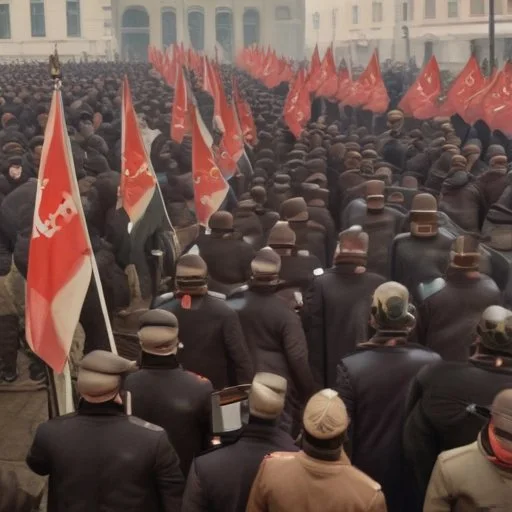
It was on this day that thousands of Russian workers, led by women, took to the streets to demand bread, peace, and an end to the monarchy, kickstarting a chain of events that would forever alter the course of Russia's destiny.
In the midst of World War I, Russia was grappling with severe food and fuel shortages, which had triggered widespread discontent among its citizens. The war effort had drained the country's resources, leaving many without basic necessities like bread and fuel. This perfect storm of economic hardship, coupled with the Tsar's unpopular decision to take personal control of the war effort, created an environment ripe for rebellion.
The demonstrations in Saint Petersburg were largely spearheaded by women, many of whom were factory workers and housewives. These unsung heroes, fueled by desperation and a desire for change, faced down the might of the Imperial Russian Army, demanding an end to the war and the monarchy. Their bravery inspired countless others to join the movement, eventually toppling the Tsar's regime.
The February Revolution marked the beginning of a new era in Russian history, paving the way for the rise of the Bolsheviks and the eventual establishment of the Soviet Union. The revolution also had far-reaching implications for world politics, as it inspired socialist and communist movements across the globe.
The February Revolution not only transformed Russia's political landscape but also had a profound impact on its cultural and social fabric. The revolution paved the way for a new era of artistic and literary expression, as writers, artists, and intellectuals began to explore the possibilities of a new, socialist Russia.
The bravery and determination of the women who led the demonstrations in Saint Petersburg continue to inspire generations of Russians and people around the world. Their struggle for bread, peace, and freedom is a testament to the power of the human spirit, and a reminder that even in the darkest of times, ordinary people can achieve extraordinary things.
In the words of Alexander Kerensky, a key figure in the provisional government that followed the February Revolution, "The Russian Revolution was a mighty storm that shook the foundations of the old world, and brought forth a new world, full of promise and hope."
The first demonstrations in Saint Petersburg on March 8, 1917, marked a pivotal moment in Russian history, one that would forever alter the course of the country's destiny. As we look back at this momentous event, we are reminded of the power of ordinary people to shape extraordinary events, and the enduring spirit of those who fought for bread, peace, and freedom.
The February Revolution had a profound impact on Russian culture, as it paved the way for a new era of artistic and literary expression. The revolution inspired a generation of writers, artists, and intellectuals, who saw the potential for a new, socialist Russia. The avant-garde movement, led by artists like Kazimir Malevich and Vladimir Tatlin, began to flourish, producing works that were radical, innovative, and deeply influenced by the revolutionary spirit.
The revolution also had a significant impact on Russian music, as composers like Igor Stravinsky and Sergei Prokofiev began to experiment with new forms and styles. The ballet, in particular, became a powerful medium for artistic expression, with works like The Rite of Spring and The Firebird capturing the mood and atmosphere of the revolutionary era.
Moreover, the February Revolution marked a shift in Russian cuisine, as traditional dishes like beef stroganoff and chicken Kiev gave way to more austere, peasant-inspired fare. The revolution's emphasis on equality and social justice also led to the emergence of a new kind of Russian fashion, characterized by simplicity, practicality, and a rejection of the opulence and extravagance of the old regime.
Alexander Kerensky, a key figure in the provisional government that followed the February Revolution, played a crucial role in shaping the course of Russian history. Born in 1881, Kerensky was a charismatic leader who rose to prominence during the revolution, using his oratory skills and personal charm to mobilize supporters and inspire loyalty.
Kerensky's early life was marked by tragedy, including the death of his father and the loss of his family's estate. Despite these challenges, he persevered, earning a law degree and becoming involved in radical politics. During the revolution, Kerensky's leadership and vision helped to galvanize the provisional government, which he eventually led as minister-chairman.
Despite his many achievements, Kerensky's legacy is complex and contested. Critics have accused him of vacillation and indecision, while supporters praise his commitment to democracy and social justice. Regardless, Kerensky remains an important figure in Russian history, a symbol of the hopes and ideals that drove the February Revolution.
The February Revolution had a devastating impact on the Russian economy, which was already reeling from the effects of World War I. The revolution led to a sharp decline in industrial production, as factories were shut down and workers went on strike. The value of the ruble plummeted, and inflation soared, making it difficult for ordinary people to afford even the most basic necessities.
The revolution also led to the nationalization of key industries, including banking, mining, and manufacturing. This move was designed to redistribute wealth and promote social justice, but it ultimately led to a decline in productivity and efficiency. The new Soviet government faced significant challenges in managing the economy, including shortages of food, fuel, and raw materials.
Despite these challenges, the February Revolution marked a significant turning point in Russian economic history. The revolution paved the way for the development of a planned economy, which would become a hallmark of Soviet socialism. The revolution also inspired a new generation of economists and policymakers, who were committed to building a more equitable and just society.
The February Revolution took place against a backdrop of global turmoil, as World War I continued to rage across Europe. The war had exhausted Russia's resources, led to widespread discontent, and created an environment ripe for revolution. The Tsar's decision to take personal control of the war effort had also alienated many Russias, who saw it as a sign of his increasing autocracy.
The revolution was closely watched by governments around the world, who saw it as a potential threat to their own power and authority. The German government, in particular, was alarmed by the rise of a socialist government in Russia, which they saw as a potential ally for their enemies. The United States, on the other hand, was cautiously optimistic, seeing the revolution as an opportunity to promote democracy and liberal values in Russia.
The February Revolution marked a significant shift in the global balance of power, as Russia's withdrawal from World War I allowed Germany to focus its attention on the Western Front. The revolution also paved the way for the rise of the Soviet Union, which would become a major player on the global stage for decades to come.
The February Revolution has been the subject of intense historiographical debate, with scholars disagreeing over its causes, course, and consequences. Some historians have seen the revolution as a spontaneous, grassroots movement, driven by the masses of Russian workers and peasants. Others have emphasized the role of elites, including intellectuals, politicians, and military leaders, in shaping the course of the revolution.
One of the most contentious issues in the historiography of the February Revolution is the role of women. While some scholars have emphasized the importance of women in leading the demonstrations and protests, others have downplayed their role, seeing them as peripheral to the main events. Recent scholarship has sought to challenge these perspectives, highlighting the ways in which women played a crucial role in shaping the revolution and its outcomes.
Another area of debate has been the question of whether the February Revolution was a "real" revolution, or simply a collapse of the old regime. Some historians have seen the revolution as a fundamental transformation of Russian society, marked by the rise of a new class of socialist leaders. Others have argued that the revolution was more of a political coup, driven by the interests of elites rather than the masses. Regardless, the February Revolution remains a pivotal event in Russian history, one that continues to shape our understanding of politics, society, and culture today.