


On June 3, 1098, after a grueling five-month siege, the Crusader army finally breached the walls of Antioch, a strategic stronghold in modern-day Turkey, marking a pivotal victory in their campaign to reclaim the Holy Land from Muslim rule. This brutal and hard-won triumph would go down in history as one of the most significant events of the First Crusade.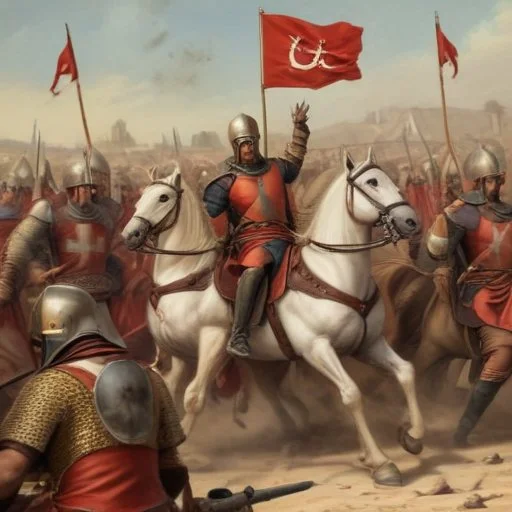
As the Crusaders marched towards Jerusalem, they faced a daunting obstacle: the fortified city of Antioch, held by the Turkish and Arab forces of Yaghi-Siyan. The city's strategic location made it a crucial prize, controlling the passage to Syria and the road to Jerusalem.
In October 1097, the Crusader army, led by princes Bohemond of Taranto and Raymond of Toulouse, laid siege to Antioch. The Turkish and Arab defenders, vastly outnumbered, employed guerrilla tactics, launching frequent sorties against the Crusader camp. The Crusaders, however, held firm, their siege engines and catapults slowly but steadily weakening the city's walls.
In February 1098, the Crusaders received a much-needed boost with the arrival of a Genoese fleet, bringing fresh supplies and troops. Emboldened, the Crusaders launched a series of fierce assaults, which finally breached the city walls on June 3, 1098.
As the Crusaders poured into the city, they unleashed a frenzy of violence, slaughtering many of its defenders and civilians alike. The streets ran red with blood, as the Crusaders claimed the city as their own. The carnage was so great that it would later be remembered as one of the most brutal episodes of the Crusades.
The fall of Antioch marked a crucial turning point in the First Crusade. The city's capture secured a vital foothold in the Middle East, paving the way for the Crusaders' eventual conquest of Jerusalem in 1099. Bohemond of Taranto would establish himself as the ruler of Antioch, founding the Principality of Antioch, which would endure for nearly two centuries.
In the end, the seizure of Antioch stands as a testament to the ferocity and determination of the Crusaders, a bloody milestone on the road to Jerusalem. As the Crusaders would later say, "Deus vult!" – God wills it!
The conquest of Antioch marked a significant shift in the geopolitical landscape of the Middle East. The city's strategic location controlling the passage to Syria and the road to Jerusalem made it a crucial prize for the Crusaders. The fall of Antioch also had far-reaching implications for the Byzantine Empire, which had lost the city to the Seljuk Turks in 1084. The Crusaders' victory would eventually lead to the establishment of a Christian foothold in the region, altering the balance of power between Christian and Muslim forces.
The Crusaders' success at Antioch also had implications for theFatimid Caliphate, which ruled over Egypt and parts of Syria. The Fatimids had been vying for control of the region with the Seljuk Turks, and the Crusaders' victory would ultimately lead to a temporary alliance between the Fatimids and the Crusaders against their common enemy.

Bohemond, a skilled military leader and one of the most prominent figures of the First Crusade, played a crucial role in the conquest of Antioch. As the leader of the Crusader army, Bohemond employed his military prowess and strategic thinking to breach the city's defenses. His arrival at Antioch in 1097 marked a turning point in the siege, as he brought much-needed troops and supplies to the beleaguered Crusader camp.
A shrewd politician, Bohemond would go on to establish himself as the ruler of Antioch, founding the Principality of Antioch, which would endure for nearly two centuries. His legacy as a brilliant military strategist and effective leader would shape the course of the Crusades, influencing the development of Christian-Muslim relations for centuries to come.
In 1097, Stephen of Blois, a prominent Crusader leader, wrote a series of letters to his wife, Adele, describing the siege of Antioch in vivid detail. These letters, which have survived to the present day, provide a unique window into the daily life of the Crusader camp, offering insights into the military tactics, personal relationships, and emotional struggles of the Crusaders.
One of the most striking aspects of Stephen's letters is the way they humanize the Crusaders, revealing their fears, doubts, and weaknesses. In one letter, Stephen writes of the Crusaders' desperation and frustration, stating that "we are surrounded by enemies, and our supplies are dwindling." Such candid admissions offer a nuanced view of the Crusades, challenging the popular image of the Crusaders as one-dimensional warriors.

The conquest of Antioch had a profound impact on Christian-Muslim relations, shaping the cultural and religious landscape of the Middle East for centuries to come. The brutal slaughter of Antioch's defenders and civilians alike would become a rallying cry for Muslim forces, fuelling anti-Christian sentiment and resentment.
In the aftermath of the siege, Christian chroniclers would portray the conquest of Antioch as a divinely sanctioned victory, legitimizing the Crusaders' actions and reinforcing the notion of a holy war against Islam. This narrative would be echoed in subsequent Crusader campaigns, perpetuating a cycle of violence and mistrust between Christian and Muslim forces.
The siege of Antioch witnessed the deployment of innovative military technologies, which would have a lasting impact on the conduct of warfare. The Crusaders' use of siege engines and catapults, borrowed from the Byzantine Empire, allowed them to breach the city's defenses and ultimately claim victory.
The development and application of these technologies would continue to shape the course of the Crusades, as both Christian and Muslim forces adapted and innovated in response to the evolving nature of warfare. The legacy of Antioch would influence the development of medieval warfare, underscoring the importance of technological innovation in military strategy.