


On January 30, 1948, India was shaken to its core as Mahatma Gandhi, the father of Indian independence, was assassinated in his home compound. This pivotal moment in Indian history would be forever remembered as Martyrs' Day, a day of national mourning and reflection.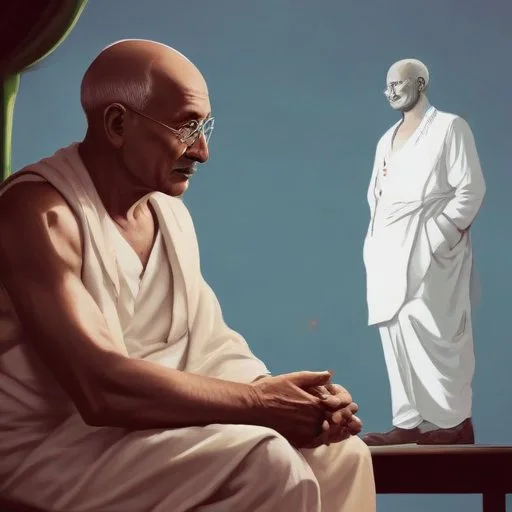
Mahatma Gandhi's philosophy of nonviolent resistance had been a beacon of hope for India's struggle for independence from British rule. His leadership and vision had inspired a nation, and his influence extended far beyond India's borders. However, not everyone was a fan of Gandhi's ideology, and he had faced opposition from various quarters, including Hindu nationalists.
On the fateful day, Gandhi was on his way to a prayer meeting when Nathuram Godse, a Hindu nationalist, and his accomplice, Narayan Apte, approached him. Godse fired three shots from a semi-automatic pistol at point-blank range, killing Gandhi instantly. The nation was in shock, and Prime Minister Jawaharlal Nehru's broadcast to the nation echoed the collective grief: "The light has gone out of our lives."
The assassination of Mahatma Gandhi sent shockwaves across the world, and India plunged into mourning. The nation came together to pay homage to its beloved leader, and the date of the assassination, January 30, was declared Martyrs' Day. The event marked a turning point in India's history, and Gandhi's martyrdom only cemented his legend as a champion of nonviolent resistance.
Mahatma Gandhi's philosophy of nonviolent resistance had inspired a generation of Indians, and his martyrdom further galvanized the nation. The event had a profound impact on Indian culture and society, and Gandhi's legacy continues to inspire people around the world.
The assassination of Mahatma Gandhi raised questions about the nature of Hindu nationalism and its role in Indian politics. The event sparked a national debate about the rise of extremism and the need for tolerance and understanding in a diverse society.
"The light has gone out of our lives." - Jawaharlal Nehru, Indian Prime Minister
"An eye for an eye only ends up making the whole world blind." - Mahatma Gandhi
On the day of the assassination, Jawaharlal Nehru was at Gandhi's home compound, and he would later recount the incident in his autobiography. Nehru's broadcast to the nation, in which he referred to Gandhi as "the light has gone out of our lives," would become an iconic moment in Indian history.
The assassination of Mahatma Gandhi marked a turning point in India's struggle for independence, and the event paved the way for India's emergence as a sovereign nation. Gandhi's legacy continues to inspire people around the world, and his philosophy of nonviolent resistance remains a beacon of hope for those fighting for justice and equality.
 The scene outside Gandhi's home compound on the day of the assassination.
 Jawaharlal Nehru's broadcast to the nation after Gandhi's assassination.
Mahatma Gandhi's life and legacy continue to inspire people around the world. His philosophy of nonviolent resistance has inspired movements for civil rights and freedom across the globe, and his martyrdom has only added to his legend.
As we remember the fateful day of Gandhi's assassination, we are reminded of the power of nonviolent resistance and the importance of tolerance and understanding in a diverse society. Martyrs' Day serves as a poignant reminder of the sacrifices made by those who have fought for India's freedom and independence.
The assassination of Mahatma Gandhi had a profound impact on Indian cinema. Many filmmakers were inspired by Gandhi's philosophy of nonviolent resistance and incorporated it into their films. The 1954 film Rajkumar, directed by P. Pullaiah, was one of the first films to depict Gandhi's life and legacy.
The event also influenced the Indian film industry's approach to portraying historical figures and events. Filmmakers began to focus on creating more realistic and nuanced portrayals of India's struggle for independence, which helped to shape the nation's cinematic identity.

Narayan Apte, the accomplice of Nathuram Godse, is often overshadowed by his more infamous partner. However, Apte played a crucial role in the assassination plot, providing logistical support and helping to create an alibi for Godse.
Apte's motivations for participating in the assassination were rooted in his own feelings of disillusionment with Gandhi's philosophy. He believed that Gandhi's approach to nonviolent resistance was ineffective in the face of British oppression.
The news of Mahatma Gandhi's assassination sent shockwaves across the world. Leaders from various countries, including the United States, the United Kingdom, and the Soviet Union, issued statements condemning the act.
The international community's response to Gandhi's assassination was a testament to his global influence and reputation as a champion of nonviolent resistance. The event marked a turning point in the global struggle for human rights and justice.

The assassination of Mahatma Gandhi had significant political implications for India. The event led to a crackdown on Hindu nationalist groups, which were seen as responsible for the assassination.
The Indian government, led by Jawaharlal Nehru, used the event to push for greater unity and cooperation among Indians, which ultimately contributed to the consolidation of power and the emergence of India as a sovereign nation.
Mahatma Gandhi's philosophy of nonviolent resistance was rooted in his belief that violence only led to more violence. He believed that true change could only be achieved through peaceful means.
Gandhi's philosophy was influenced by various intellectual and religious traditions, including Hinduism, Christianity, and Tolstoyism. His approach to nonviolent resistance has inspired movements for civil rights and freedom across the globe.