


Ford Motor Company's introduction of the first moving vehicle assembly line in 1913 marked a pivotal moment in industrial history. This innovative production method slashed production time and costs, making the Model T car an affordable reality for the average American.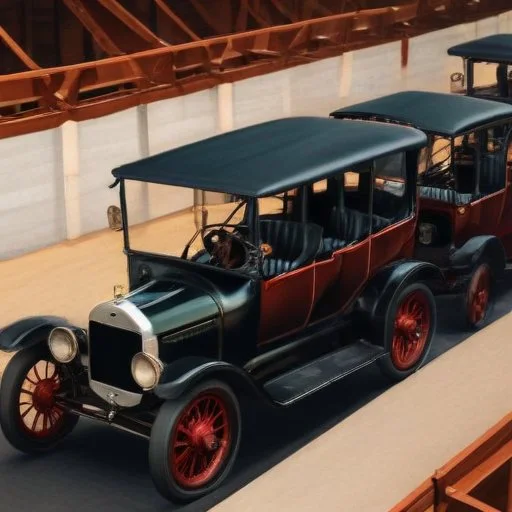
The visionary behind this groundbreaking idea was none other than Henry Ford himself. Ford's relentless pursuit of efficiency and affordability led him to challenge traditional manufacturing methods. His bold approach would not only transform the automotive industry but also have far-reaching implications for modern manufacturing.
Ford's assembly line was the culmination of years of experimentation and refinement. Here are some key milestones leading up to this revolutionary moment:
The moving assembly line was a marvel of efficiency, with workers stationed along a continuously moving conveyor belt. As the chassis moved along the belt, each worker performed a specific task, adding components to the vehicle in a predetermined sequence. This synchronized process reduced production time from 12 hours to just 2.5 hours per vehicle.
The assembly line's impact on production costs was staggering. By reducing labor costs and increasing efficiency, Ford was able to lower the price of the Model T from $850 to $260. Suddenly, car ownership was within reach of the average American, democratizing access to transportation.
The assembly line's influence extended far beyond the automotive industry. It paved the way for mass production, influencing industries such as aerospace, electronics, and consumer goods. The increased accessibility of cars also transformed American culture, enabling greater mobility and social freedom.
Ford's moving assembly line revolutionized manufacturing, earning its place in the pantheon of industrial innovations. This groundbreaking achievement continues to shape modern production methods, inspiring generations of entrepreneurs, inventors, and engineers.
As Henry Ford once said, "Any customer can have a car painted any color that he wants so long as it is black." The assembly line's impact on American history and culture is undeniable, solidifying its place as a testament to human ingenuity and innovation.
Ford's introduction of the moving assembly line in 1913 forever changed the face of manufacturing, democratizing access to cars and transforming American culture. This pioneering achievement continues to inspire and influence industries around the world.
The introduction of the assembly line by Ford had a profound impact on American identity. With the sudden availability of affordable cars, Americans were able to experience a new level of freedom and mobility. The assembly line's influence on American culture can be seen in the rise of suburbanization, the development of highway systems, and the growth of the tourism industry.
The assembly line also contributed to the growth of a consumer culture, as Americans were able to purchase goods that were previously out of their reach. This led to a shift in American values, as people began to prioritize convenience, efficiency, and affordability.

The assembly line was a technological marvel in its time, featuring a series of innovative solutions to manufacturing problems. One of the key technological advancements was the use of interchangeable parts, which allowed for greater efficiency and precision in the manufacturing process.
The assembly line also pioneered the use of conveyor belts and pulley systems to move parts and materials around the factory. This system reduced production time and increased accuracy, allowing Ford to produce cars at an unprecedented rate.
In addition, the assembly line relied on a range of specialized tools and machines, including drills, screwdrivers, and welding machines. These machines enabled workers to perform tasks quickly and efficiently, further increasing productivity.
The introduction of the assembly line had a significant impact on the economy, both in the short and long term. In the short term, the assembly line allowed Ford to reduce production costs and increase efficiency, making it possible to lower prices and increase sales.
In the long term, the assembly line contributed to the growth of the American economy, as it enabled the production of goods on a massive scale. This led to the development of new industries, such as road construction and tourism, and created new job opportunities.
The assembly line also had an impact on the global economy, as it led to the development of new manufacturing techniques and business models. The assembly line's influence can be seen in industries such as aerospace, electronics, and consumer goods.
Henry Ford was a true visionary, known for his innovative approach to manufacturing and his relentless pursuit of efficiency. Born in 1863, Ford grew up on a farm in Michigan, where he developed a strong interest in mechanics and engineering.
Ford's early career was marked by a series of experiments and innovations, as he worked to develop new manufacturing techniques. In 1891, he became an engineer at the Edison Illuminating Company, where he met Thomas Edison and developed a passion for electrical engineering.
In 1903, Ford founded the Ford Motor Company, where he began to develop the ideas that would eventually lead to the creation of the assembly line. Ford's vision was to make cars affordable and accessible to the average American, and his innovative manufacturing techniques made that vision a reality.
The development of the assembly line was a long and winding road, marked by years of experimentation and innovation. In the early 1900s, Ford began to experiment with new manufacturing techniques, including the use of interchangeable parts and the development of specialized tools.
In 1908, Ford introduced the Model T, a car designed to be affordable and durable. However, the production process was still slow and labor-intensive, with workers completing tasks in a sequential manner.
In 1912, Ford introduced the first stationary assembly line, which reduced production time by 50%. However, it wasn't until 1913 that the moving assembly line was introduced, revolutionizing the manufacturing process and transforming the automotive industry.