


In the midst of the Civil Rights Movement, on February 1, 1960, four African American college students from North Carolina Agricultural and Technical State University (NC A&T) dared to challenge the status quo, staging the first of the Greensboro sit-ins at a lunch counter in F.W. Woolworth's store in Greensboro, North Carolina. This peaceful yet powerful protest would go on to galvanize a wave of student-led demonstrations across the South, ultimately contributing to the desegregation of public facilities.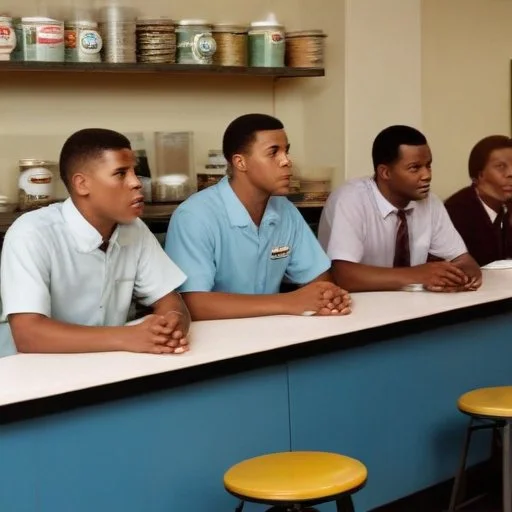
In the late 1950s, segregation was still deeply ingrained in the South. African Americans faced daily indignities, from separate and inferior facilities to blatant racial discrimination. In Greensboro, North Carolina, the city's African American community had long endured segregation, but a sense of restlessness was growing. It was against this backdrop of oppression that four young men, Ezell Blair Jr. (Jibreel Khazan), David Richmond, Franklin McCain, and Joseph McNeil, decided to take a stand.
These four friends, all students at NC A&T, had been discussing ways to challenge segregation in their city. Inspired by the nonviolent resistance philosophy of Dr. Martin Luther King Jr. and the recent success of the Montgomery Bus Boycott, they hatched a plan to integrate the lunch counter at F.W. Woolworth's, a popular five-and-dime store in downtown Greensboro. The goal was simple yet revolutionary: to desegregate the lunch counter by sitting down and politely requesting service, just like their white counterparts.
On that fateful day, February 1, 1960, the four friends, dressed in their Sunday best, walked into F.W. Woolworth's and took their seats at the lunch counter. They were promptly refused service, but they remained resolute, sitting in silence for nearly an hour. As word of their protest spread, a crowd of curious onlookers gathered outside, including some hostile whites who jeered and taunted the students. Undeterred, the quartet remained steadfast, their calm demeanor a powerful rebuke to the forces of segregation.
The Greensboro sit-in sparked a chain reaction of protests across the South. Within days, students from other colleges and universities in the region began to stage their own sit-ins, occupying lunch counters and challenging segregation in public facilities. The momentum grew, with over 50,000 students participating in sit-ins across the South by the end of the year. The civil rights movement had finally found its catalyst, and the Greensboro Four had ignited the flame.
The Greensboro sit-in was more than just a protest – it was a beacon of hope, illuminating a path towards a more just and equitable society. Today, the legacy of the Greensboro Four continues to inspire movements for social justice, reminding us that even the smallest acts of courage can spark monumental change.
"I certainly knew I was scared, but I didn't let my fears take over. I knew that I had to be strong, not just for myself, but for the movement." – Franklin McCain
"We knew we were going to be arrested, but we also knew that we had to stand up for our rights. We had to stand up for what was right." – Ezell Blair Jr. (Jibreel Khazan)
The idea of nonviolent resistance was not new to the African American community, but it was Dr. Martin Luther King Jr.'s leadership and the success of the Montgomery Bus Boycott that inspired a new wave of activism. The Greensboro Four drew inspiration from King's philosophy, which emphasized the power of nonviolent confrontation to bring about social change.
In the years leading up to the Greensboro sit-in, King's influence was spreading rapidly, particularly among young African Americans. The Montgomery Bus Boycott had shown that collective action could be an effective tool for challenging segregation, and King's message of nonviolent resistance resonated deeply with many.
The momentum generated by the Greensboro sit-in was a testament to the power of King's ideas, which continued to inspire civil rights activists throughout the 1960s. As the movement gained momentum, King's leadership and message of nonviolent resistance remained a guiding force, shaping the course of the civil rights movement.

Franklin McCain, one of the Greensboro Four, was a charismatic leader who played a key role in planning and executing the sit-in. Born into a family of modest means, McCain was driven by a strong sense of social justice and a determination to challenge the status quo.
McCain's courage and conviction inspired his fellow students, and his leadership helped to galvanize the movement. Along with his friends Ezell Blair Jr., David Richmond, and Joseph McNeil, McCain faced ridicule, intimidation, and arrest, but he remained resolute in his quest for equality.
McCain's legacy extends far beyond the Greensboro sit-in. He went on to become a successful businessman and community leader, continuing to advocate for social justice throughout his life. His story serves as a powerful reminder of the impact that ordinary individuals can have when they stand up for what they believe in.
The Greensboro sit-in had a profound impact on American culture, helping to galvanize a generation of young people who were eager to challenge the status quo. The movement inspired a wave of student-led protests and demonstrations, which in turn helped to fuel the cultural and social changes of the 1960s.
The sit-in also helped to shift the cultural narrative around race and segregation, challenging long-held stereotypes and biases. As African Americans asserted their rights and refused to accept second-class citizenship, they helped to dismantle the racial hierarchies that had long governed American society.
Today, the Greensboro sit-in remains an important cultural touchstone, symbolizing the power of nonviolent resistance and the struggle for social justice. The movement's legacy continues to inspire artists, activists, and everyday citizens, serving as a powerful reminder of the importance of standing up for what is right.

The Greensboro sit-in took place against the backdrop of a rapidly changing geopolitical landscape. The Cold War was in full swing, with the United States and the Soviet Union vying for global influence. The American South, with its entrenched system of segregation, was increasingly seen as an embarrassment to the United States on the world stage.
The sit-in and the broader civil rights movement helped to expose the contradictions between America's professed values of freedom and equality and the harsh realities of racial segregation. As the movement gained international attention, it began to exert pressure on the United States government to take action to address the issue of racial discrimination.
The economic impact of the Greensboro sit-in was significant, both in the short and long term. The movement led to boycotts of segregated businesses, which in turn helped to accelerate desegregation. As African Americans gained greater access to public facilities and services, they were able to exercise their economic power, supporting businesses that welcomed them and shunning those that did not.
In the long term, the movement helped to stimulate economic growth and development in the American South. As segregation was dismantled, businesses and industries that had long been stunted by racial segregation began to flourish. The region's economy was forever changed, as African Americans gained greater access to education, jobs, and other opportunities.