


The year 1789 marked a pivotal moment in French history, as the Third Estate, representatives of the common people, took a bold step towards democracy by declaring themselves the National Assembly. This historic event, which took place on June 17, 1789, would forever change the course of France and pave the way for the French Revolution.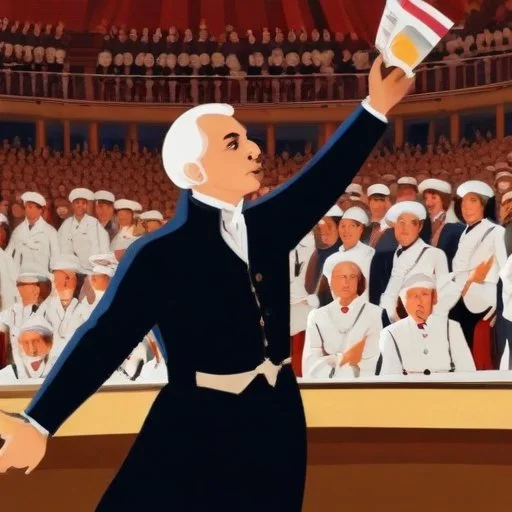
In the late 18th century, France was plagued by financial crisis, social unrest, and a weakening monarchy. The Estates-General, a representative assembly that had not met since 1614, was summoned in 1789 to address the kingdom's woes. The Third Estate, comprising commoners, merchants, and professionals, made up the majority of the population but held little political power. As the Estates-General convened, the Third Estate's representatives, fueled by the ideas of the Enlightenment, began to question the absolute authority of King Louis XVI.
On June 17, 1789, the Third Estate, defying the king's orders, gathered in a tennis court to discuss the formation of a new constitution. This impromptu meeting became known as the Tennis Court Oath, as the representatives vowed to continue their work until a new constitution was established. The next day, the Third Estate declared itself the National Assembly, solidifying its commitment to democratic governance.
The National Assembly's bold declaration marked the beginning of the end of absolute monarchy in France. The event paved the way for the French Revolution, which would ultimately lead to the execution of King Louis XVI and the rise of Napoleon Bonaparte. The National Assembly's stand also inspired similar movements across Europe, spreading the ideals of democracy and equality.
The National Assembly's declaration reflected the growing influence of the bourgeoisie, a emerging class of merchants, professionals, and industrialists. This new class, driven by capitalist ideals and a desire for social mobility, would come to dominate French politics and society in the centuries to come.
As the National Assembly declared its existence, cries of "Vive la Nation!" (Long live the Nation!) echoed through the halls of the tennis court. This rallying cry would become a powerful symbol of French patriotism and national identity.
The National Assembly's stand was a testament to the courage and determination of ordinary people. In the face of adversity and royal opposition, the representatives of the Third Estate dared to challenge the status quo, inspiring generations to come.
The National Assembly's declaration set in motion a chain of events that would shape French and European history for centuries to come. The French Revolution, the Reign of Terror, and the rise of Napoleon Bonaparte were all direct consequences of this pivotal moment. The ideals of democracy and equality, born in the National Assembly, would continue to inspire social and political movements across the world.
In the days leading up to the Tennis Court Oath, a secret meeting took place at the Palais-Royal, a Parisian palace owned by Philippe, Duke of Orléans. The meeting, attended by prominent figures such as Jean-Sylvain Bailly and Honoré Mirabeau, aimed to coordinate a unified response to the king's attempts to suppress the Third Estate's demands. This clandestine gathering laid the groundwork for the bold declaration that would soon follow.
The Palais-Royal, with its reputation for lavish balls and masquerades, was an unlikely venue for a revolutionary gathering. However, its location in the heart of Paris made it an ideal spot for a clandestine meeting. The secrecy surrounding the gathering added to the sense of intrigue, as the participants knew that their actions could have far-reaching consequences.

Jean-Sylvain Bailly, an astronomer and mathematician, was not an obvious choice to lead the Third Estate. Yet, his commitment to democracy and social justice propelled him to the forefront of the National Assembly. Bailly's analytical mind and calm demeanor helped to balance the more radical elements within the assembly, earning him the respect of his peers.
Bailly's background was marked by a passion for science and discovery. His work on the orbit of comets and the behavior of the planets earned him recognition within the scientific community. However, it was his involvement in the Enlightenment's ideals that ultimately led him to trade his telescope for a seat in the National Assembly.
The National Assembly's declaration marked a significant shift in French culture, as the bourgeoisie began to assert its influence. This emerging class of merchants, professionals, and industrialists brought with it new values and ideals that would shape the nation's identity.
The bourgeoisie's emphasis on education, hard work, and individualism contrasted sharply with the aristocracy's emphasis on privilege and nobility. As the Third Estate gained power, the cultural landscape of France began to change, paving the way for the rise of a modern, industrialized nation.

The Third Estate's decision to declare itself the National Assembly was a bold act of defiance, challenging the centuries-old authority of the French monarchy. This move was not only a rejection of the king's orders but also a calculated gamble to win popular support and legitimacy.
The Third Estate's representatives knew that their actions would be met with resistance from the monarch and the aristocracy. However, they also recognized that the growing discontent among the common people created an opportunity to tap into a powerful force that could propel them to power.
The National Assembly's declaration was not merely a political act but also an expression of deeply held philosophical and ideological beliefs. The ideas of the Enlightenment, with their emphasis on reason, individual rights, and democracy, had taken root in the minds of the Third Estate's representatives.
The writings of thinkers such as Rousseau, Voltaire, and Montesquieu had inspired a generation of French thinkers, who saw the potential for creating a more just and equal society. As the National Assembly declared its existence, it was not only making a political statement but also giving voice to a powerful ideological movement that would shape the course of history.