


In the annals of French military history, few events evoke as much sorrow and shame as the surrender of Marshal François Achille Bazaine at the Siege of Metz. On October 28, 1870, Bazaine, once hailed as a hero, reluctantly raised the white flag, ceding control of the fortress city to the Prussian forces led by General Helmuth von Moltke, and surrendering a staggering 140,000 French soldiers.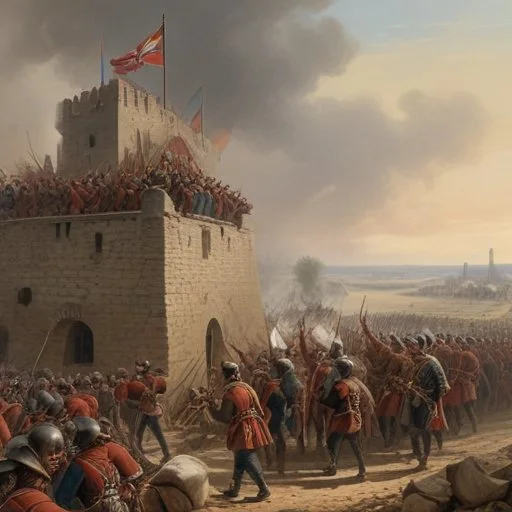
Metz, a strategic stronghold in northeastern France, had long been a symbol of French military prowess. However, in the summer of 1870, the city found itself at the epicenter of the Franco-Prussian War, a conflict that would prove to be a watershed moment in European history. As the Prussian army, bolstered by their innovative military tactics and superior firepower, marched towards Metz, Bazaine's forces were tasked with holding the city against all odds.
The siege of Metz was a grueling, 70-day ordeal that pushed both armies to the brink of exhaustion. Bazaine's forces, numbering around 140,000, were vastly superior in numbers, but the Prussian army, led by the brilliant strategist von Moltke, employed a strategy of encirclement, cutting off Bazaine's supply lines and slowly strangling the city. As the siege dragged on, Metz's defenders grew weary, and the once-mighty fortress city became a symbol of French impotence.
For Bazaine, the situation was desperate. His men were starving, morale was plummeting, and rescue seemed increasingly unlikely. Faced with the unpalatable choice of surrender or risk a catastrophic defeat, Bazaine reluctantly opted for the former, ceding control of Metz to the Prussians. The surrender was a crushing blow to French morale, and it marked a decisive turning point in the war, paving the way for the eventual defeat of Napoleon III's regime.
The fall of Metz had far-reaching consequences, both militarily and politically. The surrender of such a large force crippled the French war effort, and the Prussians went on to capture Paris, culminating in the abdication of Napoleon III. The war ultimately resulted in the formation of the German Empire, and the redrawing of the European political landscape.
Bazaine's surrender at Metz has been the subject of intense debate and controversy ever since. Critics accused him of cowardice and ineptitude, while defenders pointed to the insurmountable odds he faced. Whatever the truth may be, the event remains a painful reminder of France's military vulnerabilities and the devastating consequences of defeat.
The Siege of Metz serves as a cautionary tale about the importance of strategic thinking and adaptability in warfare. The Prussian army's innovative tactics and use of technology proved to be a decisive factor in the battle, and their approach would go on to influence military strategy for generations to come.
In conclusion, the surrender of Marshal Bazaine at the Siege of Metz was a pivotal event that marked a turning point in the Franco-Prussian War. It serves as a stark reminder of the devastating consequences of defeat and the importance of military preparedness, and its legacy continues to resonate to this day.
Marshal François Achille Bazaine was a French general and Marshal of France, born on February 13, 1811. He rose to prominence during the French Second Empire, earning a reputation as a skilled and courageous military leader. However, his defeat at the Siege of Metz marked a turning point in his career, and he was eventually court-martialed and imprisoned for his role in the surrender. Despite his fall from grace, Bazaine's military legacy continues to be debated among historians, with some viewing him as a scapegoat for the failures of the French military during the Franco-Prussian War.
Bazaine's early life and career were marked by a strong sense of duty and loyalty to France. He graduated from the École Polytechnique in 1836 and went on to serve in various military campaigns, including the Crimean War and the Italian War of Independence. His bravery and tactical skills earned him rapid promotion, and he was appointed Marshal of France in 1869.
Despite his impressive military credentials, Bazaine's leadership during the Siege of Metz has been widely criticized. His decision to surrender the city and its garrison has been seen as a grave mistake, and many have questioned his judgment and resolve in the face of adversity.

The Franco-Prussian War was a conflict that was deeply rooted in the complexities of 19th-century geopolitics. The war was fought between the French Second Empire and the Kingdom of Prussia, with the two nations having a long history of rivalry and competition.
The root cause of the conflict was the balance of power in Europe, which had been shaken by the unification of Germany under Prussian leadership. The French, who had long considered themselves the dominant military power on the continent, felt threatened by the rise of Prussia and sought to maintain their influence.
The Siege of Metz was a key moment in the war, as it marked a decisive shift in the balance of power in favor of the Prussians. The fall of the city and the surrender of Bazaine's army dealt a severe blow to French morale and paved the way for the eventual defeat of Napoleon III's regime.
The Siege of Metz was a war of attrition, with both sides employing innovative tactics and technologies to gain an advantage. The Prussian army, led by General Helmuth von Moltke, was particularly effective in its use of artillery and railways to besiege the city.
The Prussians employed a strategy of encirclement, using their superior rail network to rapidly move troops and supplies around the city. This allowed them to maintain a tight siege, cutting off Bazaine's army from supplies and reinforcements.
In response, the French attempted to use their own technological innovations, including the famous mitrailleuse, a multi-barreled machine gun that was designed to repel infantry charges. However, the weapon proved to be of limited effectiveness against the Prussian artillery and ultimately failed to stem the tide of the siege.
The fall of Metz had a profound impact on French culture and identity. The surrender of the city and its garrison was seen as a national humiliation, and it marked a turning point in the French psyche.
In the years that followed, the French people struggled to come to terms with the defeat, and a sense of introspection and self-doubt began to pervade the nation. The war marked a decline in the French Empire, and the loss of Metz was seen as a symbol of the nation's weakness and vulnerability.
However, the defeat also sparked a renewed sense of national pride and determination. The French people began to question their military and political leadership, and a movement for reform and modernization began to take shape.
Historians have long debated the significance of the Siege of Metz, with some viewing it as a decisive turning point in the Franco-Prussian War, while others have seen it as a symbol of French military incompetence.
Recent scholarship has sought to reevaluate the role of Marshal Bazaine, with some historians arguing that he was unfairly scapegoated for the defeat. Others have pointed to the broader structural weaknesses of the French military and the government of Napoleon III.
Regardless of interpretation, the Siege of Metz remains a pivotal event in European history, marking a shift in the balance of power and paving the way for the rise of a unified German state.