


The Battle of Dresden, fought on August 26-27, 1813, is renowned for being one of the most impressive victories in military history, where a heavily outnumbered French army, led by Napoleon Bonaparte, defeated a coalition of Austrian, Russian, and Prussian forces. This exceptional triumph cemented Napoleon's reputation as a military genius, renowned for his cunning tactics and ability to outmaneuver his enemies.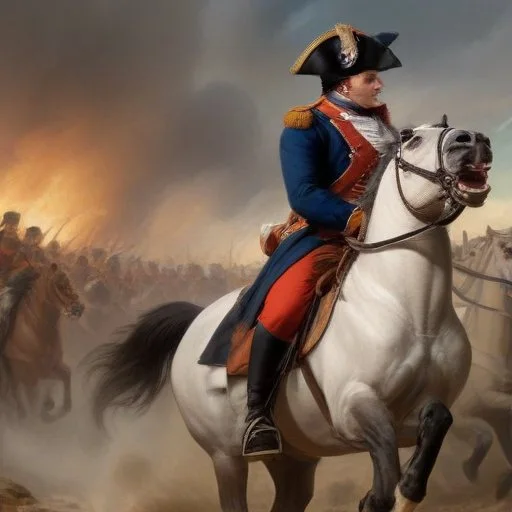
In 1813, the Sixth Coalition, comprising Austria, Russia, Prussia, and other European powers, united to defeat Napoleon and shatter his dominance over Europe. The coalition's strategy was to attack Napoleon's forces from multiple directions, hoping to overwhelm him through sheer numbers. Napoleon, however, was not one to be intimidated. He saw an opportunity to strike a decisive blow against the coalition and restore France's prestige.
August 26, 1813:
August 27, 1813:
The Battle of Dresden was a resounding victory for Napoleon, with the coalition suffering heavy casualties and widespread desertion. This triumph:
The Battle of Dresden has been subject to debate and controversy among historians, with some questioning the accuracy of Napoleon's reported victory. However, most agree that Napoleon's tactical brilliance and cunning were instrumental in securing the French victory.
"An army of sheep led by a lion is better than an army of lions led by a sheep."
- Napoleon Bonaparte
The Battle of Dresden is often compared to other notable battles, such as Austerlitz and Borodino, where Napoleon's genius was also on full display. However, the Battle of Dresden stands out for its sheer scale and the overwhelming odds faced by the French army.
"I saw Napoleon, his face lit up by the setting sun, riding towards us, his presence electrifying the entire army. It was as if he was invincible."
- French Lieutenant, Pierre Dupont
The Battle of Dresden cemented Napoleon's reputation as a military mastermind, inspiring generations of military strategists and historians. His tactics and strategies continue to be studied and emulated to this day.
The Battle of Dresden has been the subject of much historiographical debate, with scholars disagreeing on the extent of Napoleon's victory. Some have questioned the accuracy of the French army's casualty reports, while others have argued that the coalition's forces were not as demoralized as previously thought.
Additionally, historians have debated the significance of the battle in the broader context of the Napoleonic Wars. Some have seen it as a turning point, marking a shift in momentum in favor of the French, while others have argued that it was merely a temporary setback for the coalition.
Despite these debates, the Battle of Dresden remains an important event in the study of military history, offering insights into the tactics and strategies of Napoleon and his opponents.

Gebhard von Blücher, the Prussian general who led the coalition's forces at Dresden, was a seasoned military commander with a reputation for bravery and tenacity.
Despite his experience, Blücher underestimated Napoleon's cunning and was caught off guard by the French army's surprise attack on the coalition's right flank.
Blücher's defeat at Dresden was a significant blow to his reputation, but he would later redeem himself at the Battle of Waterloo, where he played a crucial role in Napoleon's final defeat.
The Battle of Dresden is often compared to other notable battles of the Napoleonic Wars, such as Austerlitz and Borodino.
While all three battles showcase Napoleon's military genius, Dresden stands out for its sheer scale and the overwhelming odds faced by the French army.
In contrast to Austerlitz, where Napoleon's forces were more evenly matched with their opponents, Dresden saw the French army outnumbered and outgunned.

The Battle of Dresden had a profound impact on European culture, cementing Napoleon's reputation as a military genius and hero of the French people.
In the aftermath of the battle, Napoleon's popularity soared, and he was hailed as a savior of France.
The battle also inspired a wave of artistic and literary works, including poems, paintings, and plays that celebrated Napoleon's victory.
The Battle of Dresden had significant economic implications for the belligerent powers, with the French army's victory allowing Napoleon to maintain his grip on Europe's economy.
The battle also disrupted trade and commerce across the continent, leading to shortages and inflation in many regions.
In the long term, the battle contributed to the economic exhaustion of France and its allies, ultimately contributing to Napoleon's downfall.