


The French invasion of Russia, a campaign that had promised glory and conquest, came to a crushing halt on a fateful day in October 1812. As Napoleon Bonaparte, the once-invincible emperor, ordered his depleted army to retreat from Moscow, the tide of war irreversibly turned against him, marking the beginning of the end of his empire.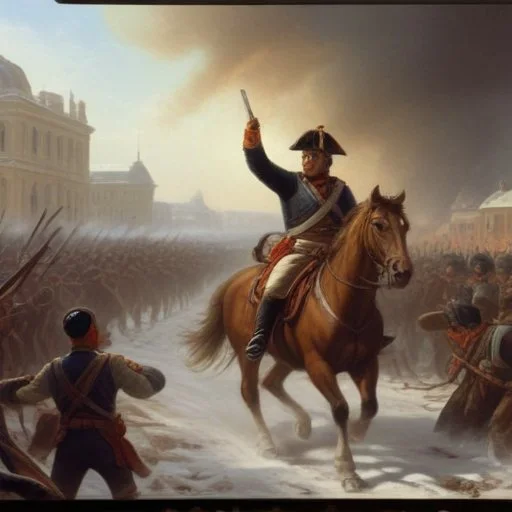
In June 1812, Napoleon's Grand Armee, consisting of over 600,000 soldiers, had crossed the Neman River into Russian territory, with the aim of defeating the Russian army and occupying Moscow. The campaign was meant to be a swift and decisive victory, but the Russian army, led by General Mikhail Kutuzov, had other plans.
The Russian army employed a scorched earth policy, burning everything in their path, leaving nothing but destruction and desolation for the French army to follow. This tactic, combined with the harsh Russian winter, took a devastating toll on the French troops, who were ill-prepared for the unforgiving climate.
By October, Napoleon's army had been reduced to a mere shadow of its former self, with estimates suggesting only around 100,000 soldiers remained. The once-mighty French forces, exhausted and demoralized, were no match for the relentless Russian army. On October 19, 1812, Napoleon begrudgingly ordered his army to retreat from Moscow, a decision that would seal his fate and alter the course of European history.
As the French army retreated, they left behind a trail of destruction, with burned-out villages, pillaged towns, and countless civilian casualties. The Russian army, hot on their heels, continued to harass and attack the French, further weakening their already fragile state.
The failure of the French invasion of Russia had far-reaching consequences, not only for Napoleon's empire but also for Europe as a whole. The campaign had drained France's resources, both human and material, and the empire's prestige and influence began to wane.
The French invasion of Russia, and Napoleon's subsequent retreat from Moscow, is remembered as one of the most catastrophic military defeats in history. The campaign serves as a testament to the folly of imperial ambition and the resilience of the human spirit in the face of overwhelming adversity.
The Russian winter played a significant role in Napoleon's defeat, but it was not the only factor. The French army's lack of preparedness for the Russian terrain and climate was also a major contributor. Napoleon's soldiers were equipped with summer clothing and footwear, which offered little protection against the freezing temperatures and snow. The army's logistical infrastructure was also inadequate, leading to shortages of food, fuel, and medical supplies.
Furthermore, the Russian army's employment of partisan warfare tactics, where small groups of soldiers would launch surprise attacks on French troops and then disappear into the countryside, drained the French army's morale and resources.
The combination of these factors ultimately led to the French army's downfall, as they were unable to adapt to the Russian environment and counter the Russian army's unorthodox tactics.

General Mikhail Kutuzov, the Russian army's commander, is often credited with Napoleon's defeat. A seasoned military strategist, Kutuzov understood the importance of exploiting the Russian terrain and climate to his advantage. He employed a scorched earth policy, which denied the French army access to food and supplies, and used partisan warfare tactics to harass and demoralize the French troops.
Kutuzov's experience and knowledge of Russian terrain also allowed him to outmaneuver Napoleon's army, forcing them to march long distances and fight pitched battles in unfavorable conditions.
The failure of the French invasion of Russia had a profound impact on European culture. The defeat marked a turning point in the Napoleonic Wars, leading to a shift in the balance of power in Europe and paving the way for the eventual defeat of Napoleon and the restoration of the Bourbon monarchy.
The Russian campaign also inspired a wave of artistic and literary works, including Leo Tolstoy's epic novel "War and Peace", which immortalized the clash between the French and Russian armies.
The campaign's impact on European culture extended beyond literature, influencing music, art, and architecture, as well as shaping the way Europeans viewed war and imperialism.

The French invasion of Russia was a costly endeavor, with estimates suggesting that it drained France's economy of over 1 billion francs. The campaign's failure led to a significant decline in France's economic influence and paved the way for the emergence of new economic powers in Europe.
The Russian campaign's economic impact was not limited to France, however. The war disrupted trade and commerce across Europe, leading to widespread economic hardship and contributing to the eventual downfall of the Continental System.
The failure of the French invasion of Russia marked a significant turning point in Napoleon's political fortunes. The defeat led to a decline in Napoleon's popularity and influence, both domestically and internationally, and paved the way for the eventual restoration of the Bourbon monarchy.
The Russian campaign's impact on Napoleon's political legacy was also profound, as it marked a decisive shift from an era of French dominance to a new era of European balance of power.
The campaign's political impact extended beyond France, however, influencing the development of European politics and shaping the course of European history for generations to come.