


The Battle of the Nile, also known as the Battle of Aboukir Bay, is renowned for being one of the most decisive and daring naval engagements in history, where a British fleet, led by the fearless Horatio Nelson, clashed with the French Revolutionary Navy in an unprecedented night battle on August 1, 1798.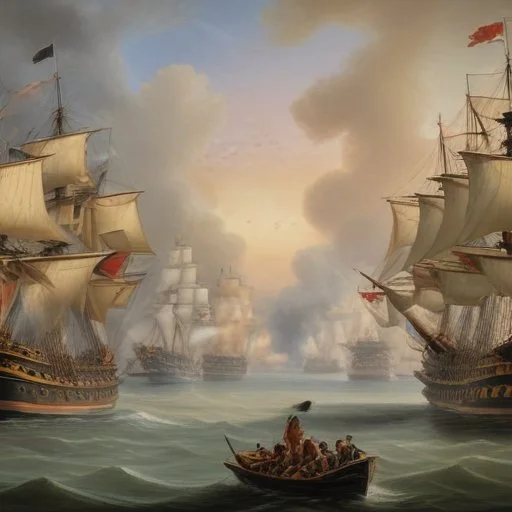
This pivotal event is celebrated for its sheer audacity, innovative tactics, and the crushing defeat inflicted upon the French, which would have far-reaching consequences on the course of the French Revolutionary Wars and beyond.
In the sweltering heat of an Egyptian summer, French Admiral François Paul Brueys d'Aigalliers anchored his fleet in Aboukir Bay, a seemingly secure location. Little did he know, a British fleet, comprised of 14 ships of the line and several smaller vessels, was lurking in the shadows, waiting for the perfect moment to strike.
Nelson, having received intelligence on the French fleet's disposition, saw an opportunity to exploit the enemy's complacency. Under the cover of darkness, the British ships navigated through the treacherous waters, their crews holding their collective breath as they closed in on their unsuspecting foes.
At around 9:00 pm, the British ships, led by HMS Goliath, launched a surprise attack on the French fleet, catching them off guard and disorganized. The night air was soon filled with the thunder of cannons, the flash of gunfire illuminating the dark sky, and the cries of the wounded and dying.
The British gunnery proved superior, and their cunning tactics allowed them to outmaneuver the French, attacking from both sides and taking advantage of the confusion. As the battle raged on, the French fleet was systematically taken apart, ship by ship.
The carnage was immense. Nine French ships of the line were either sunk, burned, or captured, leaving only four to retreat in disarray. The French suffered an estimated 1,700 casualties, while the British losses were relatively light, with around 200 killed or wounded.
The aftermath of the battle saw the French Navy crippled, their Mediterranean fleet depleted, and their ability to project power severely curtailed. The British, on the other hand, had cemented their dominance of the seas, paving the way for future naval supremacy.
The Battle of the Nile marked a significant turning point in the French Revolutionary Wars, as Napoleon's ambitions in the Mediterranean were dealt a severe blow. The British victory also had far-reaching consequences, influencing the outcome of future conflicts, including the Napoleonic Wars and beyond.
This extraordinary night battle will forever be remembered as a testament to the bravery, cunning, and tactical genius of Horatio Nelson, and a testament to the enduring legacy of the British Navy.
The Battle of the Nile took place during a tumultuous period in European history, marked by the French Revolution and the rise of Napoleon Bonaparte. The French Directory, seeking to expand its empire, had launched a military campaign in Egypt, which threatened British trade routes and interests in the region.
The British government, determined to curb French ambitions, dispatched a fleet to the Mediterranean, led by Admiral Horatio Nelson. The stage was set for a confrontation that would have far-reaching consequences for the balance of power in Europe.
In this context, the Battle of the Nile was a crucial event that would determine the fate of Napoleon's expedition and the future of European politics. The British victory would ultimately lead to the failure of Napoleon's Egyptian campaign and the weakening of French influence in the region.

François Paul Brueys d'Aigalliers, the French Admiral who commanded the French fleet during the Battle of the Nile, was a seasoned naval officer with a reputation for bravery and tactical acumen. Born in 1753, Brueys had served in the French Navy since the age of 15 and had fought in several battles during the American Revolutionary War.
Despite his experience and skills, Brueys was ultimately outmaneuvered and outgunned by the British fleet led by Nelson. His decision to anchor his fleet in Aboukir Bay, although intended to provide a secure position, proved to be a fatal mistake.
Brueys himself was mortally wounded during the battle and died on August 2, 1798. His defeat at the Battle of the Nile marked a turning point in his career and had significant consequences for the French Navy.
The Battle of the Nile has been the subject of numerous historical accounts and interpretations, with many historians praising the bravery and tactical genius of Horatio Nelson. However, some have also criticized Nelson's decision to engage the French fleet at night, citing the high risk of friendly fire and chaos.
Additionally, some historians have argued that the British victory was not solely due to Nelson's skills, but also to the superior training and discipline of the British sailors. The French fleet, on the other hand, was plagued by internal conflicts and inadequate supplies.
Despite these differing perspectives, the Battle of the Nile remains one of the most celebrated naval engagements in history, and its significance continues to be studied and debated by historians and naval enthusiasts alike.
The Battle of the Nile was a clash of two vastly different naval styles and philosophies. The French fleet, led by Brueys, was characterized by its emphasis on firepower and heavy artillery, whereas the British fleet, led by Nelson, was known for its speed, maneuverability, and innovative tactics.
The British fleet's use of night fighting and surprise attacks was a novel approach that caught the French off guard. In contrast, the French fleet's reliance on traditional line-of-battle tactics proved ineffective against the agile and adaptable British ships.
This contrast in naval styles highlights the different strategic priorities of the two nations, with the French focused on projecting power and the British focused on speed and agility.
The Battle of the Nile marked a significant turning point in the development of naval warfare, with the British fleet's innovative tactics and use of technology paving the way for future naval engagements.
The use of night fighting, for example, required the development of new navigation and signaling techniques, such as the use of lanterns and flags to communicate between ships.
The battle also highlighted the importance of ship design and construction, with the British fleet's lighter and more maneuverable ships proving superior to the heavier and more cumbersome French vessels.