


The cannons of Valmy roared to life on September 20, 1792, marking a pivotal moment in the French Revolution. This bloody stalemate halted the allied invasion of France, convincing European powers that the Revolution was a force to be reckoned with.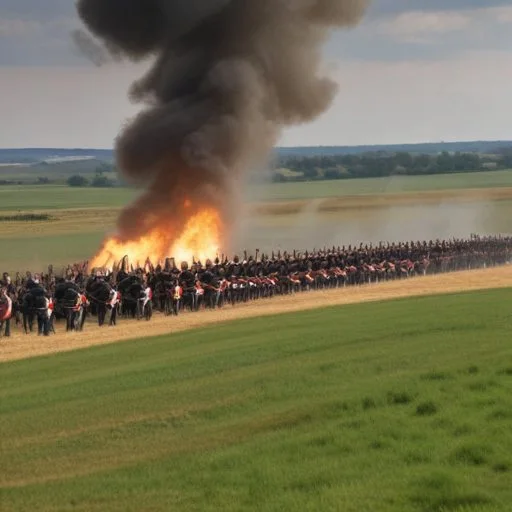
In the summer of 1792, the French Revolution was in its fourth year. The monarchy had been abolished, and the National Convention had taken power. However, the Revolution's ideals of liberty, equality, and fraternity were threatened by the reactionary forces of Europe. In response, the Duke of Brunswick, leading a coalition of Prussian, Austrian, and émigré forces, launched an invasion of France.
On the foggy morning of September 20, the French army, led by Generals Dumouriez and Kellermann, deployed on the hills of Valmy. The Prussian forces, marching in formation, were met with a wall of artillery fire. The French cannons, under the command of General Pierre-François Percy, unleashed a barrage of cannonballs and shells, slowing the Prussian advance.
The Prussians, attempting to outflank the French position, were repelled time and again. The battle raged on for hours, with both sides trading artillery fire. As the day wore on, the Prussians began to falter, their casualties mounting.
As the sun began to set, the Prussians retreated, abandoning their invasion of France. The French army, exhausted but triumphant, had saved the Revolution. The news of the victory at Valmy spread like wildfire, electrifying the French people and galvanizing their support for the Revolution.
The Battle of Valmy marked a turning point in the French Revolution. The victory reinforced the Revolution's ideals, convincing European powers that the Revolution was not to be underestimated.
In the aftermath of Valmy, the French National Convention declared France a republic, solidifying the Revolution's gains. The victory also paved the way for the Reign of Terror, as the Committee of Public Safety, dominated by Maximilien Robespierre, took control of the government.
"Vive la Nation!" ("Long live the Nation!") – General Kellermann's cry of triumph as the Prussians retreated.
"La patrie est en danger!" ("The fatherland is in danger!") – The rallying cry of the French army during the battle.
| August 1792 | The Duke of Brunswick's army invades France |
| September 20, 1792 | The Battle of Valmy takes place |
| September 21, 1792 | The French National Convention declares France a republic |
General Charles Dumouriez, a brilliant tactician, played a crucial role in the French victory at Valmy. Born in 1739, Dumouriez was a professional soldier who had fought in the Seven Years' War and the American Revolutionary War.
Dumouriez's experience and military acumen were instrumental in planning and executing the defense of Valmy. His ability to adapt to changing circumstances and his courage under fire inspired his troops and earned him the respect of his peers.

The Battle of Valmy has been interpreted in various ways by historians over the years. Some have seen it as a triumphant moment in the French Revolution, while others have viewed it as a minor skirmish that had little impact on the broader course of the war.
Recent scholarship, however, has emphasized the significance of Valmy as a turning point in the Revolution, marking a shift from the early years of turmoil and uncertainty to a more confident and assertive phase.
The Battle of Valmy and the Battle of Borodino, fought in 1812 during the Napoleonic Wars, share some interesting parallels.
Both battles involved a coalition of European powers attempting to defeat a powerful and ideologically driven opponent. Both battles saw a decisive defeat for the coalition forces, and both had significant consequences for the course of European history.
The Battle of Valmy took place in a complex and rapidly shifting geopolitical landscape.
The French Revolution had sparked a wave of counter-revolutionary sentiment across Europe, leading to the formation of the First Coalition against France.
In this context, the Battle of Valmy represented a crucial test of the French Revolution's ability to defend itself against the combined might of European monarchies.
The Battle of Valmy was more than just a military victory – it was a powerful symbol of the French Revolution's ideological commitments to liberty, equality, and fraternity.
The battle marked a moment of triumph for the values of the Enlightenment, which had inspired the Revolution and shaped its ideals.
In the aftermath of Valmy, the Revolution's ideals would continue to inspire and mobilize the French people, shaping the course of European history for generations to come.