


Genghis Khan's unrelenting campaign to conquer Central Asia culminated in a decisive battle on the banks of the Indus River, where the Mongol war machine clashed with the rebellious forces of Jalal al-Din, a prince of the Khwarazmian Empire. The outcome of this fateful encounter would seal the Mongols' grip on the region, cementing their reputation as the greatest empire-builders of the medieval era.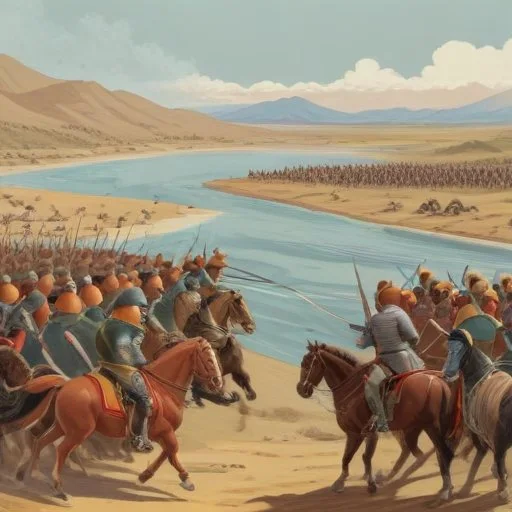
In the early 13th century, the Khwarazmian Empire, which stretched from modern-day Iran to Uzbekistan, was plagued by internal strife and external threats. Jalal al-Din, the son of the Khwarazmian ruler, Mohammed II, sought to assert his independence and challenge the Mongol Empire's expansion into Central Asia. Genghis Khan, meanwhile, had been waging a series of military campaigns to unite the Mongol tribes and expand his empire.
The two armies faced off on the Indus River in present-day Pakistan, with Jalal al-Din's forces numbering around 50,000 soldiers. Genghis Khan, meanwhile, commanded a smaller but more disciplined force of approximately 30,000 warriors. The Mongol leader employed his signature tactics, including the feigned retreat and the pincer movement, to outmaneuver and demoralize the Khwarazmian army.
The battle raged on for several days, with both sides suffering heavy casualties. However, the Mongols' superior archery and cavalry tactics ultimately proved decisive. Jalal al-Din's forces were defeated, and the prince himself was forced to flee, leaving behind his treasury and war elephants.
The Battle of the Indus marked the culmination of Genghis Khan's campaign to conquer Central Asia. The Mongols had now secured control over a vast territory stretching from China to the Caspian Sea. This strategic victory enabled the Mongols to establish trade routes, collect taxes, and impose their brand of imperial governance on the region.
The conquest of Central Asia also facilitated the exchange of ideas, cultures, and technologies between East and West. Merchants, scholars, and travelers from across the known world traversed the Silk Road, which had been revitalized under Mongol rule.
The Mongol Empire's conquest of Central Asia had far-reaching consequences, shaping the course of world history in profound ways. The empire's vast territorial expanse facilitated the spread of Buddhism, Islam, and Christianity, while its tolerance for cultural diversity fostered a rich legacy of artistic, scientific, and literary achievements.
The Mongols' military victories also inspired a new era of imperial ambition, influencing the rise of subsequent empires, including the Ottoman, Russian, and British Empires.
Genghis Khan's military campaigns were guided by a set of principles that emphasized discipline, adaptability, and strategic thinking. Among his maxims were:
These quotes offer a glimpse into the mind of a leader who transformed the medieval world and left an indelible mark on human history.
In the early 13th century, Central Asia was a complex web of rival kingdoms, city-states, and nomadic tribes. The Khwarazmian Empire, which Jalal al-Din sought to defend, was one of the largest and most powerful empires in the region. However, its vast territory and diverse population made it vulnerable to internal strife and external threats. The Mongols, with their lightning-fast cavalry and merciless tactics, were well-positioned to exploit these weaknesses and expand their empire.
The region's fertile river valleys, including the Indus River, made it an attractive prize for conquerors. Control of these valleys meant control of the region's agriculture, trade, and commerce. The Mongols' victory at the Battle of the Indus gave them a strategic foothold in the region, allowing them to expand their empire further.

Jalal al-Din, the prince of the Khwarazmian Empire, was a complex and ambitious leader. Born into a powerful family, he was trained in the art of war and statecraft from a young age. Jalal al-Din was determined to assert his independence and challenge the Mongol Empire's expansion into Central Asia. Despite his bravery and military prowess, he ultimately underestimated the ferocity and tactical genius of Genghis Khan.
Jalal al-Din's defeat at the Battle of the Indus marked the beginning of a long and tumultuous period of exile and rebellion. He would continue to fight against the Mongols, eventually seeking refuge in India and dying in 1231.
The Mongol Empire's conquest of Central Asia facilitated the exchange of ideas, cultures, and technologies between East and West. The Silk Road, which had been revitalized under Mongol rule, became a vital artery of trade and cultural exchange. Merchants, scholars, and travelers from across the known world traversed the Silk Road, bringing with them goods, ideas, and innovations from distant lands.
The Mongols' tolerance for cultural diversity fostered a rich legacy of artistic, scientific, and literary achievements. The confluence of Buddhist, Islamic, and Christian influences created a vibrant cultural landscape, marked by stunning architectural achievements, such as the Registan in Samarkand.

The Mongol Empire's conquest of Central Asia was driven, in part, by economic necessity. The Mongols needed to secure control of the region's trade routes, natural resources, and taxable populations to sustain their vast empire. The Indus River, which flowed through the heart of the Khwarazmian Empire, was a vital source of commerce and revenue.
The Mongols' victory at the Battle of the Indus gave them control of the region's lucrative trade routes, including the Silk Road. They were able to collect taxes, tributes, and customs duties from merchants and traders, generating vast revenues that helped to fund their military campaigns and administrative machinery.
Historians have long debated the nature of the Mongols' military genius. While some have attributed their success to their brutal tactics and lightning-fast cavalry, others have argued that their victories were the result of careful planning, strategic thinking, and clever use of propaganda. The Battle of the Indus, in particular, has been hailed as a masterclass in tactical maneuvering and psychological warfare.
Recent scholarship has emphasized the Mongols' ability to adapt to changing circumstances, improvise, and innovate on the battlefield. Their military campaigns were often marked by clever deceptions, feints, and diversions, which allowed them to outmaneuver and outflank their opponents.