


The Good Friday Agreement, a landmark accord aimed at establishing a powersharing government in Northern Ireland, was resoundingly endorsed by the region's electorate on May 23, 1998, with a staggering 75% of voters casting their ballots in favor of the agreement. This momentous occasion marked a significant departure from the centuries-old animosities that had long plagued the relationships between Unionists and Nationalists, paving the way for a more harmonious and peaceful era in the region.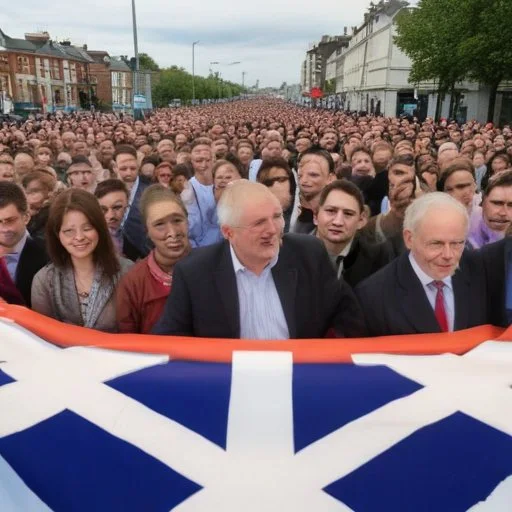
The Good Friday Agreement was the culmination of protracted negotiations and diplomatic efforts undertaken by various stakeholders, including the governments of the United Kingdom and the Republic of Ireland, as well as political parties from Northern Ireland. The agreement's genesis can be traced back to the Downing Street Declaration of 1993, which outlined a framework for peace and reconciliation in the region. This declaration laid the groundwork for the subsequent Framework Documents of 1995, which further elaborated on the principles and structures necessary for a lasting peace.
The Good Friday Agreement's successful implementation has had a profound impact on the political and social landscape of Northern Ireland. Some of the most notable outcomes include:
The Good Friday Agreement has also had a profound impact on the cultural and social fabric of Northern Ireland. The agreement's emphasis on reconciliation and mutual understanding has helped to promote a more inclusive and diverse cultural identity, one that acknowledges and celebrates the region's rich cultural heritage. This, in turn, has contributed to a more harmonious and peaceful social environment, as manifested in the decrease in sectarian violence and the growth of cross-community initiatives.
While the Good Friday Agreement has been widely hailed as a groundbreaking achievement, it has not been immune to criticism and controversy. Some of the most significant challenges and concerns include:
"The Good Friday Agreement is a triumph of politics over violence, of hope over despair... It is a testament to the power of dialogue and cooperation." - Tony Blair, former Prime Minister of the United Kingdom
"This is a momentous day... We have taken a major step towards a new era of peace, stability, and cooperation." - Bertie Ahern, former Taoiseach of the Republic of Ireland
The Good Friday Agreement's influence extends far beyond the borders of Northern Ireland. The accord has served as a model for conflict resolution and peacebuilding initiatives around the world, offering valuable insights into the complexities of reconciliation and powersharing. As such, it continues to inspire and inform international efforts aimed at promoting peace, stability, and cooperation.
The historiography of the Good Friday Agreement is a complex and multifaceted field of study. While some historians have hailed the agreement as a triumph of diplomacy and statesmanship, others have criticized it as a flawed and imperfect compromise. One of the most influential historians of the agreement is Paul Bew, who has argued that the accord was the result of a long process of negotiations and concessions between the British and Irish governments. Bew's work has been influential in shaping our understanding of the agreement's historical context and significance.
Another important historiographical perspective on the Good Friday Agreement is the revisionist school, which has challenged the dominant narrative of the agreement as a straightforward triumph of peace and reconciliation. Revisionist historians such as Ed Moloney and Brian Feeney have argued that the agreement was the result of a more complex and contested process, shaped by political and ideological struggles within Northern Ireland and the wider world.

Tony Blair, the former Prime Minister of the United Kingdom, played a crucial role in the Good Friday Agreement. Blair's leadership and diplomacy were instrumental in bringing the parties together and securing a deal. His commitment to the peace process was driven by a deep understanding of the history and politics of Northern Ireland, as well as a strong sense of moral purpose.
Bertie Ahern, the former Taoiseach of the Republic of Ireland, was another key player in the Good Friday Agreement. Ahern's experience and expertise in Irish politics were invaluable in navigating the complex negotiations and finding a compromise that would satisfy all parties.
The Good Friday Agreement has had a profound impact on the cultural landscape of Northern Ireland. The agreement's emphasis on reconciliation and mutual understanding has helped to promote a more inclusive and diverse cultural identity, one that acknowledges and celebrates the region's rich cultural heritage.
The agreement has also led to a flourishing of cultural initiatives and projects, aimed at promoting cross-community understanding and exchange. From music and art projects to cultural festivals and events, the Good Friday Agreement has helped to create a more vibrant and diverse cultural scene in Northern Ireland.

The Good Friday Agreement was shaped by the geopolitical context of the time. The end of the Cold War and the decline of traditional nationalism created a new space for diplomacy and negotiation. The agreement was also influenced by the growing importance of the European Union, which provided a framework for cooperation and integration between the UK and Ireland.
The agreement's success was also influenced by the role of the United States, which provided diplomatic support and encouragement to the parties involved. The Clinton administration's commitment to the peace process was instrumental in helping to bring about a deal.
The Good Friday Agreement was underpinned by a set of philosophical and ideological principles, including a commitment to democracy, human rights, and the rule of law. The agreement's emphasis on reconciliation and mutual understanding was driven by a recognition of the need to transcend traditional sectarian and nationalist divisions.
The agreement's philosophical underpinnings were also influenced by the ideas of thinkers such as John Hume, who argued that the conflict in Northern Ireland was fundamentally a conflict of ideas and values, rather than a conflict of interests.