


The Tiananmen Square protests of 1989 are infamous for the brutal suppression of peaceful demonstrations by the Chinese government, leaving a lasting impact on the country's politics, society, and human rights. The seven-week occupation of Tiananmen Square by thousands of protesters, mainly students and workers, culminated in a bloody crackdown on June 4, 1989, as troops and tanks rolled into the square, killing hundreds and injuring thousands.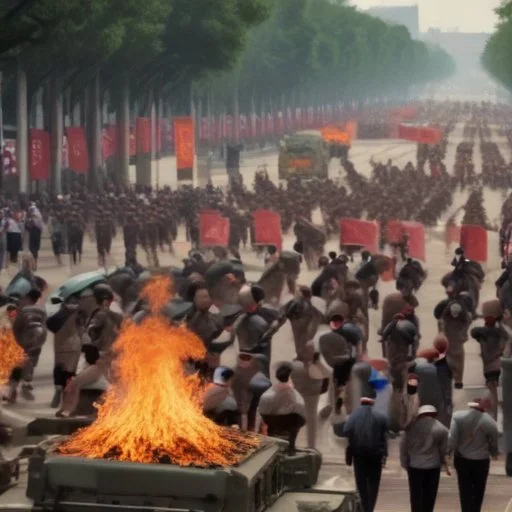
The roots of the Tiananmen Square protests can be traced back to the death of Hu Yaobang, a reformist Communist Party leader, in April 1989. His death sparked nationwide mourning and protests, particularly among students and intellectuals, who saw him as a symbol of democratic reform. The protests initially focused on mourning Hu's death and demanding greater freedom of speech and press, but soon evolved into calls for broader political reforms and an end to corruption.
From mid-April to early June 1989, Tiananmen Square was occupied by protesters, who erected tents, banners, and makeshift statues, including the iconic Goddess of Democracy, a replica of the Statue of Liberty. The movement gained momentum, with intellectuals, workers, and even some government officials joining the protests. The protesters' demands included democratic elections, freedom of the press, and an end to corruption.
On the night of June 3-4, 1989, the Chinese government, under the leadership of Deng Xiaoping, deployed troops and tanks to disperse the protesters. The ensuing violence resulted in the deaths of hundreds of protesters and bystanders, with estimates ranging from several hundred to over a thousand. The crackdown was marked by brutality, with reports of soldiers firing on civilians, and the use of tanks to crush protesters.
The Tiananmen Square massacre had far-reaching consequences for China and the world. The event sparked international outrage, leading to widespread condemnation and economic sanctions against China. Domestically, the crackdown marked a turning point in China's political landscape, with the government cracking down on dissent and tightening its grip on power. The event also led to the imposition of stricter controls on the media, education, and civil society.
The Tiananmen Square protests and massacre continue to cast a long shadow over Chinese politics and society. The event remains a taboo topic in China, with the government actively suppressing any mention or commemoration of the event. However, the protests have inspired generations of human rights activists, both within and outside China, and serve as a powerful symbol of resistance against authoritarianism.
"We want to be citizens, not subjects. We want to be part of the system, not outside it." - Wang Dan
"The Tiananmen Square protests were not just about democracy, but about the right to be human." - Chai Ling

Image: Protesters gather in Tiananmen Square, May 1989.
The Tiananmen Square protests and massacre serve as a poignant reminder of the power of human courage and resilience in the face of oppression. While the event was marked by tragedy, it also inspired a generation of activists and advocates for human rights and democracy. As we remember the sacrifices of those who lost their lives, we honor their legacy by continuing to fight for the values they embodied.
The Tiananmen Square protests were not an isolated event, but rather the culmination of a series of democratic movements that had been brewing in China since the 1980s. One of the key precursors to the protests was the Democracy Wall movement, which began in 1978 and saw thousands of people gathering in Beijing to post dissident messages and poems on a wall in the city center. This movement, led by figures such as Wei Jingsheng, laid the groundwork for the democratic activism that would later emerge in the late 1980s.
Another important factor that contributed to the protests was the economic crisis of the late 1980s. China was experiencing high inflation, corruption, and a lack of government accountability, which led to widespread discontent among the population. This economic discontent merged with the demand for political reform, creating a potent mix that ultimately fueled the Tiananmen Square protests.

Zhao Ziyang: The Premier Who Supported the Protesters
Zhao Ziyang, the Chinese premier who supported the Tiananmen Square protesters, was a reformist leader who believed in democratic values and economic liberalization. Born in 1919, Zhao rose through the ranks of the Communist Party and became premier in 1987. He was known for his economic reforms, which aimed to decentralize power and increase economic autonomy. During the Tiananmen Square protests, Zhao sided with the protesters, advocating for dialogue and reform. His stance ultimately led to his downfall, as he was replaced by a hardliner, Jiang Zemin, and was placed under house arrest until his death in 2005.
The Tiananmen Square protests of 1989 bear striking similarities to other democratic movements around the world. One notable parallel is the Velvet Revolution in Czechoslovakia, which took place in the same year and saw mass protests against the communist government. Both movements shared demands for democratic reform, an end to corruption, and greater freedom of speech and assembly.
Another comparable event is the Gwangju Democratization Movement in South Korea, which occurred in 1980. Like Tiananmen, the Gwangju movement saw students and citizens taking to the streets to demand democratic reforms and an end to authoritarian rule. Both events were marked by brutal government crackdowns, resulting in significant loss of life.
The Tiananmen Square protests had a profound impact on Chinese culture, inspiring a new generation of artists, writers, and musicians to express their dissent and advocate for change. The event also led to the creation of the Jasmine Revolution, a term coined by Chinese poet and activist, Wang Dan, to describe the wave of democratic movements sweeping across Asia in the late 1980s and early 1990s.
The protests also influenced the Chinese diaspora, with many Chinese artists and intellectuals abroad using their work to commemorate the event and advocate for democratic reform in China. The legacy of Tiananmen Square continues to shape Chinese cultural and artistic expression, with many creatives using their work to push the boundaries of censorship and advocate for human rights.
The Tiananmen Square massacre had significant economic repercussions, both domestically and internationally. In the aftermath of the crackdown, China faced widespread economic sanctions, including the suspension of World Bank loans and the imposition of trade restrictions by the United States and other countries. This led to a decline in foreign investment and a slowdown in economic growth.
In the long term, however, the Chinese government's response to the protests accelerated the country's economic reforms. The government sought to promote economic growth and stability, which ultimately led to China's emergence as a global economic power. While the Tiananmen Square massacre was a human rights disaster, it also marked a turning point in China's economic development.