


The Grande Armée's arrival at the Kremlin in Moscow on September 14, 1812, marked a hollow victory in Napoleon Bonaparte's disastrous French invasion of Russia. This pivotal event, touted as a triumph by Napoleon, would eventually prove to be the beginning of the end of his imperial ambitions, as the Russian winter and scorched-earth tactics would ultimately force his retreat, changing the course of the Napoleonic Wars.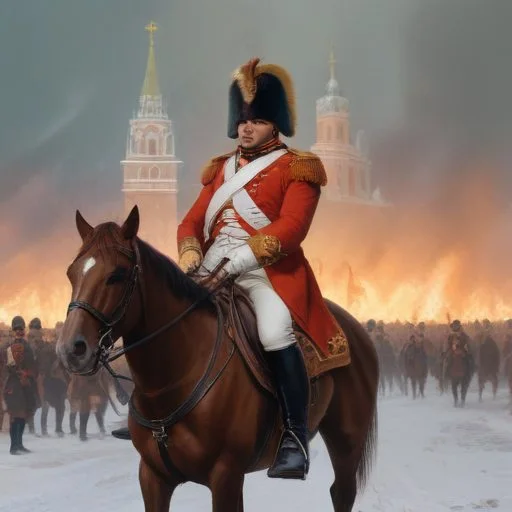
Napoleon's decision to invade Russia was driven by his desire to weaken the Russian army, secure a crucial ally in his quest for European domination, and assert French authority over the continent. The Grande Armée, comprising over 600,000 soldiers, was the largest and most formidable force ever assembled in Europe.
Upon arriving at the Kremlin, Napoleon expected a grand reception, complete with pomp and circumstance. Instead, he was met with an eerie silence. The Russian army had retreated, leaving behind a deserted city, devoid of supplies and amenities.
The Grande Armée's occupation of the Kremlin was short-lived. As winter approached, the harsh Russian climate began to take its toll on the French army. Temperatures plummeted, and supplies dwindled further, forcing Napoleon to confront the reality of his situation.
The failed Moscow campaign marked a turning point in the Napoleonic Wars. The disastrous Russian invasion exposed the vulnerabilities of Napoleon's army, emboldened his European foes, and paved the way for his eventual downfall.
The Grande Armée's retreat from Moscow was a slow and painful process, with the Russian army nipping at their heels, inflicting heavy casualties and destroying whatever was left of the French army's morale.
The Moscow campaign's failure had far-reaching consequences, influencing the course of European history, shaping the fate of nations, and serving as a cautionary tale about the perils of hubris and ambition.
In the end, the Grande Armée's ill-fated Moscow campaign served as a poignant reminder that even the most powerful empires can falter when they overextend their reach, ignoring the wisdom of the ages: "Pride goes before destruction, and a haughty spirit before a fall."
As the snowflakes gently fell on the empty streets of Moscow, Napoleon's imperial ambitions were slowly extinguished, leaving behind a legacy of defeat, destruction, and the whispered promise of a brighter future.
Napoleon's decision to invade Russia was a culmination of his grandiose ambitions, forged in the crucible of his own ego and sense of destiny. Born in 1769, Napoleon rose to prominence during the French Revolution, leveraging his military prowess and strategic brilliance to catapult himself to power.
As Emperor of France, Napoleon's insatiable hunger for dominance drove him to expand his empire, often at the expense of his own people. His invasion of Russia was the apotheosis of his megalomania, a catastrophic blunder that would ultimately seal his fate.

The disastrous Russian invasion drained France's coffers, exacerbating an already precarious economic situation. The costs of maintaining a massive army, coupled with the loss of men and materiel, dealt a devastating blow to the French economy.
The blockade of France, orchestrated by the British Navy, further strangulated the French economy, leading to widespread poverty, inflation, and discontent. The Moscow campaign's failure marked the beginning of the end of Napoleon's economic hegemony in Europe.
Russia's vast territory and natural resources made it a coveted prize in Napoleon's quest for European dominance. Control of Russia would have provided Napoleon with a strategic foothold, allowing him to exert influence over Eastern Europe and the Mediterranean.
The failure to conquer Russia not only stifled Napoleon's ambitions but also elevated Russia to a position of prominence in European politics, paving the way for the Holy Alliance and the Congress of Vienna.

The Moscow campaign's cultural impact was profound, inspiring a plethora of literary and artistic works, including Tolstoy's War and Peace, which drew heavily from the campaign's events. The campaign's haunting imagery, from the icy Russian winter to the burning ruins of Moscow, continues to captivate artists and writers to this day.
The campaign's influence extended beyond the arts, shaping the French psyche and informing the nation's identity. The Moscow campaign's failure became a cautionary tale, etched in the collective memory of the French people.
The Moscow campaign has been the subject of intense historiographical debate, with scholars grappling with the motivations behind Napoleon's decision to invade Russia. Some have argued that Napoleon was driven by a desire to spread the revolutionary ideals of liberty, equality, and fraternity, while others have posited that he sought to establish a French-dominated empire.
The campaign's catastrophic failure has led historians to reexamine the Napoleonic Wars, questioning the nature of power, ambition, and the limits of human endeavor.