


In the summer of 1936, the Soviet Union descended into a nightmare of unimaginable proportions as the Great Purge, a brutal campaign of repression, torture, and executions, began to unfold. At the heart of this dark chapter in Soviet history was the Moscow Trials, a series of sham trials that would claim millions of lives and cement Stalin's iron grip on the nation.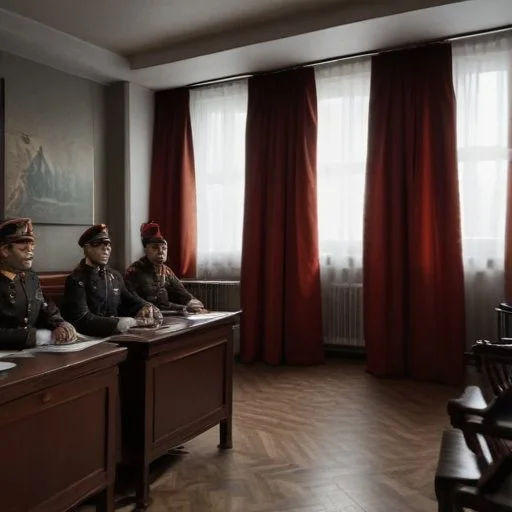
The Great Purge was the culmination of Stalin's growing paranoia and mistrust of his own people. Having solidified his position as the supreme leader of the Soviet Union, Stalin became increasingly obsessed with rooting out perceived threats to his rule, real or imagined. The slightest whisper of dissent or opposition was enough to spark a brutal crackdown, and the Moscow Trials were the public face of this campaign of terror.
The first of the Moscow Trials, held from August 19 to August 24, 1936, set the tone for the darkness that would follow. Sixteen high-ranking officials, including Grigory Zinoviev and Lev Kamenev, were hauled before the courts, accused of treason, espionage, and plotting against Stalin. The trials were a farce, with forced confessions, fabricated evidence, and predetermined verdicts. The outcome was a foregone conclusion: death by firing squad.
The Great Purge had far-reaching consequences for the Soviet Union and the world at large. Millions died, entire families were torn apart, and a climate of fear and mistrust pervaded Soviet society. The Purge also had significant implications for the Soviet economy, as skilled workers and intellectuals were decimated, leading to a brain drain and a crippling of the nation's industrial base.
The Great Purge had a profound impact on Soviet culture and society. Artists, writers, and intellectuals were among the first to be targeted, leading to a stifling of creativity and a homogenization of Soviet art and literature. The Purge also fractured Soviet society, as families and friends turned against each other in a desperate bid to survive.
"Death solves all problems - no man, no problem." - Joseph Stalin
As the Great Purge raged on, the world watched in horror, mesmerized by the sheer brutality and scale of the atrocities committed. The Moscow Trials, once intended to demonstrate Stalin's strength, ultimately exposed the rotten core of the Soviet system, leaving a lasting scar on the nation's psyche.
Lev Kamenev: The Rise and Fall of a Soviet Leader
Lev Kamenev, one of the first victims of the Moscow Trials, was a prominent Soviet politician who played a crucial role in the Russian Revolution. Born in 1883, Kamenev was a close ally of Vladimir Lenin and served as the Soviet Minister of Trade and Industry in the 1920s. However, his criticism of Stalin's policies and his perceived threat to Stalin's leadership led to his downfall.
Kamenev's involvement in the Moscow Trials was a mere formality, with his fate already sealed. His forced confession and execution sent a chilling message to potential opponents of Stalin's regime.
The Economic Devastation of the Great Purge
The Great Purge had a crippling effect on the Soviet economy, with millions of skilled workers, intellectuals, and professionals being arrested, tortured, and executed. The loss of human capital was staggering, with entire industries and sectors being decimated.
The purge of industrial leaders and managers led to a decline in industrial production, while the execution of skilled engineers and technicians led to a brain drain that would take years to recover from. The Soviet economy, which had been experiencing rapid growth in the 1930s, was brought to its knees.
The Silencing of Soviet Culture
The Great Purge had a profound impact on Soviet culture, with artists, writers, and intellectuals being among the first to be targeted. The Stalinist regime sought to impose a rigid ideological conformity on the arts, leading to a stifling of creativity and innovation.
Many famous writers, including Osip Mandelstam and Isaak Babel, were arrested and executed, while others, such as Boris Pasternak and Anna Akhmatova, were forced into exile or silence. The purge of cultural figures led to a homogenization of Soviet art and literature, with only state-approved works being tolerated.
The Dark Timeline of the Great Purge
The Great Purge was a complex and multifaceted event that unfolded over several years. Here are some key dates that highlight the scale and brutality of the purge:
1934: Stalin begins to consolidate power, using the Kirov assassination as a pretext to launch a campaign of terror.
1936: The first Moscow Trial takes place, marking the beginning of the Great Purge.
1937-1938: The purge reaches its peak, with millions arrested, tortured, and executed.
The Political Motivations behind the Great Purge
The Great Purge was, at its core, a political campaign aimed at consolidating Stalin's power and eliminating perceived threats to his rule. Stalin's paranoia and mistrust of his own people led to a climate of fear and paranoia, in which any opposition, real or imagined, was ruthlessly crushed.
The purge was also motivated by a desire to impose a rigid ideological conformity on the Soviet Union, with Stalin seeking to eliminate any dissenting voices or alternative ideologies.