


The Haitian slave revolution, which began in Saint-Domingue, Haiti, on August 14, 1791, is remembered as the largest and most successful slave uprising in modern history, leading to the abolition of slavery and the independence of Haiti.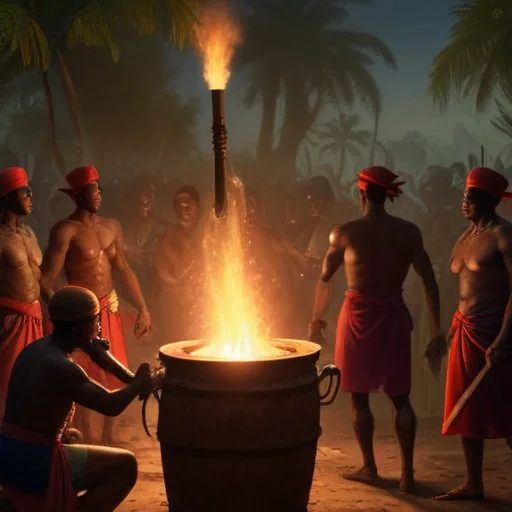
In the sweltering tropics of Saint-Domingue, a French colony in the 18th century, enslaved Africans were subjected to brutal treatment, forced labor, and dehumanizing conditions. Amidst this backdrop of oppression, a spark of resistance was ignited, fueled by the ideals of the French Revolution and the rhythmic beats of Vodou drums.
Boukman, a charismatic slave and Vodou priest, emerged as the revolution's leader, rallying thousands of enslaved Africans to join the fight for freedom. Alongside Boukman, other prominent figures like Toussaint Louverture, Jean-Jacques Dessalines, and Henri Christophe played significant roles in the revolution.
The Haitian slave revolution resulted in the establishment of Haiti as the first independent black nation in the world, and the only nation born from a successful slave revolt. This monumental event had far-reaching implications, inspiring abolitionist movements globally and redefining the concept of freedom and human rights.
Vodou, a syncretic religion combining African, European, and indigenous Taino traditions, played a central role in the revolution, serving as a symbol of resistance, unity, and cultural identity. The Haitian slave revolution also shaped the country's unique Creole culture, which celebrates African, French, and indigenous influences.
Despite its significance, the Haitian slave revolution has been subject to controversy and misinformation. Historians have debated the accuracy of Boukman's role and the event's portrayal in popular culture. However, the revolution's legacy as a beacon of freedom and self-determination remains uncontested.
"Liberty, Equality, Fraternity" – the motto of the Haitian Revolution, echoing the ideals of the French Revolution, became a rallying cry for those fighting for freedom.
In 1793, a French priest, Father Antoine, wrote about the revolution, describing the "negroes" as "inspired by a fanatical spirit of liberty." This account provides a glimpse into the minds of those who witnessed the birth of a new nation.
The Haitian slave revolution inspired abolitionist movements worldwide, influencing the fight against slavery in the United States, Latin America, and the Caribbean. The revolution's legacy continues to shape Haitian identity and inform contemporary debates on social justice and human rights.
The Haitian slave revolution stands as a testament to the power of resistance, cultural identity, and the unwavering pursuit of freedom. This pivotal event in world history continues to inspire and educate, serving as a beacon of hope for generations to come.
Boukman, the enslaved African and Vodou priest, is often credited as the spark that ignited the Haitian slave revolution. Little is known about his early life, but his legacy as a fearless leader and passionate orator has endured. His powerful speeches and Vodou ceremonies rallied thousands of slaves to join the fight for freedom.
Boukman's leadership was marked by his unwavering commitment to the cause, his ability to unite people from different backgrounds, and his tactical genius on the battlefield. Though he was killed in 1791, his vision of a free Haiti inspired generations to come.

Vodou, a syncretic religion born in Haiti, played a central role in the slave revolution. This unique blend of African, European, and indigenous Taino traditions became a symbol of resistance, unity, and cultural identity for the enslaved Africans.
Through Vodou ceremonies, Boukman and other leaders mobilized the slaves, fostering a sense of community and solidarity. Vodou also provided a platform for spiritual expression, allowing the enslaved to maintain their cultural heritage in the face of brutal oppression.
Today, Vodou remains an integral part of Haitian culture, a testament to the power of cultural identity in shaping the course of history.
The French Revolution's ideals of liberty, equality, and fraternity resonated deeply with the enslaved Africans in Saint-Domingue. The Revolution's rhetoric of freedom and human rights inspired Boukman and other leaders to seek similar liberties for themselves.
The Haitian slave revolution was, in part, a response to the contradictions of the French Revolution. While France proclaimed the universal rights of man, it continued to condone slavery in its colonies. The Haitian slaves saw this hypocrisy as a call to action, demanding equal rights and treatment.

While Toussaint Louverture, Jean-Jacques Dessalines, and Henri Christophe are well-known figures in the Haitian slave revolution, there were many other unsung heroes who played crucial roles in the fight for freedom.
Marie-Jeanne Lamartinière, a former slave, fought bravely alongside her husband in the Battle of Vertières, contributing to the Haitian army's victory. Others, like Romaine-la-Prophétesse, a charismatic leader, and Pierre Pinchinat, a skilled military strategist, also made significant contributions to the revolution.
Their stories, often overlooked in popular accounts, highlight the diverse range of individuals who fought for freedom and independence in Haiti.
The Haitian slave revolution had far-reaching economic consequences, both for Haiti and the global economy. The abolition of slavery led to a significant decline in sugar and coffee production, impacting France's colonial economy.
In Haiti, the newly independent nation faced the daunting task of rebuilding its economy. The country's early struggles to establish a stable economic system were compounded by the Dominican Republic's occupation in 1822.
Despite these challenges, the Haitian slave revolution paved the way for Haiti's economic self-determination, allowing the country to slowly build its own economic infrastructure and institutions.