


In the dawn of 1986, the world witnessed a rare and awe-inspiring event – the return of Halley's Comet to the inner Solar System. This majestic celestial body, known for its 76-year orbit, captured the imagination of scientists and sky gazers alike, providing a unique opportunity to study and marvel at its ethereal beauty.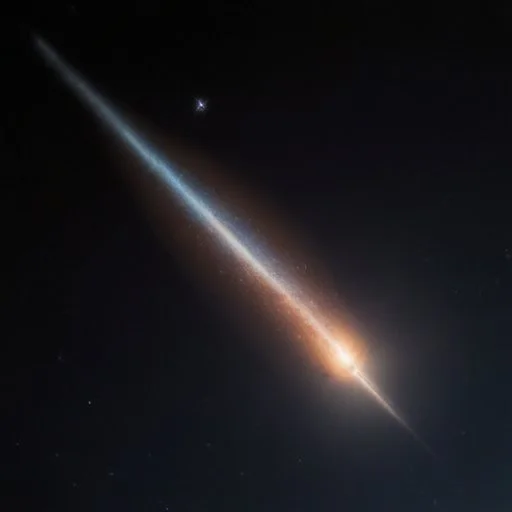
Halley's Comet has been a harbinger of wonder and curiosity throughout human history. First recorded by ancient Chinese astronomers in 240 BCE, the comet's appearance has been documented in various cultures, often viewed as an omen or a sign of significant events. In 1066, the comet's visit coincided with the Norman Conquest of England, while in 1456, it was seen as a warning sign by Pope Callixtus III.
In February 1986, Halley's Comet began its journey into the inner Solar System, visible to the naked eye from Earth for the first time in nearly eight decades. As it hurtled towards the Sun, its ionic tail glowed bright, mesmerizing astronomers and enthusiasts alike. The comet's closest approach, known as perihelion, occurred on February 9, allowing scientists to gather crucial data on its composition and behavior.
The 1986 encounter was a culmination of efforts by astronomers, engineers, and scientists worldwide. The European Space Agency's Giotto spacecraft, launched in 1985, flew by the comet's nucleus, capturing stunning images and providing unprecedented insights into its composition. The NASA-led International Halley Watch, a global network of astronomers, coordinated observations and data collection, significantly advancing our understanding of cometary science.
The comet's visit led to numerous breakthroughs in astrophysics and planetary science. Scientists discovered the comet's nucleus was shaped like a peanut, and its surface was composed of organic material, water ice, and rocky particles. The data collected during the encounter has had a lasting impact on our comprehension of cometary formation, evolution, and the origins of life on Earth.
Halley's Comet has inspired artistic and literary works throughout history. From ancient Chinese poems to modern literature, the comet has been a symbol of wonder, change, and the infinite. The 1986 encounter sparked a renewed interest in astronomy, inspiring a new generation of scientists, writers, and artists.
The 1986 encounter with Halley's Comet has left an indelible mark on the scientific community and the world at large. As we look to the future, we continue to draw inspiration from this celestial visitor, driving innovation, exploration, and a deeper understanding of our place in the universe.
Historians have long debated the significance of Halley's Comet in shaping human history. While some view its appearances as mere coincidence, others believe the comet's visits had a profound impact on the course of human events. One such argument suggests that the comet's appearance in 1066 influenced the outcome of the Norman Conquest of England, with the comet's ominous presence instilling fear and uncertainty among the English nobility.
Another perspective suggests that Halley's Comet played a role in the development of astronomy as a scientific discipline. The comet's regular returns allowed ancient civilizations to refine their understanding of celestial mechanics, laying the foundation for modern astronomy.
Regardless of one's stance on the comet's historical significance, it is clear that Halley's Comet has left an indelible mark on human culture and imagination.

Edmond Halley: The Man Behind the Comet
Edmond Halley, the English astronomer who first predicted the comet's return in 1758, was a polymath and a pioneer in his field. Born in 1656, Halley made significant contributions to navigation, actuarial science, and astronomy, earning him a reputation as one of the most influential scientists of his time.
Halley's fascination with comets began in the 1680s, when he observed and recorded the passage of multiple comets. His meticulous observations and calculations led him to conclude that the comet seen in 1531, 1607, and 1682 was, in fact, the same celestial body.
Halley's work on Halley's Comet cemented his legacy as a trailblazing astronomer, inspiring future generations of scientists to pursue the study of comets and celestial mechanics.
The 1986 encounter with Halley's Comet drove significant advancements in space technology and exploration. The European Space Agency's Giotto spacecraft, launched in 1985, flew by the comet's nucleus, capturing unprecedented images and data that helped scientists better understand cometary composition and behavior.
The mission also tested the capabilities of spacecraft design, propulsion systems, and data transmission technology, paving the way for future deep space missions.
The scientific community's ability to coordinate observations and data collection on a global scale also demonstrated the importance of international cooperation in space exploration.
Halley's Comet has long been a source of inspiration for artists, writers, and musicians. From ancient Chinese poems to modern literature, the comet has been a symbol of wonder, change, and the infinite.
The 1986 encounter sparked a renewed interest in astronomy and science, inspiring a new generation of creatives to explore the intersection of art and science.
In popular culture, Halley's Comet has been featured in films, literature, and music, often serving as a metaphor for transformation, renewal, and the unknown.
The 1986 encounter with Halley's Comet also had a profound impact on social dynamics, particularly in the realm of education. The comet's visit sparked a renewed interest in science education, with schools and educational institutions around the world incorporating cometary science into their curricula.
The event also brought people together, fostering a sense of global community and shared experience. As people gathered to witness the comet's passage, social and cultural barriers were temporarily suspended, allowing individuals to connect with one another on a deeper level.
In the years following the encounter, there was a surge in public participation in science, with amateur astronomers and enthusiasts driving the growth of astronomy clubs and organizations worldwide.