


The Holocaust, one of humanity's most tragic events, took a devastating turn on March 17, 1942, when the first group of Jews from the Lvov Ghetto were forcibly transported to the Belzec death camp in eastern Poland. It was here that they met their horrific fate, becoming the first victims of the camp's gas chambers, marking the beginning of a dark and sinister era.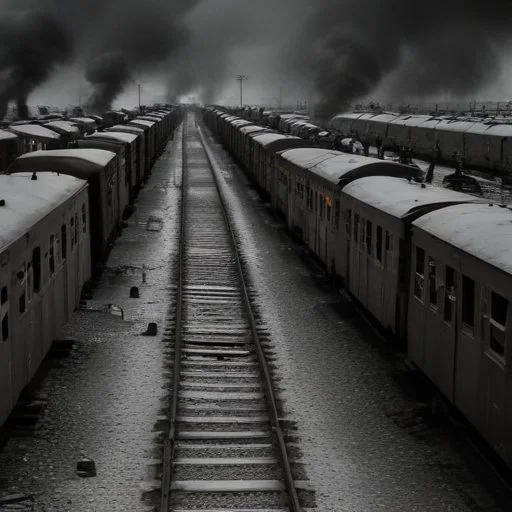
In the early 1940s, the Nazi regime, under the leadership of Adolf Hitler, began to implement their "Final Solution," a systematic plan to exterminate the Jewish population of Europe. The Lvov Ghetto, located in present-day Ukraine, was one of the largest and most significant ghettos established by the Nazis, with over 120,000 Jews confined within its walls.
The first group of Jews from the Lvov Ghetto were rounded up and forced onto overcrowded train cars, unaware of their destination or the fate that awaited them. The journey to Belzec was a grueling one, with prisoners subjected to harsh conditions, lack of food and water, and brutal treatment at the hands of their Nazi captors.
Upon arrival at Belzec, the prisoners were greeted by the camp's commander, Christian Wirth, a notorious SS officer. The camp was designed to be a highly efficient killing machine, with a capacity to murder thousands of people per day. The first group of Jews from Lvov Ghetto were led directly to the gas chambers, where they met their tragic end.
The first gassings at Belzec marked the beginning of a systematic and industrial-scale genocide, resulting in the murder of over 6 million Jews and millions of others deemed undesirable by the Nazi regime. The Holocaust would go on to become one of the darkest chapters in human history, leaving a lasting impact on humanity and serving as a stark reminder of the dangers of prejudice, hatred, and discrimination.
One of the most poignant accounts of the first gassings at Belzec comes from Rudolf Reder, a survivor of the camp. In his testimony, Reder recalled the horrors of the gas chamber, describing the cries of the victims and the eerie silence that followed. His account serves as a powerful reminder of the human cost of the Holocaust.
The first gassings at Belzec set a devastating precedent for the rest of the Holocaust, paving the way for the establishment of other death camps and the systematic murder of millions of innocent people. The event would go on to influence future genocides and human rights atrocities, serving as a stark reminder of the dangers of unchecked power and prejudice.
Today, the Belzec death camp stands as a somber memorial to the victims of the Holocaust, a poignant reminder of the dangers of hatred and discrimination. As we remember the first gassings at Belzec, we honor the memories of those who were lost and recommit ourselves to fighting for a world free from prejudice and hatred.
The establishment of Belzec death camp was a culmination of the Nazi's years-long experimentation with mass murder techniques. In 1941, the Nazis began testing gas vans at the Sachsenhausen concentration camp, using carbon monoxide to kill Soviet prisoners of war. The success of these experiments led to the development of more efficient killing methods, including the use of Zyklon B gas at Auschwitz and the construction of dedicated death camps like Belzec.
The site of Belzec was chosen specifically for its accessibility to the Lvov Ghetto, with the Nazis able to transport Jews quickly and efficiently to the camp. The camp's remote location also allowed the Nazis to carry out their atrocities in secrecy, far from prying eyes. Over time, Belzec would become one of the deadliest Nazi camps, responsible for the murders of hundreds of thousands of Jews.

Christian Wirth, the commander of Belzec, was a notorious SS officer known for his brutality and efficiency. Born in 1885, Wirth served in World War I before joining the Nazi party in the 1930s. He quickly rose through the ranks, becoming a key figure in the Nazi's "euthanasia" program, in which people with disabilities were killed in gas chambers.
Wirth's experience in the "euthanasia" program made him the perfect candidate to oversee the development of Belzec death camp. He was tasked with designing the camp's gas chambers and organizing the logistics of the mass killings. Wirth's role in the Holocaust was so significant that he earned the nickname "Christian the Terrible."
The Belzec death camp was situated in a region that was strategically important to the Nazis. The camp was located near the city of Lublin, which was a major transportation hub and a key location for the Nazi's military operations.
The surrounding area was also home to a large Jewish population, making it an ideal location for the Nazis to carry out their "Final Solution." The camp's proximity to the Soviet border also allowed the Nazis to easily transport Jews from the eastern territories, further expanding the reach of their genocidal campaign.

The Holocaust, and the Belzec death camp in particular, had a profound impact on Jewish culture and identity. The trauma and devastation caused by the genocide have been passed down through generations, shaping the Jewish experience and informing Jewish art, literature, and music.
The Holocaust has also had a lasting impact on the cultural identity of Poland, where the majority of the Nazi's atrocities took place. The country's complex history of antisemitism and its role in the Holocaust continue to be a topic of discussion and debate today.
The Holocaust raises fundamental questions about the nature of humanity and the dangers of unchecked power and prejudice. The genocide was the result of a deliberate and systematic campaign to dehumanize and destroy an entire people, and it highlights the dangers of ideologies that promote hatred and intolerance.
The Belzec death camp, in particular, serves as a stark reminder of the dangers of industrialized killing and the devastating consequences of reducing human life to mere statistics. It challenges us to consider the moral implications of our actions and to reflect on the importance of promoting empathy, compassion, and understanding.