


On a fateful day in 1945, the Nazi regime committed one of its most heinous crimes, executing 33 Upper Austrian socialist and communist leaders in the notorious Mauthausen concentration camp. This brutal act marked the final use of gas chambers in Mauthausen, forever etching the camp's name in the annals of humanity's darkest hour.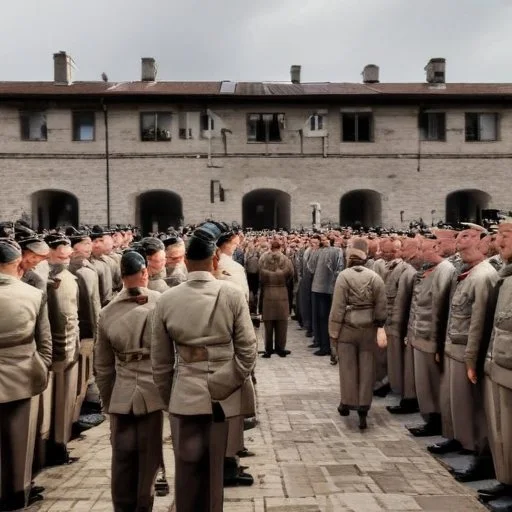
As World War II drew to a close, the Nazi regime was on the brink of collapse. In a last-ditch effort to maintain power and eliminate potential threats to their crumbling authority, the Nazis turned to brutal suppression and murder. The 33 Upper Austrian leaders, who had dared to defy the Nazi regime, were rounded up and brought to Mauthausen, a camp notorious for its inhumane conditions and brutal treatment of prisoners.
The gas chamber, a tool of mass murder, was the Nazis' weapon of choice for their final act of genocide in Mauthausen. The 33 prisoners, who had been subjected to forced labor, starvation, and unimaginable brutality, were led to the gas chambers, unaware of the horrors that awaited them. The execution, carried out in the spring of 1945, was a testament to the Nazi regime's unrelenting brutality and disregard for human life.
Mauthausen concentration camp, located in Upper Austria, was one of the most notorious camps in the Nazi regime's network of death camps. Established in 1938, the camp was designed to imprison and eliminate political opponents, Jews, Romani people, homosexuals, and others deemed undesirable by the Nazi regime. The camp's gas chamber, where the 33 Upper Austrian leaders met their fate, was just one of the many tools of terror used to maintain the regime's grip on power.
The 33 Upper Austrian socialist and communist leaders who lost their lives in Mauthausen's gas chamber execution were courageous individuals who dared to defy the Nazi regime. Their bravery in the face of unimaginable horror serves as a testament to the human spirit's capacity for resistance and defiance. Their memory lives on, a poignant reminder of the importance of standing up against oppression and fighting for freedom and justice.
The liberation of Mauthausen concentration camp by American forces on May 5, 1945, brought an end to the Nazi regime's reign of terror. The Allied victory marked the beginning of a new era, one in which the atrocities committed during World War II would be acknowledged and remembered. The execution of the 33 Upper Austrian leaders in Mauthausen's gas chamber serves as a stark reminder of the horrors of the Holocaust and the importance of learning from the past.
The legacy of Mauthausen's gas chamber execution serves as a poignant reminder of the importance of remembering and learning from the past. As we strive to build a better future, we must never forget the horrors of the Holocaust and the bravery of those who dared to stand against oppression.
The Mauthausen concentration camp's gas chamber execution of 33 Upper Austrian socialist and communist leaders in 1945 was a political tactic to crush opposition and maintain control. The Nazi regime, fearing defeat, targeted perceived threats to their authority, including political opponents, intellectuals, and those who refused to conform to their ideology.
The brutal suppression of these 33 individuals was a desperate attempt to maintain power and eliminate potential leaders who could have played a role in rebuilding Austria after the war. By eliminating these individuals, the Nazis aimed to create a power vacuum and ensure their own continued dominance.
The political significance of this event cannot be overstated. It marked a turning point in the Nazi regime's descent into brutality and its willingness to commit atrocities to achieve its goals. The execution of these 33 leaders served as a warning to others who dared to oppose the regime, and it solidified Mauthausen's reputation as a place of terror and despair.

Franz Danimann, a key figure among the 33 executed leaders, was a prominent socialist and trade unionist from Upper Austria. His bravery in the face of Nazi oppression inspired others to resist, and his legacy continues to be celebrated in Austria today.
Danimann's story is a testament to the human spirit's capacity for resistance and defiance. Despite being imprisoned and subjected to forced labor, he continued to organize and inspire others, ultimately paying the ultimate price for his courage.
The historical significance of Mauthausen's gas chamber execution lies in its timing, coming as it did in the final months of World War II. As Allied forces closed in on the camp, the Nazis were determined to eliminate all evidence of their atrocities, including the prisoners who could have testified against them.
The execution of the 33 Upper Austrian leaders was part of a larger effort to destroy evidence and silence witnesses. The Nazis' frantic attempts to conceal their crimes only served to underscore the horrors they had committed, and the world would soon be shocked by the atrocities revealed in the aftermath of the camp's liberation.

The cultural impact of Mauthausen's gas chamber execution has been profound, serving as a symbol of the horrors of the Holocaust and the importance of remembering the past. The camp's liberation and the subsequent trials of Nazi officials helped to raise awareness about the atrocities committed during World War II.
Today, Mauthausen Memorial stands as a testament to the victims of the Holocaust, a place of quiet reflection and contemplation. The memorial serves as a reminder of the dangers of extremism, prejudice, and hatred, and the importance of promoting tolerance, understanding, and human rights.
The geopolitical context of Mauthausen's gas chamber execution is complex and multifaceted. As World War II drew to a close, the Allies were advancing on multiple fronts, and the Nazi regime was desperate to maintain control and avoid defeat.
The execution of the 33 Upper Austrian leaders was part of a broader strategy to eliminate perceived threats to Nazi authority and maintain control over occupied territories. The event highlights the brutal and ruthless nature of the Nazi regime, which was willing to go to any lengths to achieve its goals, even in the face of defeat.