King Henry V defeats French cavalry at Agincourt
In a stunning upset, King Henry V of England led his army of lightly armored infantry and archers to a crushing victory over the heavily armored French cavalry at the Battle of Agincourt. Despite being vastly outnumbered, the English longbowmen unleashed a hail of arrows that decimated the French knights, leaving thousands dead or captured. This remarkable upset marked a major turning point in the Hundred Years' War and cemented Henry V's reputation as a brilliant military strategist.
The Unlikely Triumph: Henry V's Victory at Agincourt
A Lesson in Military Strategy and Sheer Luck
The Battle of Agincourt, fought on October 25, 1415, is renowned for its David-and-Goliath proportions, where King
Henry V of England led his outnumbered army of lightly armored infantry and archers to a resounding victory over the heavily armored French cavalry. This remarkable upset marked a significant turning point in the Hundred Years War, showcasing Henry V's brilliance as a military strategist.
Historical Background
The Hundred Years War, a series of conflicts between England and France, had been raging on since 1337. By the early 15th century, the war had reached a stalemate, with both sides suffering heavy losses. In 1415, Henry V, determined to reclaim the French territories and assert his claim to the throne, set out with an expeditionary force of approximately 6,000-9,000 men.
The Battlefield Advantage
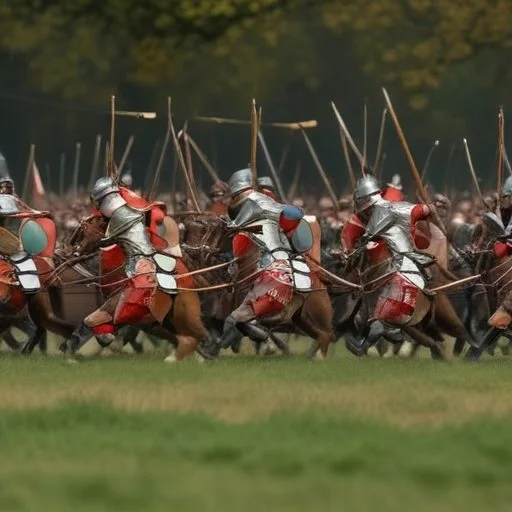
The French army, comprised of heavily armored knights and men-at-arms, had not anticipated the English army's adaptability and innovative tactics. The muddy terrain at Agincourt, which proved a nightmare for the French cavalry, became a crucial ally for the English. The narrow terrain and dense forest restricted the French cavalry's movement, rendering their advantage in numbers useless. Meanwhile, the English longbowmen, positioned behind a makeshift palisade of wooden stakes, unleashed a hail of arrows that decimated the French ranks.
Key Figures Involved
- King Henry V of England: The young king, who had recently ascended to the throne, led his army with bravery and tactical genius.
- Charles d'Albret, Constable of France: Led the French army, but underestimated the English forces, leading to disastrous consequences.
Timeline of Events
- October 13, 1415: Henry V's army sets out from Harfleur, marching towards Calais.
- October 24, 1415: The English army reaches Agincourt, where they encounter the French forces.
- October 25, 1415: The Battle of Agincourt takes place, resulting in a decisive English victory.
Major Outcomes and Impacts
- The English suffered minimal casualties, estimated between 100-500 men, while the French lost an estimated 7,000-10,000 men, including many nobles.
- The battle led to a significant shift in the balance of power, as the English gained control of large swathes of French territory.
- The victory cemented Henry V's reputation as a brilliant military strategist and leader.
Cultural and Social Influences
The Battle of Agincourt has left an indelible mark on English folklore, inspiring countless literary and artistic works, including
William Shakespeare's famous play, _Henry V_. The battle's legacy continues to inspire and captivate people to this day, serving as a testament to the power of adaptability, strategic thinking, and sheer determination.
Triviality and Fun Facts
- The English longbowmen were so effective that the French knights were forced to dismount and fight on foot, negating their advantage in armor.
- The muddy terrain at Agincourt became so infamous that it inspired the term "Agincourt mud" to describe treacherous terrain.
The Battle of Agincourt remains an enduring symbol of military ingenuity and against-the-odds triumph, a testament to the power of human resourcefulness and determination in the face of overwhelming adversity.
Complete Historical Record
The English army's journey to Agincourt was not without its challenges. After setting out from Harfleur, they faced harsh weather conditions, including heavy rain and strong winds, which made the march treacherous. The army had to navigate through boggy terrain, which slowed their progress and exhausted the men.
Despite these obstacles, Henry V remained resolute in his determination to engage the French forces. He was driven by a strong sense of duty to his country and his people, and he was willing to risk everything to secure a victory.
The English army's arrival at Agincourt on October 24, 1415, marked a turning point in the campaign. The French forces, led by Charles d'Albret, were already assembled in the area, and the stage was set for a confrontation.

Detailed Character Insight
Charles d'Albret, Constable of France: A seasoned military commander, Charles d'Albret was tasked with defending French territory against the English invasion. Despite his experience and bravery, he underestimated the English forces, leading to disastrous consequences.
According to historical accounts, d'Albret was a proud and arrogant man, who believed in the superiority of the French nobility and the heavily armored knights. This overconfidence proved to be a fatal flaw, as he failed to adapt to the changing circumstances of the battle.
Contrastive Analysis
The Battle of Agincourt is often compared to the Battle of Crécy, another English victory against the French during the Hundred Years War. Both battles showcased the effectiveness of the English longbowmen against heavily armored knights.
However, there are significant differences between the two battles. Agincourt was fought on a much smaller scale, with fewer troops involved, and the terrain played a more crucial role in the outcome.
In contrast, the Battle of Crécy was fought on a larger scale, with more troops involved, and the English victory was more decisive.

Study of Cultural Impact
The Battle of Agincourt has had a profound impact on English literature and culture. William Shakespeare's play, Henry V, immortalized the battle and cemented its place in English folklore.
The play's portrayal of Henry V as a heroic and brave leader has shaped the public perception of the king and the battle, and has influenced artistic and literary works for centuries.
The battle has also inspired numerous works of art, including paintings, sculptures, and poems, which continue to captivate audiences to this day.
Geopolitical Dynamics Review
The Battle of Agincourt took place during a time of great upheaval in Europe, with the Hundred Years War raging on for nearly a century. The war had drained the resources of both England and France, and had led to a decline in their economies.
The battle was fought against the backdrop of a complex web of alliances and rivalries between European powers, including the Holy Roman Empire, Burgundy, and Aragon.
The English victory at Agincourt had significant geopolitical implications, as it shifted the balance of power in favor of England and paved the way for further conquests in France.


