


The Stif massacre is remembered as a dark stain on France's colonial legacy, a brutal display of force that left hundreds of Algerian civilians dead and many more wounded. This tragic event, which took place on May 8, 1945, marked a decisive moment in Algeria's struggle for independence, galvanizing nationalist sentiment and paving the way for the long and bloody conflict that would eventually lead to Algeria's independence from France.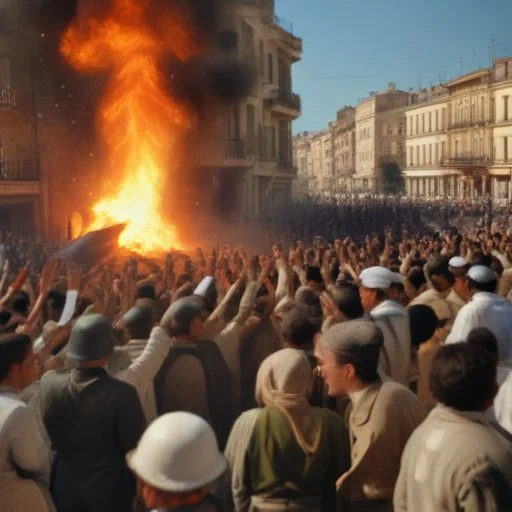
As World War II drew to a close, Algerian nationalists, who had long been seeking independence from French rule, saw an opportunity to press their demands. The Allies' victory in Europe had weakened France's grip on its colonies, and the Algerian people, inspired by the Atlantic Charter's promise of self-determination, began to organize and demand their rights.
On May 8, 1945, Algerians took to the streets of Stif, a small town in the Constantine Province, to celebrate the Allied victory in Europe. However, French Army soldiers, still reeling from the Nazi occupation, viewed this display of Algerian nationalism as a threat to their authority. Without warning, they opened fire on the crowd, sparking a wave of violence that would leave hundreds of civilians dead and many more wounded.
The Stif massacre sent shockwaves throughout Algeria, galvanizing nationalist sentiment and paving the way for the Algerian War of Independence. The event marked a turning point in the country's struggle for independence, as Algerians began to organize and fight back against French rule. The massacre also had significant international repercussions, with the international community condemning France's actions and calling for Algerian independence.
The Stif massacre has left a lasting impact on Algerian culture and society. The event is remembered as a symbol of French brutality and oppression, and its anniversary is marked by protests and commemorations throughout Algeria. The massacre has also inspired a range of literary and artistic works, including novels, poems, and films that reflect on the trauma and loss suffered by the Algerian people.
The Stif massacre bears striking similarities to other colonial-era massacres, such as the Amritsar Massacre in India and the Sharpeville Massacre in South Africa. These events, which saw colonial powers unleash brutal force against unarmed civilians, highlight the darker aspects of colonialism and the struggle for independence and self-determination.
Ferhat Abbas, the Algerian nationalist leader, was born in 1899 in the Constantine Province. Abbas's early life was marked by a deep sense of national identity, which was shaped by his experiences as a French-educated Arab.
Abbas's involvement in politics began in the 1920s, when he joined the North African Star, a nationalist movement that sought to promote Algerian independence. He later became a key figure in the Algerian People's Party, which advocated for Algerian autonomy.
Abbas's leadership during the Stif massacre and its aftermath played a significant role in galvanizing national sentiment and paving the way for the Algerian War of Independence.

The Stif massacre has had a profound impact on Algerian literature and art, with many writers and artists drawing inspiration from the event.
One of the most notable examples is the novel The Battle of Algiers, written by Saadi Yacef, which tells the story of the Algerian struggle for independence and features the Stif massacre as a pivotal event.
The massacre has also inspired a range of artistic works, including paintings, sculptures, and installations that reflect on the trauma and loss suffered by the Algerian people.
The Stif massacre bears striking similarities to the Amritsar Massacre, which took place in India in 1919.
Both events involved the brutal suppression of nationalist sentiment by colonial powers, resulting in the deaths of hundreds of unarmed civilians.
Both events also had significant international repercussions, with the international community condemning the brutality and calling for greater autonomy and independence for the colonized peoples.

The Stif massacre took place at a time of great geopolitical upheaval, with the Allies' victory in Europe marking a significant shift in the global balance of power.
The event was also influenced by the emergence of the United States and the Soviet Union as superpowers, which led to a re-evaluation of colonialism and the role of European powers in the world.
The massacre was a stark reminder of the darker aspects of colonialism and the need for greater self-determination and autonomy for colonized peoples.
Historians have interpreted the Stif massacre as a turning point in Algeria's struggle for independence, marking a shift from peaceful protest to armed resistance.
Some historians have argued that the massacre was a catalyst for the Algerian War of Independence, which lasted from 1954 to 1962 and resulted in Algeria's independence from France.
Others have seen the event as a symbol of the brutality and oppression of colonialism, highlighting the need for greater accountability and recognition of the suffering of colonized peoples.