


In the early morning hours of October 13, 1307, the tranquility of the French countryside was shattered as hundreds of Knights Templar were arrested by King Philip the Fair's men, accused of the most heinous crimes: heresy. The ensuing months would see these revered knights, once protectors of the faith, subjected to unimaginable torture, forced to confess to atrocities they never committed.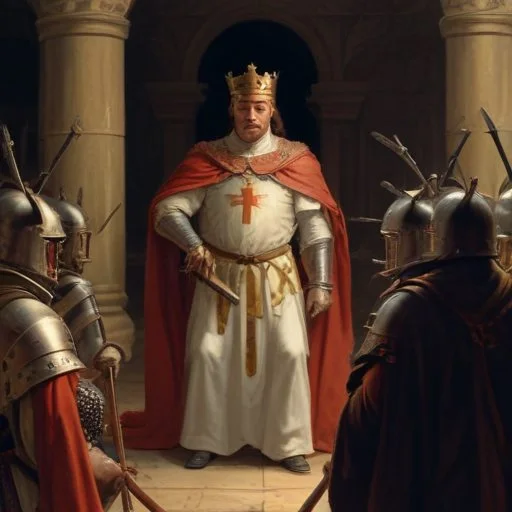
The roots of this tragic event lay in the complex web of politics, finance, and power struggles that defined medieval Europe. King Philip IV, nicknamed "Philip the Fair," had long been at odds with the Knights Templar, an Order of warrior monks who had amassed immense wealth and influence over the centuries.

The seeds of distrust were sown when the King, deeply in debt to the Templars, began to covet their riches and resented their autonomy. He cleverly manipulated public opinion, spreading scurrilous rumors and fabricating charges of blasphemy, sodomy, and worship of false idols against the Order.
Meanwhile, the Grand Master of the Templars, Jacques de Molay, remained confident in the Order's innocence, unaware of the treachery that awaited them. As the noose tightened around their necks, the Templars were caught off guard, unable to mount an effective defense against the King's Machiavellian tactics.
In the dungeons of the royal castle, the Knights Templar were subjected to an agonizing regimen of torture, designed to extract confessions that would validate the King's accusations. The screams of the tortured echoed through the corridors as men were stretched on the rack, burned with hot irons, and subjected to other forms of medieval brutality.

Under the unrelenting torture, many Templars eventually broke, confessing to crimes they did not commit. These coerced confessions were then used as "proof" of the Order's guilt, further fueling the public's outrage and hysteria.
The consequences of this brutal affair were far-reaching and devastating. The Knights Templar, once a pillar of Christianity, were dismantled, their assets seized, and their members either executed or forced to flee. The Order's reputation, once synonymous with courage and honor, was forever tarnished.
The papacy, initially hesitant to intervene, eventually succumbed to pressure from King Philip, and in 1312, Pope Clement V officially disbanded the Knights Templar. The once-mighty Order was reduced to a mere memory, leaving behind a legacy of mystery, intrigue, and shame.
This infamous episode in history has sparked heated debates and controversies, with many questioning the true motives behind King Philip's actions. Was it greed, politics, or something more sinister that drove him to destroy the Templars? The answers, much like the secrets of the Knights themselves, remain shrouded in mystery.
As we reflect on this dark chapter in human history, we are reminded of the dangers of unchecked power, the devastating consequences of fear-mongering, and the importance of standing against injustice, even in the face of overwhelming odds.
"The truth is often obscured, but the echoes of the past will always whisper secrets to those who dare to listen."
Historians have long debated the motivations behind King Philip IV's ruthless suppression of the Knights Templar. Some argue that his actions were driven by a genuine distrust of the Order's growing power and influence, while others believe it was a cynical ploy to replenish his depleted treasury. Regardless of the King's true intentions, the consequences of his actions were far-reaching and devastating.
Recent studies have shed new light on the medieval mindset, suggesting that the Templars' autonomy and wealth may have been perceived as a threat to the authority of the Catholic Church.
Furthermore, the political climate of 14th-century Europe was marked by a surge in nationalist sentiment, which may have contributed to the King's desire to assert his dominance over perceived foreign entities like the Knights Templar.
By examining the historical context in which these events unfolded, we gain a deeper understanding of the complex forces that shaped the fate of the Knights Templar.
Grand Master Jacques de Molay, the last leader of the Knights Templar, remains an enigmatic figure in the annals of history. Born in Rahon, France, circa 1240, Molay rose through the ranks of the Order, earning a reputation as a skilled military strategist and diplomat.
Despite his valiant efforts to defend the Order against King Philip's accusations, Molay was ultimately executed in 1307, along with dozens of his brethren.
His bravery in the face of overwhelming odds has become a testament to the unwavering dedication of the Knights Templar to their faith and their Order.
Little is known about Molay's personal life, but his legacy as a champion of the Templars' cause continues to inspire and fascinate historians and enthusiasts alike.
The geopolitics of medieval Europe played a significant role in the downfall of the Knights Templar. The rise of nationalist monarchies, such as France and England, had created an atmosphere of tension and competition between European powers.
The Templars, with their vast network of connections and influence, became a convenient scapegoat for the rivalries and conflicts between these nations.
The rivalry between King Philip IV and King Edward I of England, for instance, may have contributed to the former's desire to curtail the Templars' influence and wealth.
Furthermore, the Templars' role in the Crusades had earned them many enemies in the Middle East, leading to accusations of heresy and treason.
The economic implications of the Knights Templar's suppression were far-reaching and devastating. The seizure of their assets, including vast tracts of land, treasure, and trade routes, significantly enriched King Philip IV's coffers.
The dissolution of the Order also led to the displacement of thousands of Templars, who were forced to flee or go into hiding to avoid persecution.
The financial consequences of the Templars' downfall were felt across Europe, as trade and commerce were disrupted and the economy was plunged into recession.
The loss of the Templars' expertise in banking and finance further exacerbated the economic instability of the time.
The cultural impact of the Knights Templar's suppression has been profound and lasting. The Order's reputation was forever tarnished, and their legacy was shrouded in mystery and intrigue.
Their former strongholds, once symbols of power and prestige, were either destroyed or repurposed, erasing the physical reminders of their existence.
The suppression of the Templars also led to a cultural shift, as the Catholic Church consolidated its power and influence, and the notion of chivalry and honor was redefined.
Their enigmatic story has captivated artists, writers, and historians for centuries, inspiring countless works of fiction and non-fiction.