


In the turbulent aftermath of World War I, Hungary's fragile democracy crumbled, paving the way for a radical experiment: the Hungarian Soviet Republic. This bold venture, established on March 21, 1919, became the first Communist government in Europe, following in the footsteps of Russia's October Revolution.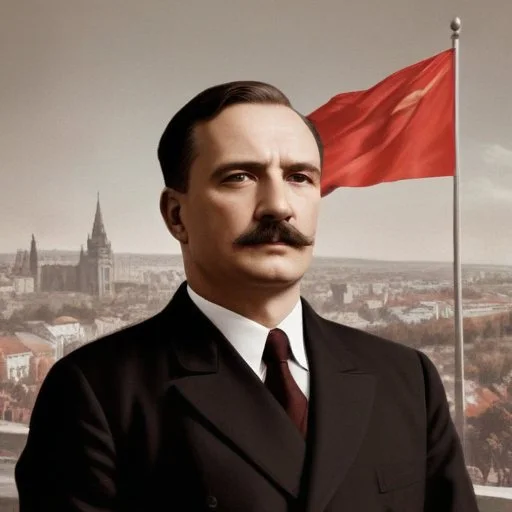
After the war, Hungary was in shambles. The economy was in ruins, and the country was struggling to come to terms with the loss of its territories and the collapse of the Austro-Hungarian Empire. Amidst this chaos, a charismatic figure emerged: Béla Kun, a journalist and ardent communist who had been inspired by Vladimir Lenin's Bolsheviks.
Kun's passion and conviction resonated with the Hungarian people, who were desperate for change. He rallied the masses with promises of land redistribution, social reform, and an end to exploitation. As the leader of the Hungarian Communist Party, Kun was well-positioned to capitalize on the nation's discontent.
On March 21, 1919, Kun declared the establishment of the Hungarian Soviet Republic. This new government nationalized industries, redistributed land to peasants, and implemented sweeping social reforms. The people were captivated by Kun's vision of a classless society, and for a brief moment, it seemed as though the impossible had been achieved.
Despite its promising start, the Hungarian Soviet Republic was doomed from the outset. The government faced opposition from neighboring countries, and Kun's radical policies alienated many Hungarians. As the Romanian Army advanced on Budapest, Kun's government crumbled, and the Hungarian Soviet Republic was no more.
Though short-lived, the Hungarian Soviet Republic left an indelible mark on European history. It paved the way for future Communist movements and inspired a generation of social reformers. Today, the brief, shining moment of the Hungarian Soviet Republic remains a testament to the power of human idealism and the enduring appeal of radical change.
"We will create a new Hungary, a Hungary of the workers, peasants, and intellectuals!" - Béla Kun
"The Hungarian Soviet Republic is not only a Hungarian affair, but a European and international one." - Béla Kun
The aftermath of World War I was a time of great upheaval across Europe. The Austro-Hungarian Empire, which had once spanned across much of Central Europe, had collapsed, leaving in its wake a power vacuum that various factions and nations sought to fill. The Treaty of Trianon, signed in 1920, would eventually redraw the borders of Hungary, but in the meantime, the country was in a state of chaos.
The economy was in shambles, with widespread poverty and unemployment. The war had left Hungary's infrastructure crippled, and the country was struggling to rebuild. It was amidst this turmoil that Béla Kun and his communist ideology emerged as a beacon of hope for many Hungarians.

Born in 1886, Béla Kun was a journalist and politician who had been involved in left-wing politics from an early age. He was charismatic and persuasive, able to rally the masses with his impassioned speeches and promises of radical change. Kun's conviction and dedication to his ideology inspired many, and he quickly became a leader among Hungary's communist movement.
Kun's background as a journalist had honed his communication skills, allowing him to articulate his vision of a classless society in clear and compelling terms. His passion and energy were infectious, and he was able to mobilize large crowds to support his cause.
The Hungarian Soviet Republic was not the first attempt at radical social change in Europe. The Paris Commune of 1871, which had emerged in the aftermath of the Franco-Prussian War, had also sought to establish a socialist government. While both movements shared similarities, they also had significant differences.
Unlike the Paris Commune, which was largely driven by anarchists and radical socialists, the Hungarian Soviet Republic was dominated by communists. Kun's government was heavily influenced by Lenin's Bolsheviks, and sought to implement a centralized, authoritarian state. The Paris Commune, on the other hand, was more decentralized and democratic.

The Hungarian Soviet Republic emerged at a time of great geopolitical upheaval. The Russian Revolution had brought the Bolsheviks to power, and the Soviet Union was seeking to expand its influence across Europe. The Hungarian Soviet Republic was seen as a key ally in this effort, and Kun's government received significant support from Moscow.
However, the Hungarian Soviet Republic was also surrounded by hostile powers. The Romanian Army, backed by the Entente powers, was opposed to the communist government and sought to crush it. The republic's geographic location, bordering on both the Soviet Union and Romania, made it vulnerable to external pressure.
Despite its brief existence, the Hungarian Soviet Republic was marked by intense political rivalries and power struggles. Kun's communist government faced opposition from social democrats, who sought to establish a more moderate, parliamentary system. The communists, in turn, viewed the social democrats as weak and compromising.