


The morning of February 1, 1979, marked a pivotal moment in Iranian history as Ayatollah Ruhollah Khomeini stepped off a chartered Air France Boeing 747 at Tehran's Mehrabad Airport, ending nearly 15 years of exile. This momentous occasion was met with unbridled enthusiasm from millions of Iranians, who had been yearning for their spiritual leader's return.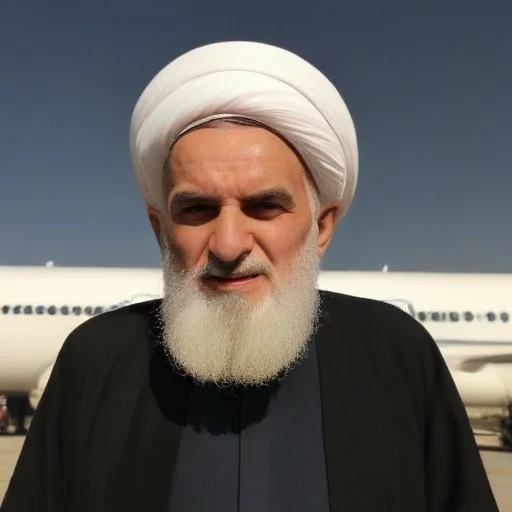
In the early 1960s, Khomeini, a prominent Shia cleric and politician, emerged as a vocal critic of the Mohammad Reza Pahlavi's secular government. His outspoken stance against the Shah's modernization policies and close ties with the United States led to his exile in 1964. During his time in exile, Khomeini continued to inspire and mobilize the Iranian opposition, cementing his reputation as a champion of Islamic values and social justice.
Khomeini's return to Tehran was the culmination of years of tireless efforts by the Iranian opposition, who had been working to overthrow the Pahlavi regime. As news of his arrival spread, millions of Iranians poured onto the streets, eager to catch a glimpse of their beloved leader. The atmosphere was electric, with chants of "Allahu Akbar" and "Khomeini, Khomeini" echoing through the streets.
Khomeini's return marked the beginning of a new era in Iranian history, paving the way for the establishment of an Islamic republic. The subsequent revolution led to the overthrow of the Pahlavi regime and the adoption of a new constitution, which enshrined Islamic principles and values as the foundation of the state. This seismic shift in Iranian politics had far-reaching consequences, not only for the country but also for the Middle East and the world at large.
Khomeini's return and the subsequent revolution had a profound impact on Iranian culture and society. The Islamic republic that emerged in its aftermath promoted a distinctive blend of religiosity and nationalism, which continues to shape Iranian identity to this day. The event also inspired a new wave of Islamist movements across the region, as well as sparking a global debate on the role of religion in politics.
"We will not rest until we have reclaimed our country and restored the honor of Islam." - Ayatollah Ruhollah Khomeini, upon his return to Tehran.
Khomeini's words, spoken on that fateful morning, captured the essence of the revolution and the hopes of a nation. They have since become an iconic refrain, symbolizing the unyielding spirit of the Iranian people.
One eyewitness, a young Iranian woman, recalled the moment Khomeini stepped off the plane: "It was as if the sun had burst forth from the clouds. His presence was like a ray of hope, illuminating our path forward. We knew that our country would never be the same again."
Such personal accounts, like countless others, attest to the profound emotional impact of Khomeini's return on the Iranian people. They paint a vivid picture of a moment that will be etched in the collective memory of Iranians for generations to come.
Khomeini's return and the subsequent revolution set in motion a chain of events that continues to shape the Middle East today. The establishment of an Islamic republic in Iran inspired similar movements across the region, while also sparking a geopolitical rivalry with Western powers that endures to this day.
In conclusion, Ayatollah Ruhollah Khomeini's triumphant return to Tehran on February 1, 1979, was a watershed moment in Iranian history, marking the beginning of a new era of Islamic governance and social transformation. As we reflect on this pivotal event, we are reminded of the power of conviction, perseverance, and faith in shaping the course of human events.
The morning of February 1, 1979, was a culmination of years of clandestine meetings, secret messages, and underground organizing. Khomeini's return was facilitated by a network of sympathizers who had infiltrated the Shah's government, providing crucial intelligence and logistical support. One such sympathizer was Amir-Entezam, a high-ranking official in the Ministry of Foreign Affairs, who played a key role in arranging Khomeini's chartered flight from Paris.
As Khomeini's plane touched down at Mehrabad Airport, a contingency plan was set in motion. Thousands of supporters, many of whom had been bused in from surrounding cities, converged on the airport, overwhelming the security forces. The airport's gates were breached, and the crowds surged forward, chanting slogans and waving banners.
Khomeini's bodyguards, a group of fiercely loyal and well-trained militants, ensured the Ayatollah's safe passage through the throngs of people.
Ayatollah Khomeini was a complex figure, driven by a profound sense of conviction and moral purpose. Born in 1902, Khomeini was raised in a clerical family and was deeply influenced by the Shia tradition of martyrdom and resistance. His early years as a theologian and preacher in Qom were marked by a growing unease with the secularizing policies of the Pahlavi regime.
Khomeini's brand of Islamism was rooted in a mystical and apocalyptic vision, which emphasized the need for a divinely guided state. His charismatic leadership and unwavering commitment to his principles inspired a generation of Iranians, who saw him as a symbol of resistance against Western imperialism and domestic tyranny.
Despite his intransigent stance on many issues, Khomeini was also a pragmatic politician, willing to form alliances and make concessions when necessary.Khomeini's return to Tehran had a profound impact on Iranian culture, sparking a revolution in values, norms, and artistic expression. The new Islamic regime actively promoted a distinctive brand of Islamic art, literature, and music, which drew inspiration from Shia piety and Persian national heritage.
The popularization of martyrdom and self-sacrifice as ideals of revolutionary heroism led to a proliferation of martyrological art, literature, and film. The government-sponsored festivals and commemorations of revolutionary anniversaries helped to create a new national calendar, which was infused with Islamic themes and motifs.
The Khomeini regime's cultural policies had far-reaching consequences, shaping the trajectory of Iranian art, literature, and cinema for decades to come.
The political landscape of Iran was forever changed by Khomeini's return and the subsequent revolution. The collapse of the Pahlavi monarchy marked the demise of Iran's royal dictatorship and the rise of a new authoritarian order, which claimed to be rooted in popular sovereignty and divine authority.
The Islamic Republic that emerged in 1979 was a hybrid system, which combined elements of democratic participation, clerical rule, and authoritarian control. Khomeini's concept of velayat-e faqih, or the guardianship of the Islamic jurist, provided a legitimizing framework for clerical rule, which has continued to shape Iran's political institutions and practices.
The Iranian Revolution's impact on regional politics was profound, inspiring similar movements across the Middle East and North Africa.The global context of Khomeini's return to Tehran was marked by a shifting balance of power and a growing sense of multipolarity. The 1970s witnessed a surge in oil prices, a decline in US influence, and the rise of new regional powers, such as Iran and Saudi Arabia.
The Iranian Revolution was seen as a major blow to US interests in the region, and it marked a turning point in the Cold War. The Soviet Union, which had long sought to expand its influence in the Middle East, was initially wary of Khomeini's Islamist ideology but eventually came to see the Iranian Revolution as an opportunity to gain a strategic foothold in the region.
The Iranian Revolution's impact on the global political economy was profound, leading to a reconfiguration of energy markets, a shift in the global balance of power, and a new era of geopolitical rivalry.