


In 1897, British physicist J.J. Thomson sent shockwaves through the scientific community with his groundbreaking announcement at the Royal Institution in London: the discovery of the electron, a subatomic particle over 1,800 times smaller than a proton in the atomic nucleus.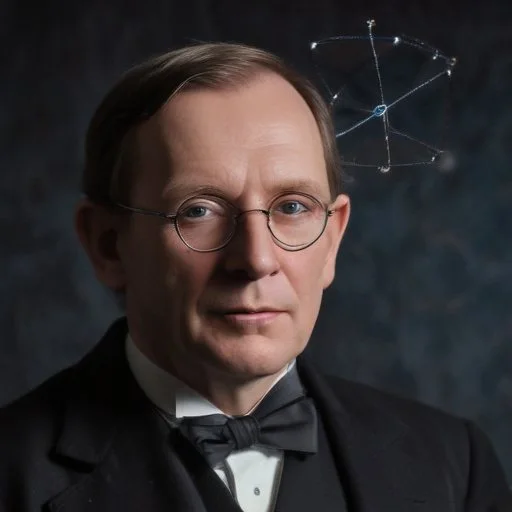
This pioneering finding not only reshaped our understanding of atomic structure but also laid the foundation for trailblazing advancements in fields like electronics, quantum mechanics, and beyond.
The late 19th century was an era of intense curiosity and exploration in the realm of atomic physics. Scientists like Ernest Rutherford and Wilhelm Conrad Röntgen were busy unraveling the mysteries of the atom, driven by a desire to understand the fundamental building blocks of matter.
In this context, Thomson's work at the Cavendish Laboratory, Cambridge University, was instrumental in pushing the boundaries of human knowledge. His innovative experiments and theories sparked a new wave of inquiry, propelling the field of physics forward.
On that fateful spring evening in 1897, Thomson took the stage at the Royal Institution, electrifying the audience with his lecture on "Cathode Rays." With elegance and precision, he presented his findings, which would soon become the cornerstone of modern physics.
Using a clever combination of experiments and mathematical deductions, Thomson demonstrated the existence of a subatomic particle with a negative charge, later dubbed the electron. This remarkable discovery not only confounded the scientific community but also raised a multitude of questions about the nature of atomic structure.
The discovery of the electron paved the way for the development of modern electronics, enabling the creation of devices like vacuum tubes, transistors, and ultimately, the microchip.
The concept of subatomic particles opened up new avenues for research, leading to a deeper understanding of quantum mechanics and the behavior of matter at the atomic and subatomic level.
Thomson's work laid the foundation for future breakthroughs in nuclear physics, including the discovery of neutrons and protons, and the development of nuclear energy.
Thomson's announcement sparked intense debate among scientists, with some questioning the validity of his findings. However, as the evidence mounted, the electron's existence became increasingly difficult to refute.
In the public sphere, the discovery of the electron sparked widespread fascination, captivating the imagination of people from all walks of life. The idea that tiny, invisible particles could shape our world resonated deeply, inspiring a new generation of scientists and thinkers.
Thomson's biographers note that he was a humble and unassuming individual, preferring to focus on his work rather than seek the limelight. Despite this, his groundbreaking discovery catapulted him to international fame, earning him numerous accolades and recognition.
In his later years, Thomson reflected on his discovery, stating, "The electron is a very curious thing. It is a sort of material unit, and yet it is not material in the ordinary sense of the word."
Thomson's trailblazing work earned him numerous honors, including the Nobel Prize in Physics in 1906. He was also knighted in 1908 and became a member of the Order of Merit in 1912.
Today, Thomson's legacy continues to inspire scientists and researchers worldwide, his discovery of the electron remaining a fundamental cornerstone of modern physics.
Thomson's remarkable journey serves as a testament to the power of human curiosity, perseverance, and innovation. His groundbreaking discovery reminds us that even the most seemingly insurmountable challenges can be overcome with dedication and a passion for knowledge.
As we continue to explore the mysteries of the universe, Thomson's legacy inspires us to push the boundaries of human understanding, to question the unknown, and to strive for greatness.
In the words of Thomson himself, "The important thing is not to stop questioning. Curiosity has its own reason for existence."
The discovery of the electron by J.J. Thomson in 1897 marked a pivotal moment in the historiography of physics. It signaled a shift from the classical understanding of the atom to a more nuanced, modern perspective.
Historians of science have argued that Thomson's work was instrumental in establishing the discipline of subatomic physics, paving the way for future breakthroughs in quantum mechanics and nuclear physics.
In the context of historiographical perspectives, Thomson's discovery highlights the importance of experimentation and empirical evidence in scientific inquiry, underscoring the role of human curiosity and ingenuity in shaping our understanding of the natural world.
The discovery of the electron had far-reaching cultural implications, captivating the imagination of the general public and inspiring a new generation of scientists and thinkers.
In the early 20th century, the concept of subatomic particles became a cultural phenomenon, inspiring literature, art, and music that explored the mysteries of the atom and the nature of reality.
The electron's discovery also had significant cultural resonance, symbolizing the power of human innovation and the boundless potential of scientific inquiry.
The discovery of the electron revolutionized the field of electronics, enabling the development of vacuum tubes, transistors, and eventually, the microchip.
This technological lineage has had a profound impact on modern society, transforming the way we communicate, work, and live.
The electron's discovery has also driven innovation in fields such as medicine, energy, and transportation, underscoring the profound impact of scientific discovery on our daily lives.
Born in 1856, J.J. Thomson was a British physicist who embodied the spirit of scientific inquiry, driven by a passion for discovery and a commitment to experimentation.
Thomson's character was marked by a humility and dedication to his work, earning him the respect and admiration of his peers.
His remarkable journey serves as a testament to the power of human curiosity and the importance of perseverance in the pursuit of knowledge.
Beyond the discovery of the electron, Thomson made significant contributions to the field of physics, including the development of the plum pudding model of the atom and the discovery of isotopes.
His work on cathode rays and X-rays also laid the foundation for future breakthroughs in radiation physics and nuclear medicine.
Thomson's scientific legacy continues to inspire new generations of physicists, underscoring the importance of fundamental research in driving innovation and progress.