


The Russo-Japanese War, a pivotal conflict that would shatter the illusion of Western military supremacy, began with a daring surprise attack on Russian-controlled Port Arthur on February 8, 1904. This bold move by Japanese forces would forever change the course of history, marking a significant turning point in the balance of power in East Asia and beyond.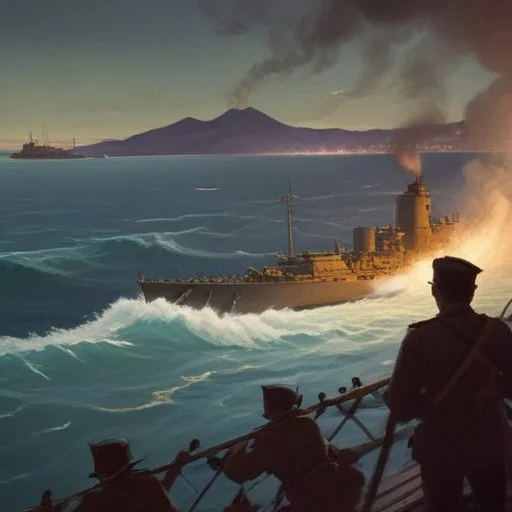
In the late 19th and early 20th centuries, Russia and Japan were engaged in a heated rivalry for influence in Manchuria and Korea. The construction of the Trans-Siberian Railway, which connected Moscow to Vladivostok, had heightened tensions between the two nations. Japan, seeking to expand its empire and secure vital resources, was determined to challenge Russia's dominance in the region.
Admiral Heihachiro Togo, a brilliant and innovative strategist, was the architect of the surprise attack on Port Arthur. Togo, who would later become a national hero in Japan, had studied naval tactics in England and was well-versed in the latest military technologies. His unorthodox approach to warfare, which emphasized speed, stealth, and surprise, would prove decisive in the battle ahead.
On the night of February 8, 1904, Togo's fleet of Japanese warships, led by the flagship Mikasa, emerged from the darkness, their torpedoes locked and loaded. The Russian naval squadron at Port Arthur, considered one of the most formidable in the world, was caught off guard, its ships anchored and unprepared for battle. The Japanese launched a barrage of torpedoes, sinking two Russian battleships and damaging several others.
The surprise attack on Port Arthur marked the beginning of a long and bloody siege. Japanese forces, supported by artillery and infantry, gradually tightened their grip on the city, eventually forcing the Russian garrison to surrender on January 2, 1905. The fall of Port Arthur was a crushing blow to Russian prestige, and it paved the way for Japan's ultimate victory in the war.
The Russo-Japanese War marked a significant turning point in world history. The war's outcome, in which a non-Western power had defeated a European great power, sent shockwaves throughout the international community. It inspired nationalist movements across Asia and Africa, and it marked the beginning of Japan's rise as a major world power.
The surprise attack on Port Arthur, which launched the Russo-Japanese War, is remembered in Japan as a symbol of national pride and sacrifice. The war's heroes, including Admiral Togo, are celebrated as national heroes, and their bravery and cunning are still studied by military strategists around the world.
Admiral Heihachiro Togo's early life and career laid the foundation for his bold strategy in the Russo-Japanese War. Born in 1848, Togo was raised in a samurai family and was trained in traditional martial arts from a young age. He was one of the first Japanese students to be sent to study abroad, where he honed his naval skills in England. Togo's experiences during the First Sino-Japanese War, including his role in the Battle of the Yellow Sea, further refined his tactical prowess.
Togo's leadership style was marked by his emphasis on discipline, training, and innovation. He was known for his ability to inspire loyalty in his crew and to make swift, decisive decisions in the heat of battle. These qualities, combined with his mastery of Western naval tactics and his understanding of Japanese cultural values, made him the ideal commander for the surprise attack on Port Arthur.

The surprise attack on Port Arthur was a paradigmatic example of asymmetric warfare, where a smaller, less powerful force successfully exploited the weaknesses of a larger, more powerful opponent. The Japanese Navy's use of torpedoes, mines, and other guerrilla tactics to attack the Russian fleet was a deliberate strategy to counterbalance the Russians' superior numbers and firepower.
In contrast, the Russian Navy's reliance on traditional naval tactics, such as broadside battles and line formations, made them vulnerable to the Japanese attack. The Russian ships were anchored and unprepared for battle, whereas the Japanese fleet was mobilized and highly maneuverable. This asymmetry in strategy and tactics ultimately contributed to the Japanese victory.
The Russo-Japanese War was not only a military conflict but also a clash of imperial ambitions in East Asia. The Russian Empire, seeking to expand its influence in the region, had established a sphere of influence in Manchuria and Korea, which threatened Japan's own territorial ambitions. Japan, in turn, saw the war as an opportunity to challenge Russian dominance and establish itself as a major power in the region.
The war was also influenced by the broader geopolitical context of the time, including the decline of the Qing dynasty in China and the rise of European colonialism. The Japanese government, led by Emperor Meiji, saw the war as a chance to assert its independence and modernity in the face of Western imperialism.

The Russo-Japanese War saw the introduction of several new technologies that would revolutionize modern warfare. The Japanese Navy's use of wireless telegraphy, for example, allowed for rapid communication between ships and enabled more effective coordination of naval strategy.
The war also witnessed the debut of new naval technologies, such as torpedoes, minefields, and dreadnoughts. The Russian Navy's reliance on Battleships, which were slow and cumbersome, was no match for the Japanese Navy's faster, more maneuverable ships.
The Russo-Japanese War had significant environmental impacts on the region, particularly in the areas surrounding Port Arthur. The war led to the destruction of natural habitats and ecosystems, as well as the pollution of waterways and soil.
The war also resulted in the displacement of local populations, who were forced to flee their homes and livelihoods due to the conflict. The environmental and social costs of the war would be felt for generations to come.