


On May 8, 1429, a pivotal moment in the Hundred Years War, the enigmatic Joan of Arc led a victorious charge to liberate the besieged city of Orléans, breaking the stranglehold of the English army and revitalizing French morale. This audacious feat marked a turning point in the protracted conflict, as the tide of the war began to shift in favor of the French.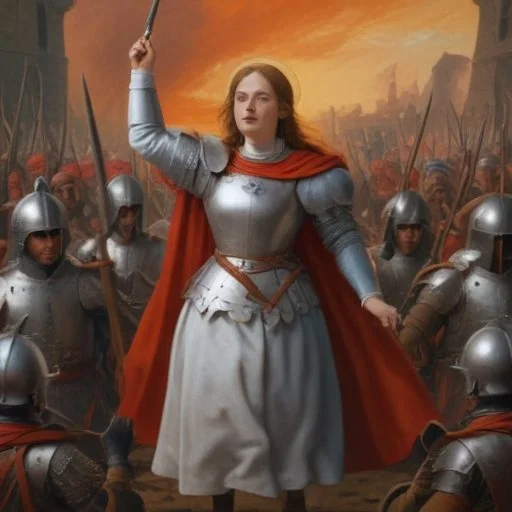
The city of Orléans, a strategic stronghold in north-central France, had been under siege by the English army since October 1428. The English, led by the Earl of Suffolk, had been making steady gains, and the city's defenses were on the brink of collapse. The French monarchy, mired in turmoil and internal strife, seemed powerless to intervene.
Enter Joan of Arc, a 17-year-old peasant girl from Domrémy, who claimed to have received divine visions from Saint Catherine, Saint Margaret, and the Archangel Michael. Convinced of her mission to free Orléans and crown the Dauphin Charles VII as the rightful king of France, Joan petitioned Robert de Baudricourt, the garrison commander of Vaucouleurs, for an escort to the royal court at Chinon.
Accompanied by a small group of soldiers, Joan traveled to the besieged city, arriving on April 29, 1429. Despite initial skepticism, Joan's unwavering conviction and charisma soon won over the hearts and minds of the French troops. Under her leadership, the army began to reorganize and prepare for battle.
The decisive battle took place on May 7-8, 1429. Joan, adorned in male attire and carrying a banner emblazoned with the French coat of arms, led the charge against the English forces. In a series of daring assaults, the French army, bolstered by Joan's unyielding faith, breached the English lines and took control of the city.
Joan of Arc's bravery and conviction have inspired generations, earning her the sobriquet "The Maid of Orléans." Her legend has been immortalized in art, literature, and film, cementing her place as a symbol of French resistance and patriotism.
The Siege of Orléans, a pivotal moment in the Hundred Years War, will forever be remembered as a testament to the power of faith, determination, and courage. Joan of Arc's unwavering commitment to her vision, despite overwhelming odds, continues to inspire and captivate audiences to this day, solidifying her place as one of history's most iconic figures.
The siege of Orléans was a brutal and grueling 143-day ordeal that pushed the city's defenders to the brink of collapse. The English army, led by the Earl of Suffolk, had laid siege to the city on October 12, 1428, and had been making steady gains ever since. The city's walls were breached in several places, and the defenders were running low on food, water, and morale.
Despite the dire situation, the French defenders held out, aided by the city's strong fortifications and the bravery of its citizens. But it was clear that the city could not hold out for much longer, and it was only a matter of time before the English army broke through the defenses and captured the city.
Robert de Baudricourt, the garrison commander of Vaucouleurs, was a reluctant ally in Joan of Arc's mission to free Orléans. Initially skeptical of Joan's claims of divine visions, de Baudricourt was eventually won over by her conviction and charisma.
A seasoned military leader, de Baudricourt provided Joan with a small group of soldiers to escort her to the royal court at Chinon, where she hoped to persuade the Dauphin Charles VII to let her lead a relief army to Orléans.
Despite his reservations about Joan's abilities, de Baudricourt remained loyal to her throughout her journey, providing crucial support and guidance when she needed it most.
Joan of Arc has been a source of inspiration for countless artists, writers, and filmmakers throughout the centuries. From Shakespeare's Henry VI, Part 1 to George Bernard Shaw's Saint Joan, Joan's story has been retold and reinterpreted in countless ways.
In art, Joan has been depicted by some of the greatest masters, including Jules Bastien-Lepage and Paul Dubois. Her iconic image has been used to symbolize French resistance and patriotism, and continues to be a powerful cultural symbol to this day.
The Hundred Years War was a complex and multifaceted conflict that involved several European powers, including England, France, Burgundy, and Scotland. At its heart, the war was a struggle for control of the French throne, with the English monarchy claiming the right to rule France.
The war was fought on multiple fronts, with battles taking place in northern France, the Low Countries, and even Scotland. The war was also marked by several key events, including the Black Death, which decimated the populations of both England and France.
The lifting of the siege of Orléans was a major turning point in the Hundred Years War, and had significant political implications for both the English and French monarchies.
The French monarchy, buoyed by Joan's victory, was able to regain the initiative and launch a series of counterattacks against the English. The English monarchy, on the other hand, was forced to regroup and reassess its strategy in the wake of the defeat.