


The echoes of gunfire and the cries of the innocent still linger in the streets of Amman, Jordan's capital, as the nation recalls the fateful days of September 1970. This month marks the infamous conflict that came to be known as Black September, a brutal and devastating war that pitted King Hussein's Jordanian army against the Palestine Liberation Organization (PLO), led by the enigmatic Yasser Arafat.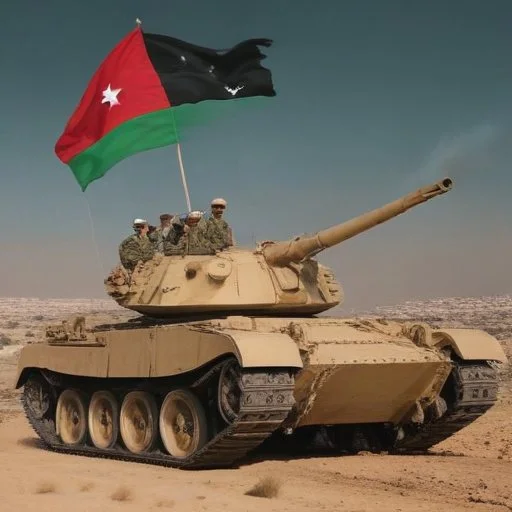
In the aftermath of the 1967 Arab-Israeli War, Jordan became a haven for Palestinian refugees and guerrilla fighters seeking to reclaim their homeland. The PLO, initially backed by the Jordanian government, began to establish itself as a potent force in the region. However, as the PLO's influence grew, so did King Hussein's concerns about the threat they posed to his rule.
On September 1, 1970, a group of PLO fighters hijacked three international airliners, forcing them to land in Jordan's Dawson's Field. This brazen act of terrorism sparked a chain reaction of events that ultimately led to King Hussein declaring war on the PLO.
King Hussein's tanks rolled into Amman on September 17, 1970, marking the beginning of a brutal conflict that would last for several weeks. The Jordanian army, backed by the United States and Israel, clashed with PLO fighters in a series of intense battles that left thousands dead and wounded.
The war resulted in the expulsion of the PLO from Jordan, forcing Arafat and his followers to seek refuge in Lebanon. The conflict also led to a significant shift in the regional balance of power, with Jordan emerging as a key player in the Middle East.
Black September had a profound impact on Jordanian society, leading to a renewed sense of national identity and a greater awareness of the country's role in the region. The conflict also spawned a generation of Palestinian artists, writers, and musicians who drew inspiration from the struggle for independence.
One Jordanian soldier, who wished to remain anonymous, recalled the horrors of the conflict: "I remember the sound of gunfire and the smell of smoke filling the air. It was as if the very fabric of our society was being torn apart."
The war remains a contentious issue, with many questioning King Hussein's decision to declare war on the PLO. Critics argue that the conflict was a brutal suppression of Palestinian nationalism, while supporters see it as a necessary step to maintain Jordan's stability.
Black September set the stage for future conflicts in the region, including the 1973 Yom Kippur War and the 1982 Lebanon War. The conflict also underscored the importance of diplomacy and dialogue in resolving the Arab-Israeli dispute.
In conclusion, Black September remains a pivotal moment in Jordan's history, a testament to the complexity and nuance of Middle Eastern politics. As the region continues to evolve, it is essential to remember the lessons of this turbulent chapter and strive for a more peaceful and stable future.
Yasser Arafat, the founder and leader of the Palestine Liberation Organization (PLO), was a complex figure who played a central role in the Black September conflict. Born in 1929 in Jerusalem, Arafat was a charismatic leader who dedicated his life to the Palestinian nationalist movement.
Arafat's early life was marked by turmoil and displacement, which would later shape his political beliefs and actions. He was forced to flee Palestine in 1948, during the Arab-Israeli War, and later studied civil engineering in Egypt.
Arafat's leadership of the PLO was marked by controversy and inconsistency. While he was revered by many Palestinians as a symbol of resistance against Israeli occupation, he was also criticized for his authoritarian style and willingness to engage in violent acts of terrorism.

The Black September conflict took place against the backdrop of a rapidly changing Middle East. The 1967 Arab-Israeli War had left the region in a state of flux, with the Israeli occupation of the West Bank and Gaza Strip creating a sense of urgency among Arab states.
Thecold war superpowers, the United States and the Soviet Union, were also vying for influence in the region, further complicating the dynamics of the conflict. The United States, in particular, was concerned about the growing influence of the PLO and its potential to destabilize Jordan.
The Black September conflict had a profound impact on Palestinian culture and identity. The conflict marked a turning point in the Palestinian national movement, as it highlighted the need for Palestinians to assert their own identity and narrative.
The conflict also spawned a generation of Palestinian artists, writers, and musicians who drew inspiration from the struggle for independence. The iconic Palestinian poet, Mahmoud Darwish, wrote extensively about the conflict and its impact on Palestinian identity.

King Hussein of Jordan faced a delicate political balancing act during the Black September conflict. On one hand, he needed to maintain good relations with the United States and Israel, while on the other hand, he had to address the growing influence of the PLO and its potential threat to his rule.
Hussein's decision to declare war on the PLO was a calculated move to assert his authority and maintain stability in Jordan. However, the conflict also underscored the limitations of Jordan's ability to manage the Palestinian nationalist movement.
Historians have interpreted the Black September conflict in various ways, reflecting shifting perspectives on the Arab-Israeli conflict and the role of the PLO. Some have viewed the conflict as a brutal suppression of Palestinian nationalism, while others have seen it as a necessary step to maintain regional stability.
More recent historiography has highlighted the agency of Palestinian actors and the complexity of the conflict, moving beyond simplistic narratives of good vs. evil.