


In the unforgiving landscape of Turkish politics, one name echoes through the valleys: Abdullah Öcalan, the enigmatic leader of the Kurdistan Workers' Party (PKK). On a fateful day in 1999, Öcalan stood before a Turkish court, accused of treason for his role in spearheading the Kurdish insurgency against the Turkish government.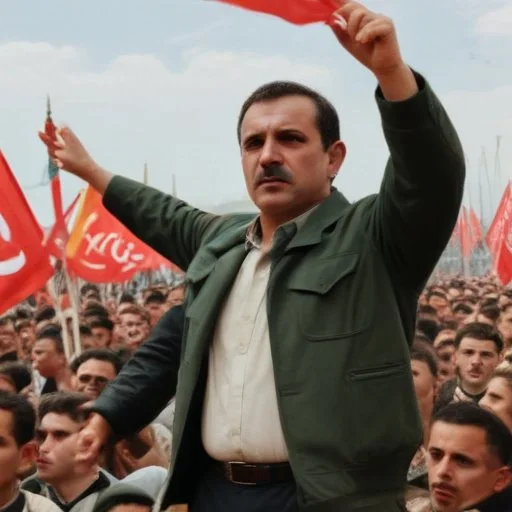
Öcalan's journey to notoriety began in the 1970s, when he founded the PKK with a handful of like-minded individuals. As theorganization's charismatic leader, he galvanized the Kurdish population, demanding greater autonomy and recognition from the Turkish state. Öcalan's message resonated deeply, and soon the PKK became a force to be reckoned with, waging a guerrilla war against the Turkish military.
In February 1999, Öcalan was apprehended by Turkish special forces in Nairobi, Kenya, following a dramatic cat-and-mouse game. The capture sent shockwaves through the region, and Öcalan's subsequent trial sparked widespread unrest among Kurdish communities in Turkey and abroad. The state's case against Öcalan hinged on his alleged role in orchestrating attacks on Turkish targets, which resulted in thousands of deaths.
The Öcalan affair laid bare the deep-seated tensions between the Turkish state and its Kurdish population. As the trial unfolded, Kurdish protesters clashed with security forces, leading to fatalities and widespread unrest. The international community watched with bated breath, as the Öcalan case threatened to destabilize the already fragile politics of the region.
Öcalan's trial and subsequent conviction marked a turning point in the Kurdish-Turkish conflict. While his imprisonment did not quell the insurgency, it led to a period of relative calm, as the PKK regrouped and reassessed its strategy. Today, Öcalan remains a polarizing figure, reviled by some as a terrorist and revered by others as a champion of Kurdish rights. His legacy continues to shape the politics of the region, serving as a beacon of resistance for Kurdish nationalists and a symbol of defiance in the face of state oppression.
“I have never taken part in any terrorist activity. I have always been opposed to terrorism.” – Abdullah Öcalan, during his trial in 1999
The Öcalan affair served as a catalyst for the Kurdish-Turkish conflict, highlighting the deep-seated tensions between the two groups. As the region continues to navigate the complexities of identity and nationhood, Öcalan's legacy remains a powerful symbol of resistance and defiance. His story serves as a poignant reminder of the human cost of conflict and the enduring power of the human spirit.
The historiography of the Öcalan affair is marked by a stark divide between Turkish and Kurdish narratives. While Turkish accounts often portray Öcalan as a terrorist mastermind, Kurdish narratives frame him as a champion of resistance against state oppression. This dichotomy reflects the deeper tensions between Turkish and Kurdish identities, with each side selectively presenting historical facts to bolster their claims.
Academic studies have attempted to move beyond this binary, foregrounding the complexities of the Kurdish-Turkish conflict. However, even these accounts are often inflected by nationalist or ideological biases, underscoring the need for a more nuanced and impartial approach to the historiography of this critical event.

Abdullah Öcalan's early life was marked by poverty and marginalization. Born in 1949 in the southeastern Turkish province of Diyarbakır, Öcalan grew up in a family of Kurdish farmers. His experiences of discrimination and exclusion would later inform his political ideology, as he became determined to challenge the Turkish state's treatment of Kurdish citizens.
Öcalan's charismatic leadership style and ability to galvanize Kurdish masses have been attributed to his humble beginnings, which allowed him to connect with ordinary Kurds and understand their struggles. Despite his later notoriety, Öcalan's early life remains somewhat shrouded in mystery, with conflicting accounts of his family background and education.
The Öcalan affair unfolded against the backdrop of a rapidly shifting geopolitical landscape. The end of the Cold War had created a power vacuum in the Middle East, as regional actors vied for influence in the post-Soviet era. Turkey, anxious to assert its dominance, had long been wary of Kurdish nationalism, fearing it could embolden separatist movements across the region.
The Öcalan trial became a flashpoint in this broader struggle for regional influence, with Turkey seeking to demonstrate its resolve against Kurdish separatism. The trial also sparked a flurry of diplomatic activity, as Western powers attempted to navigate the complexities of Turkish-Kurdish relations and mitigate the potential fallout.

The Öcalan affair bears striking parallels with other instances of nationalist insurgency and state repression. The Algerian war of independence, the Irish Republican Army's fight against British rule, and the Palestinian struggle against Israeli occupation all share echoes of the Kurdish-Turkish conflict.
Comparative analysis of these cases reveals common themes, including the use of guerrilla warfare, the role of charismatic leadership, and the fraught negotiations between rebel groups and state authorities. Such comparisons can illuminate the broader dynamics driving nationalist conflicts and inform strategies for reconciliation and conflict resolution.
The Öcalan trial's most poignant artifact is the defendant's infamous 1999 statement to the court. In a dramatic gesture, Öcalan declared, "I have never taken part in any terrorist activity. I have always been opposed to terrorism."
This bold assertion, made in the face of overwhelming evidence to the contrary, has been interpreted as a calculated attempt to reframe the narrative of the Kurdish-Turkish conflict. Öcalan's statement has become an emblem of the trial's high stakes and the defendant's unwavering commitment to his political ideals.