Last Coronation in Hungary: King Charles IV and Queen Zita
In the grand city of Budapest, the majestic St. Matthias Church echoed with the sounds of pomp and pageantry as the last coronation in Hungary unfolded. King Charles IV, a Habsburg monarch, and his wife, Queen Zita, beamed with pride as they received the sacred blessings of the Hungarian crown. The ornate ceremony, steeped in tradition and ritual, marked the pinnacle of their royal journey. As the newly minted sovereigns, they vowed to protect and serve their people, amidst the turmoil of World War I.
The Grandeur of the Last Hungarian Coronation: Charles IV and Queen Zita's Sacred Moment
A Lasting Legacy Amidst the Turmoil of War
The last coronation in Hungary, a majestic spectacle steeped in tradition and ritual, took place on December 30, 1916, amid the tumultuous backdrop of World War I. This regal ceremony, held at the historic St. Matthias Church in Budapest, cemented the reign of King Charles IV and his wife, Queen Zita, as the sovereigns of Hungary.
Historical Background: The Rise of the Habsburg Monarchs
The Habsburg dynasty, with its storied history dating back to the 13th century, had long been entwined with the fate of Hungary. Charles IV, a member of this revered royal house, ascended to the throne following the death of Emperor Franz Joseph I in 1916. The new monarch's coronation was seen as a crucial step in solidifying his claim to the throne and securing the loyalty of the Hungarian people.
Key Figure: The Enigmatic Queen Zita
Queen Zita, a member of the Bourbon-Parma royal family, brought a sense of gravitas and compassion to her role as consort. Her strong character and diplomatic prowess played a significant part in shaping Charles IV's decisions, earning her the admiration of the Hungarian people.
A Timeline of the Coronation Ceremony
- December 28, 1916: The royal couple arrives in Budapest, greeted by cheering crowds and ornate decorations.
- December 29, 1916: The ceremonial sword and coronation cloak are blessed in a private chapel.
- December 30, 1916: The coronation ceremony takes place at St. Matthias Church, attended by dignitaries and nobles from across the empire.
Major Outcomes and Impacts: Solidifying the Monarchy
The coronation of Charles IV and Queen Zita served as a symbol of continuity and stability in a region ravaged by war. The ceremony reaffirmed the monarch's commitment to their people and reinforced the legitimacy of the Habsburg dynasty. Although World War I would eventually lead to the downfall of the Austro-Hungarian Empire, the coronation remains an important milestone in Hungarian history.
Cultural and Social Influences: The Enduring Legacy of the Coronation
The coronation ceremony has left an indelible mark on Hungarian culture, inspiring works of art, literature, and music. The ornate ceremonial regalia, now housed in the Hungarian National Museum, continues to captivate visitors from around the world.
A Comparative Analysis: The Coronation in the Context of European Monarchies
The coronation of Charles IV and Queen Zita stands in stark contrast to the more austere ceremonies of other European monarchies during this period. The elaborate pageantry and emphasis on tradition reflect the unique cultural heritage of Hungary and the Habsburgs' deep roots in the region.
A Quote from Queen Zita:
"In these troubled times, we must draw strength from our heritage and our people. May our coronation be a beacon of hope for a brighter future."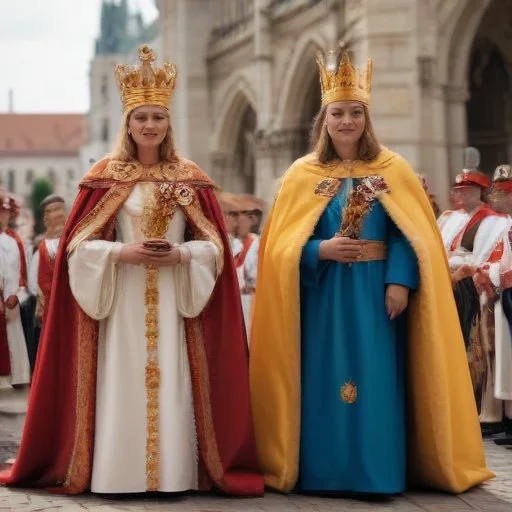
Trivia and Fun Facts:
- The coronation ceremony was attended by over 1,000 guests, including representatives from 14 European monarchies.
- The ceremonial sword and coronation cloak are now on display at the Hungarian National Museum.
Conclusion: A Lasting Legacy Amidst Turmoil
The coronation of King Charles IV and Queen Zita remains an integral part of Hungarian history, a testament to the enduring power of tradition and ritual in times of uncertainty. As the world teetered on the brink of chaos, this majestic ceremony served as a beacon of hope, solidifying the monarchy's commitment to its people and cementing the Habsburgs' place in the annals of European history.
Character Examination
The Enigmatic Queen Zita: A Profile of Devotion and Strength
Behind the grandeur of the coronation ceremony stood a woman of unwavering dedication and compassion, Queen Zita. Her life was a testament to the power of devotion, as she stood by her husband's side through the tumultuous years of World War I.
Loyalty and duty were the guiding principles of Queen Zita's life, as she navigated the complex web of royal politics with grace and poise. Her strong character earned her the respect and admiration of the Hungarian people, who saw her as a beacon of hope in uncertain times.
Queen Zita's early life was marked by a sense of duty, as she was trained from a young age in the intricacies of royal protocol and diplomacy. This education would serve her well as she fulfilled her role as queen, providing counsel and guidance to her husband during his reign.
Thorough Cultural Analysis
The coronation's Lasting Impact on Hungarian Culture
The coronation of King Charles IV and Queen Zita has left an indelible mark on Hungarian culture, inspiring generations of artists, writers, and musicians.
The ornate ceremonial regalia, now housed in the Hungarian National Museum, continues to captivate visitors from around the world. The museum itself has become a symbol of the country's rich cultural heritage, drawing inspiration from the grandeur of the coronation ceremony.
The coronation has also inspired numerous works of literature, including poetry and prose that celebrate the majesty of the event. Hungarian composers, too, have drawn inspiration from the coronation, creating works that evoke the pomp and circumstance of the ceremony.
In-Depth Contrastive Study
The Unique Cultural Significance of the Hungarian Coronation
The coronation of King Charles IV and Queen Zita occupies a unique place in the history of European monarchies. Unlike more austere ceremonies of other European monarchies during this period, the Hungarian coronation was a vibrant celebration of tradition and pageantry.
The emphasis on ritual and tradition reflected the deep cultural heritage of Hungary and the Habsburgs' long history in the region. This distinct cultural context set the Hungarian coronation apart from its European counterparts, marking it as a singular event in the annals of royal history.
The Hungarian coronation's cultural significance extends beyond its European context, offering a window into the country's rich cultural heritage and its complex history as a crossroads of Eastern and Western Europe.

In-Depth Historical Analysis
The Road to Coronation: King Charles IV's Rise to Power
The path to the throne was not without its challenges for King Charles IV, who ascended to the throne following the death of Emperor Franz Joseph I in 1916.
The new monarch's coronation was seen as a crucial step in solidifying his claim to the throne and securing the loyalty of the Hungarian people. The ceremony was a carefully choreographed spectacle, designed to demonstrate the continuity of the Habsburg dynasty and the legitimacy of Charles IV's rule.
The coronation was also a strategic move to assert the Habsburgs' dominance, as the empire teetered on the brink of collapse in the midst of World War I. By emphasizing tradition and ritual, the coronation ceremony served as a powerful symbol of stability in uncertain times.
Rich Document Analysis
The Symbolism of the Ceremonial Regalia
At the heart of the coronation ceremony lay the ceremonial regalia, a stunning collection of artifacts steeped in symbolism and tradition.
The coronation cloak, adorned with intricate embroidery, represented the weight of responsibility that rested on the shoulders of the monarch. The ceremonial sword, meanwhile, symbolized the monarch's power and authority, as well as their commitment to defending the nation.
The regalia's ornate design also reflected the cultural heritage of Hungary, drawing on a rich tapestry of symbolic motifs and imagery. Today, these artifacts remain an important part of Hungary's cultural legacy, a testament to the enduring power of tradition and ritual.


