


On March 12, 1930, Mahatma Gandhi embarked on a historic journey that would shake the foundations of British rule in India. Along with 78 devoted followers, he set out on a 200-mile trek to the sea, boldly challenging the British Empire's notorious salt monopoly, imposed on India since 1882.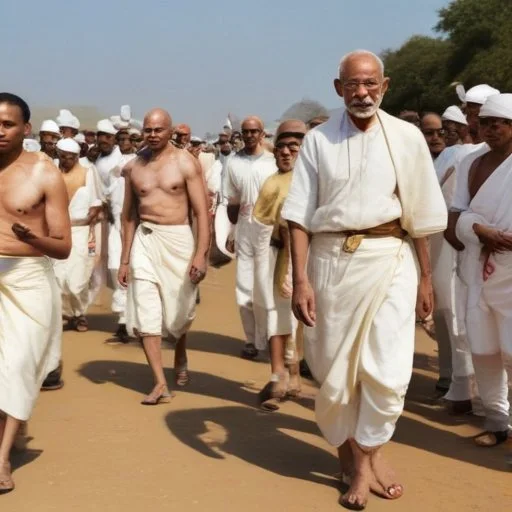
The salt tax, a symbol of British oppression, had been a thorn in the side of Indian nationalists for decades. By producing salt freely, Gandhi aimed to strike at the heart of British tyranny, inspiring a nation to rise up against colonial rule.
As the morning sun rose over the village of Sabarmati, Gandhi and his fellow marchers, including celebrated Indian poet and philosopher, Rajaji, set off on their epic journey. The air was thick with anticipation, as the sound of chanting and prayer filled the air.
With each step, Gandhi's message of nonviolent resistance echoed across the nation. The Salt March was more than just a protest against the salt tax; it was a powerful symbol of Indian defiance against British rule.
The Salt March marked a turning point in India's struggle for independence, galvanizing the Quit India movement and inspiring nonviolent resistance against colonial rule. The British government, faced with growing international pressure, was forced to negotiate with Gandhi and Indian nationalists, ultimately leading to the Gandhi-Irwin Pact in 1931.
"I want world sympathy in this struggle...I know that the British Government will not be able to withhold freedom from us when it has the applause of the world." – Mahatma Gandhi
Gandhi's courage and determination inspired countless Indians to join the struggle for independence. The Salt March demonstrated the power of nonviolent resistance, paving the way for future freedom movements around the world.
The Salt March remains an enduring symbol of Indian resilience and determination, a testament to the power of courage and conviction in the face of oppression.
Rajaji, also known as Chakravarti Rajagopalachari, was a renowned Indian poet, philosopher, and statesman. Born in 1878, he was an early follower of Mahatma Gandhi and played a significant role in the Indian independence movement.
Rajaji's wisdom and literary talents earned him great respect among his contemporaries. He was a vocal advocate for nonviolent resistance and was instrumental in shaping Gandhi's philosophy of non-cooperation.
During the Salt March, Rajaji marched alongside Gandhi, using his eloquence to rally supporters and inspire others to join the cause.

The British salt tax had far-reaching environmental consequences in India. The artificial scarcity of salt led to the destruction of natural salt pans and the depletion of natural salt deposits.
Furthermore, the illegal salt trade that arose as a result of the tax encouraged unsustainable and environmentally harmful practices, such as over-extraction of salt from natural sources.
The Salt March not only challenged British rule but also highlighted the need for sustainable and environmentally conscious practices in India's extractive industries.
The Salt March took place against the backdrop of a global economic crisis, the Great Depression. As the world struggled to recover from the devastating economic downturn, the Indian independence movement capitalized on the opportunity to draw attention to their struggle.
The march also coincided with the rise of nationalist movements across the world, as people from various nations began to challenge colonial and imperial powers.
In this context, the Salt March became a beacon of hope and inspiration for freedom movements everywhere.

Mahatma Gandhi's philosophy of nonviolent resistance, exemplified by the Salt March, was rooted in his belief in the power of love and non-cooperation.
Gandhi's approach challenged traditional notions of resistance and revolution, offering a new paradigm for social change that emphasized moral authority over physical force.
The Salt March demonstrated the effectiveness of nonviolent resistance, paving the way for its adoption by civil rights movements around the world.
The Salt March was a testament to the power of social mobilization and collective action. The march brought together people from diverse backgrounds, including farmers, workers, and intellectuals, united in their quest for independence.
The march also highlighted the critical role of women in the Indian independence movement, as many women participated in the march, defying traditional gender norms.
The Salt March demonstrated that social change is often driven by the collective efforts of ordinary people, rather than the actions of a few charismatic leaders.