


On the evening of April 3, 1968, Martin Luther King Jr. stood before a crowd of striking sanitation workers in Memphis, Tennessee, and delivered a speech that would become one of the most iconic and poignant in American history. The "I've Been to the Mountaintop" speech was a call to action, a declaration of hope, and a prediction of his own demise - all in one powerful and emotional address.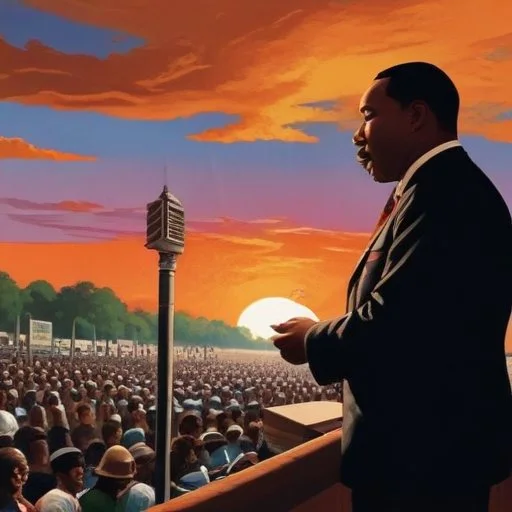
In the months leading up to the speech, Memphis had been embroiled in a bitter sanitation workers' strike, sparked by the deaths of two African American garbage collectors who were crushed to death by a malfunctioning truck. The strike was a symbol of the deeper issues of racial injustice and economic inequality that plagued the city. King, who had been increasingly focused on issues of poverty and economic empowerment, was drawn to the struggle in Memphis, seeing it as a crucial moment in the ongoing fight for civil rights.
Kings' speech was a masterclass in oratory, weaving together themes of justice, equality, and sacrifice. He spoke of the struggles of the past, the progress that had been made, and the work that still needed to be done. But he also spoke of his own mortality, saying, "I may not get there with you. But I want you to know tonight, that we, as a people, will get to the Promised Land."
These words, spoken with conviction and passion, would prove to be hauntingly prophetic. Less than 24 hours later, King would be assassinated on the balcony of the Lorraine Motel, sending shockwaves across the nation and plunging the country into chaos.
The news of King's assassination sparked widespread outrage and devastation. Riots erupted in cities across the country, as people took to the streets to express their grief and anger. But amidst the chaos, a sense of resolve began to take hold. The civil rights movement, which had lost its leader and guiding light, began to regroup and reorganize, determined to carry on King's legacy and continue the fight for justice and equality.
The "I've Been to the Mountaintop" speech has become an enduring symbol of King's message of hope and resilience. It has inspired countless people around the world to engage in the struggle for justice and human rights, and continues to be studied and referenced by scholars, activists, and leaders today.
In the words of King himself, "Human progress is neither automatic nor inevitable... Every step toward the goal of justice requires sacrifice, suffering, and struggle; the tireless exertions and passionate concern of dedicated individuals."
According to those who were present, King's speech was delivered with a sense of urgency and passion, as if he knew that time was running out. His friend and fellow activist, Ralph Abernathy, later recalled that King was "dead-tired" that evening, but still managed to deliver a speech that would be remembered for generations to come.
The "I've Been to the Mountaintop" speech, and King's subsequent assassination, had a profound impact on the course of American history. The event galvanized the civil rights movement, leading to increased activism and protest, and ultimately, the passage of the Fair Housing Act in 1968. It also led to a renewed focus on issues of poverty and economic inequality, which would become a central theme of the movement in the years to come.
Ralph Abernathy, a close friend and fellow activist of Martin Luther King Jr., played a crucial role in the Civil Rights Movement. As the president of the Southern Christian Leadership Conference (SCLC), Abernathy worked closely with King to organize protests, marches, and boycotts across the South.
Abernathy was deeply moved by King's "I've Been to the Mountaintop" speech, and later recalled the sense of urgency and passion with which it was delivered. Despite King's assassination the following day, Abernathy continued to fight for civil rights, taking over as the leader of the SCLC and leading the Poor People's March on Washington in 1968.

Martin Luther King Jr.'s "I've Been to the Mountaintop" speech has had a profound impact on American culture. The speech's themes of hope, resilience, and sacrifice have inspired countless artists, writers, and musicians.
The speech has been referenced in numerous songs, including "The Mountaintop" by Kirk Franklin and "I've Been to the Mountaintop" by The Soul Children. It has also been referenced in literature, film, and art, cementing its place in the cultural lexicon.
The "I've Been to the Mountaintop" speech was delivered at a critical moment in American politics. The civil rights movement was gaining momentum, and King's speech was seen as a call to action for politicians and policymakers.
The speech was a direct challenge to the Johnson administration's policies on civil rights, and King's assassination just hours later sparked widespread outrage and protests.

The sanitation workers' strike in Memphis had significant economic implications for the city. The strike, which lasted for 64 days, resulted in a loss of over $1 million in revenue for the city.
The strike also had a ripple effect on the local economy, with businesses losing revenue due to the lack of sanitation services. However, the strike ultimately led to improved working conditions and higher wages for African American sanitation workers.
The "I've Been to the Mountaintop" speech was delivered at a time of great global upheaval. The Vietnam War was raging, and anti-war protests were sweeping across the United States.
The speech was also delivered in the midst of a global wave of social and political change, with movements for civil rights, women's rights, and anti-colonialism gaining momentum around the world.