


In the sweltering summer of 1209, the tranquility of Béziers, a thriving city in southern France, was shattered by the brutal massacre of nearly 20,000 innocent souls, marking the inception of the Albigensian Crusade. This brutal episode in history is remembered for its unrelenting ferocity, as the Catholic Crusaders, fueled by zealous fervor, indiscriminately slaughtered both Catholics and Cathars, leaving a trail of devastation in their wake.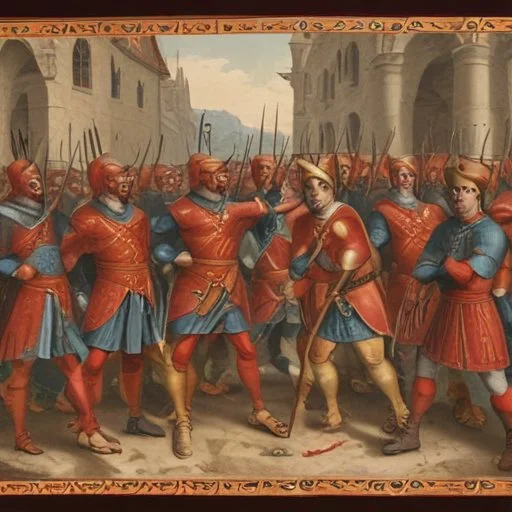
The roots of the Albigensian Crusade lay in the growing influence of Catharism, a heretical movement that rejected the authority of the Catholic Church. The Cathars, whose name derived from the Greek word "katharos," meaning "pure," attracted a significant following in the Languedoc region of southern France. As the Catholic Church perceived the Cathars as a threat to its dominance, Pope Innocent III declared a crusade against them in 1208.
Simon de Montfort, a skilled military commander from the Île-de-France region, emerged as the leader of the Crusade. De Montfort's fervor for the Catholic cause earned him the trust of the Pope, and he was appointed as the commander of the Crusader army. His unwavering dedication to the Church's cause would soon prove disastrous for the people of Béziers.
The devastating consequences of the massacre at Béziers heralded a brutal 20-year crusade against the Cathars. The city itself was left in ruins, and the horrific event set a precedent for the unchecked violence that would characterize the Albigensian Crusade. The Crusaders' actions sparked a wave of fear and resentment among the people of Languedoc, galvanizing resistance against the Catholic Church's authority.
The massacre at Béziers widened the chasm between the Catholic Church and the people of Languedoc, fostering an atmosphere of mistrust and hostility. The event would have far-reaching repercussions, as the Albigensian Crusade would go on to become one of the most brutal and devastating conflicts in medieval European history.
The survivors of the massacre would recount the traumatic events in hushed tones, their words painting a harrowing picture of death and destruction. One eyewitness account tells of a group of women and children seeking refuge in a church, only to be slaughtered alongside the priests who had promised them safety.
The massacre at Béziers set a dire precedent for the Albigensian Crusade, foreshadowing the atrocities that would follow. The relentless persecution of the Cathars would drive them underground, fueling a resentment that would simmer for centuries. The brutal episode would also leave an indelible mark on the collective memory of the people of Languedoc, shaping their identity and informing their relationships with the Catholic Church.
The Massacre at Béziers stands as a stark reminder of the devastating consequences of unchecked zealotry and the horrors that can unfold when religious fervor is allowed to supersede humanity. As we reflect on this dark chapter in history, we are reminded of the importance of compassion, tolerance, and understanding in the face of perceived differences.
The historiography of the Massacre at Béziers is marked by a distinct shift in perspective over the centuries. While early accounts, such as those by Catholic chroniclers, portrayed the event as a necessary evil in the fight against heresy, later historians have been more critical of the Crusaders' actions. In the 19th century, liberal historians began to view the massacre as a brutal example of religious intolerance, while modern scholars have sought to contextualize the event within the broader framework of medieval politics and society.
One of the most influential historians to write about the Albigensian Crusade was Joseph Strayer, who argued that the massacre was a turning point in the development of the medieval state. Strayer's work has been built upon by later historians, who have continued to refine our understanding of the event and its consequences.

Simon de Montfort, the leader of the Crusader army, was a complex figure driven by a mix of religious fervor and personal ambition. Born in the Île-de-France region, de Montfort was a skilled military commander who had gained experience fighting in the Holy Land.
Despite his reputation for ruthlessness, de Montfort was also a shrewd politician who knew how to navigate the intricacies of medieval court politics. His ability to secure the trust of Pope Innocent III was crucial in his appointment as the leader of the Crusade.
De Montfort's actions during the massacre at Béziers have been the subject of much debate among historians. While some have portrayed him as a bloodthirsty zealot, others have argued that he was a product of his time, driven by a genuine desire to root out heresy.
The Massacre at Béziers bears striking similarities to other medieval massacres, such as the sack of Jerusalem during the First Crusade. In both cases, religious fervor and a sense of righteous duty led Crusaders to commit atrocities against civilian populations.
However, the massacre at Béziers also had distinct characteristics that set it apart from other medieval massacres. The Crusaders' targeting of both Catholics and Cathars, for example, marked a turning point in the Albigensian Crusade, as it demonstrated a willingness to disregard traditional notions of chivalry and moral conduct.

The massacre at Béziers had a profound impact on the cultural identity of the Languedoc region. The event marked the beginning of a long period of repression and violence against the Cathars, who were forced to go underground in order to survive.
The trauma of the massacre was passed down through generations, influencing the development of Occitan culture and folklore. The event also shaped the regional identity of the Languedoc, fostering a sense of mistrust and resentment towards the Catholic Church.
The massacre at Béziers took place against the backdrop of a rapidly changing geopolitical landscape. The Albigensian Crusade was, in part, a response to the growing influence of the Kingdom of Aragon in southern France.
The Crusade also had significant implications for the balance of power in medieval Europe. The involvement of the Catholic Church and the French monarchy in the Crusade marked a significant shift in the dynamics of medieval politics, as traditional alliances and rivalries were reconfigured in response to the threat of heresy.