


The year was 1453, and the fate of the Byzantine Empire hung in the balance as Mehmed II, the ambitious Sultan of the Ottoman Empire, set his sights on the prized city of Constantinople. The city, touted as the Queen of Cities, fell on May 29 after a grueling 53-day siege, marking a pivotal moment in world history.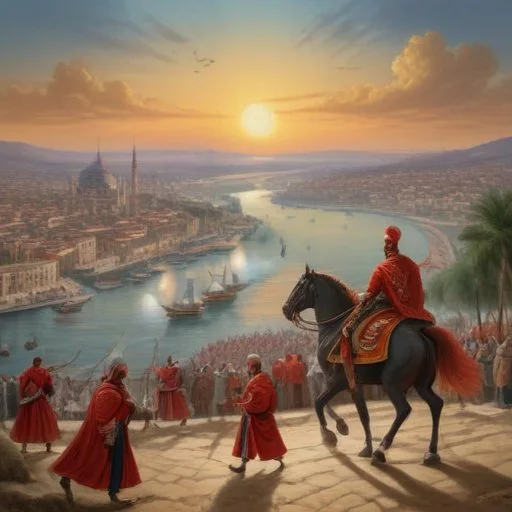
The Byzantine Empire, once a powerful and influential force in the Mediterranean, had been in decline for centuries. Weakened by internal strife, external threats, and economic decline, the empire was ripe for the taking. Mehmed II, determined to expand his empire and secure a strategic foothold in Europe, saw Constantinople as the key to unlocking his ambitions.
Mehmed II's army, comprised of over 100,000 soldiers, laid siege to the city on April 6, 1453. The city's defenses, although formidable, were no match for the Ottoman Empire's military prowess. The Byzantine Emperor, Constantine XI, rallied his troops, but they were vastly outnumbered and outgunned.
On May 29, 1453, the city walls were finally breached, and the Ottoman Empire poured inside, claiming the city as their own. The Byzantine Empire, once a powerful and proud civilization, had fallen to the rising tide of the Ottoman Empire.
In the aftermath of the siege, Mehmed II ordered the city to be renamed Istanbul, a name that would stick for centuries to come. The city, once a symbol of Byzantine power, was now a testament to the Ottoman Empire's military prowess and strategic genius.
The fall of Constantinople sent shockwaves throughout Europe, marking the end of the Byzantine Empire and the beginning of a new era in world history. The city's capture secured the Ottoman Empire's position as a dominant force in the region, paving the way for centuries of imperial grandeur.
The siege of Constantinople and its subsequent fall had far-reaching consequences, shaping the course of world history in profound ways.
In conclusion, the siege of Constantinople and its subsequent fall to the Ottoman Empire was a pivotal moment in world history, marking the end of an era and the beginning of a new chapter in the story of human civilization.
The fall of Constantinople had a profound impact on the cultural landscape of Europe and the Middle East. The city, once a bastion of Byzantine culture, was now a hub of Ottoman culture, marking a shift in the balance of power between East and West.
The Ottoman Empire's conquest of Constantinople led to the transfer of Greek scholars to Italy, where they played a significant role in sparking the Renaissance. This, in turn, had a profound impact on Western art, literature, and philosophy.
The cultural exchange that followed the fall of Constantinople also led to the introduction of Eastern influences into Western art and architecture, resulting in the development of new styles and techniques.

Mehmed II, the Sultan of the Ottoman Empire, was a shrewd and ambitious leader who saw the conquest of Constantinople as a key to expanding his empire. He was known for his military prowess and his ability to unite the disparate tribes of Anatolia.
Despite his reputation as a ruthless conqueror, Mehmed II was also a patron of the arts and a supporter of learning. He was fascinated by the ancient Greek classics and saw himself as a successor to the Roman Empire.
Constantine XI, the last Byzantine Emperor, was a valiant but ultimately doomed leader who rallied his troops against the Ottoman Empire's siege. Despite his bravery, he was unable to stem the tide of the Ottoman Empire's relentless assault.
The fall of Constantinople marked a significant shift in the geopolitics of the Mediterranean region. The Ottoman Empire's conquest of the city gave it control over the Bosphorus Strait, a crucial waterway that connected Europe and Asia.
The city's strategic location made it a prized possession for any power seeking to dominate the region. The Ottoman Empire's control of Constantinople gave it a significant advantage over its rivals, allowing it to expand its empire and influence throughout the Mediterranean.
The fall of Constantinople also marked the beginning of a new era of conflict between the Ottoman Empire and Europe, as the two powers vied for control of the region.

Historians have long debated the significance of the fall of Constantinople, with some seeing it as a pivotal moment in the decline of the Byzantine Empire and the rise of the Ottoman Empire.
Others have argued that the fall of Constantinople was a symbolic event, marking the end of the medieval period and the beginning of the early modern era.
Regardless of interpretation, the fall of Constantinople remains a significant event in world history, one that continues to captivate historians and scholars to this day.
The Ottoman Empire's cannons, including the massive "Düldentasha" cannon, played a crucial role in the siege of Constantinople. The cannons were able to breach the city's walls, allowing the Ottoman Empire's troops to pour inside.
The fall of Constantinople also led to the discovery of ancient Greek texts, which were preserved in the city's libraries and archives. These texts would go on to play a significant role in the development of Western philosophy and science.
The city's defenses, including its famous Theodosian Walls, are now a testament to the engineering prowess of the Byzantine Empire. Despite being breached, the walls remain an impressive architectural achievement.