


The Mexican-American War was a conflict born of the United States' desire for expansion. With the annexation of Texas in 1845, the US had set its sights on the vast territories to the west, and Mexico was unwilling to give up its land without a fight.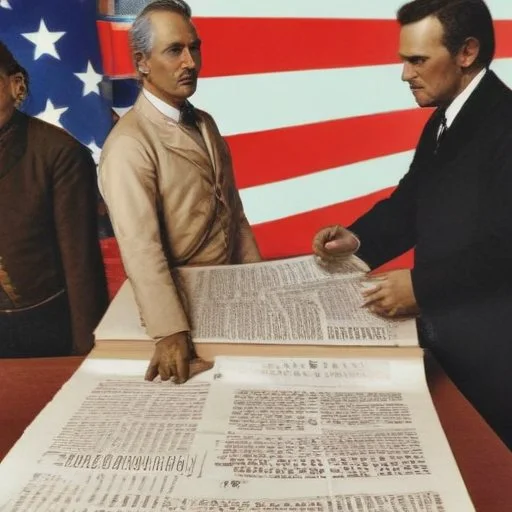
Among the key figures involved in the treaty was Nicholas Trist, the American diplomat and chief negotiator. Trist, who had been sent to Mexico to negotiate a peaceful resolution to the conflict, played a crucial role in brokering the treaty.
The Treaty of Guadalupe Hidalgo was a comprehensive agreement that brought an end to the war and established new boundaries between the two nations. Under the terms of the treaty, Mexico ceded a vast amount of land to the United States, including present-day California, Nevada, Utah, Arizona, New Mexico, Texas, and parts of Colorado, Kansas, Oklahoma, and Wyoming.
In exchange for this land, the United States agreed to pay Mexico $15 million and assume $3.25 million in Mexican debts to American citizens.
The Treaty of Guadalupe Hidalgo marked a significant turning point in the history of the United States. The acquisition of new territories not only expanded the country's borders but also paved the way for the nation's westward expansion.
The Treaty of Guadalupe Hidalgo has been the subject of controversy and debate for generations. Many Mexicans saw the treaty as a betrayal, feeling that their government had been forced to cede too much land to the United States.
In the years following the treaty, many Americans questioned the morality of taking land from Mexico, with some viewing it as an act of aggression.
The Treaty of Guadalupe Hidalgo may have been signed over 170 years ago, but its impact is still felt today. The treaty paved the way for the United States' expansion into the west, shaping the course of the nation's history.
As we look back on this pivotal moment in American history, we are reminded of the complex and often controversial nature of human conflict. The Treaty of Guadalupe Hidalgo serves as a reminder of the importance of diplomacy and the enduring legacy of the decisions we make.
Historians have long debated the significance and implications of the Treaty of Guadalupe Hidalgo. Some have argued that the treaty marked a significant milestone in the westward expansion of the United States, while others have criticized it as an act of imperialism and aggression against Mexico.
Some historians, such as Frederick Merk, have argued that the treaty was a necessary step in the growth and development of the United States, while others, such as Ramón Eduardo Ruiz, have seen it as a betrayal of Mexican sovereignty.
Recent historiographical trends have sought to reexamine the treaty in the context of modern debates around imperialism, colonialism, and globalization.

Nicholas Trist, the chief negotiator of the Treaty of Guadalupe Hidalgo, played a crucial role in shaping the terms of the agreement.
A seasoned diplomat with extensive experience in Latin American affairs, Trist was well-versed in the complexities of Mexican politics and culture.
Despite his instrumental role in securing the treaty, Trist's legacy has been somewhat overshadowed by more prominent figures of the era.
Trist's diplomatic acumen and cultural sensitivity helped to facilitate a peaceful resolution to the conflict, paving the way for a new era of US-Mexico relations.
The Treaty of Guadalupe Hidalgo had far-reaching economic implications for both the United States and Mexico.
The acquisition of new territories and resources provided a significant boost to the US economy, while Mexico was forced to confront the loss of valuable lands and revenue.
The treaty also led to a significant shift in the balance of trade between the two nations, with the US emerging as a dominant economic power in the region.
In the years following the treaty, the US saw a surge in economic growth, driven in part by the exploitation of new natural resources and the expansion of trade networks.

The Treaty of Guadalupe Hidalgo was shaped by a complex set of geopolitical factors, including the rise of the United States as a global power and the decline of the Spanish Empire in the Americas.
The US had long been expansionist in its outlook, seeking to extend its territory and influence across North America.
Mexico, meanwhile, was struggling to maintain its independence and sovereignty in the face of internal instability and external pressures.
The treaty was a key moment in the ongoing struggle for power and influence in the Americas, marking a significant shift in the balance of power between the US and Mexico.
The Treaty of Guadalupe Hidalgo had a profound impact on the cultural landscape of the Americas, shaping the course of cultural exchange and interaction between the US and Mexico.
The treaty marked a significant moment in the transfer of cultural knowledge and practices between the two nations, as US and Mexican cultural forms began to intersect and interact in new and complex ways.
The treaty also led to the displacement and marginalization of indigenous communities, who were forced to navigate the complexities of US and Mexican cultural norms.
In the years following the treaty, the US saw a surge in cultural exchange and influence, as American cultural forms began to dominate the cultural landscape of the Americas.