


Zheng He's maiden voyage marks a pivotal moment in world history, as the Chinese admiral sets sail to explore the vast expanse of the Indian Ocean and beyond. This groundbreaking journey, which began in 1405, would establish China as a dominant maritime power and pave the way for centuries of cultural exchange and discovery.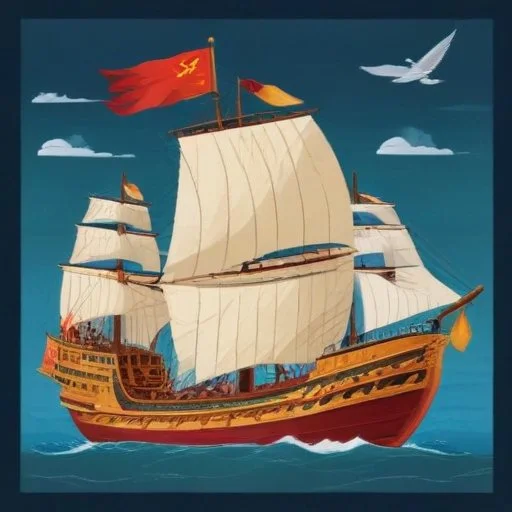
The early 15th century was a time of great change and upheaval in China. The Ming dynasty, which had risen to power in 1368, was seeking to expand its borders and establish itself as a major world power. The emperor, Zhu Di, was keenly aware of the importance of maritime trade and exploration, and saw an opportunity to extend China's influence beyond its borders.
Zheng He's fleet was a marvel of its time, consisting of 317 vessels, including massive "treasure ships" that dwarfed any others in existence. The crew of 27,800 sailors, soldiers, and scholars was equally impressive, featuring a diverse range of ethnicities and skills. The fleet set sail from the bustling port of Nanjing, China's capital city, on July 11, 1405.
Zheng He, a trusted advisor to Emperor Zhu Di, was a seasoned mariner and explorer with a wealth of experience in the Indian Ocean. Born into a Muslim family in Yunnan Province, Zheng He had traveled extensively throughout Southeast Asia and India, and was well-versed in the languages and customs of the region. His expertise would prove invaluable on the upcoming voyage.
Zheng He's maiden voyage marked the beginning of a new era of maritime discovery and cultural exchange between China and the nations of the Indian Ocean. The voyage established trade routes, facilitated the exchange of ideas and cultures, and paved the way for future exploratory missions.
The voyage had a profound impact on Chinese culture, as the influx of exotic goods and ideas stimulated artistic and intellectual innovation. The exchange of cultures also led to the adoption of new technologies, including the introduction of the astrolabe, which would revolutionize navigation and exploration.
Zheng He's voyage is often compared to those of European explorers, such as Vasco da Gama and Christopher Columbus. While these explorers also achieved remarkable feats of navigation and discovery, Zheng He's voyage stands out for its scale, scope, and cultural significance.
| Year | |
|---|---|
| 1405 | Zheng He's fleet sets sail from Nanjing, China |
| 1406 | The fleet visits Southeast Asia, including present-day Indonesia, Malaysia, and Thailand |
| 1407 | Zheng He's fleet explores the Indian Ocean, visiting Sri Lanka, India, and the Middle East |
| 1410 | The fleet returns to China, bearing exotic goods and tales of adventure |
Zheng He's maiden voyage serves as a powerful reminder of the importance of exploration, cultural exchange, and the pursuit of knowledge. This extraordinary journey has inspired generations of explorers, scholars, and leaders, and continues to captivate audiences around the world.
Zheng He's fleet made a significant stop in Malacca, a strategic port city in present-day Malaysia, during its maiden voyage. This stopover was crucial in establishing trade relations between China and the kingdoms of Southeast Asia. The fleet's presence in Malacca also facilitated the exchange of goods, including spices, textiles, and porcelain.
Malacca's location at the confluence of the Indian and Pacific Oceans made it an essential hub for maritime trade. Zheng He's fleet took advantage of this strategic location, using Malacca as a base to explore the surrounding regions and establish trade agreements with local kingdoms.
The visit to Malacca marked a significant milestone in Zheng He's voyage, as it demonstrated the Chinese admiral's ability to navigate complex diplomatic relationships and establish mutually beneficial trade agreements.
Zheng He was born into a Muslim family in Yunnan Province, China, in 1371. His birth name was Ma He, and he was raised in a multicultural environment that would later influence his worldview.
Little is known about Zheng He's early life, but it is believed that he was castrated at a young age, a common practice for boys who served in the imperial court. This experience likely shaped his perspective on life and influenced his future decisions as a navigator and explorer.
Zheng He's unique cultural background and experiences would later contribute to his success as a diplomat and navigator, allowing him to navigate complex cultural and political landscapes.Zheng He's maiden voyage is often compared to the expeditions of European explorers, such as Vasco da Gama and Christopher Columbus. While these explorers also achieved remarkable feats of navigation and discovery, Zheng He's voyage stands out for its scale, scope, and cultural significance.
Unlike European explorers, who often relied on violence and coercion to achieve their goals, Zheng He's fleet relied on diplomacy and trade agreements to establish relationships with foreign kingdoms. This approach allowed Zheng He to build lasting relationships and establish a network of trade partners.
Zheng He's voyage serves as a testament to the power of diplomacy and cultural exchange in facilitating exploration and discovery.
Zheng He's voyage had a profound impact on Chinese culture, as the influx of exotic goods and ideas stimulated artistic and intellectual innovation. The exchange of cultures also led to the adoption of new technologies, including the introduction of the astrolabe, which would revolutionize navigation and exploration.
The voyage also had a significant impact on the cultures of Southeast Asia and the Indian Ocean, as Chinese influences began to shape the art, architecture, and literature of the region. The exchange of ideas and cultures facilitated by Zheng He's voyage would have a lasting impact on the development of these civilizations.
Zheng He's voyage serves as a powerful symbol of the importance of cultural exchange and collaboration in shaping our collective cultural heritage.Zheng He's fleet was a marvel of technological innovation, featuring advanced navigational tools, including the astrolabe and the magnetic compass. These tools allowed the fleet to navigate the Indian Ocean with unprecedented accuracy and precision.
The fleet's vessels were also designed with advanced technology, including watertight compartments and sternpost rudders. These innovations enabled the ships to withstand the harsh conditions of the Indian Ocean and traverse long distances with ease.
Zheng He's fleet's technological advancements played a crucial role in the success of the voyage, allowing the fleet to overcome the challenges of navigating the Indian Ocean and establishing a network of trade partners.