


On April 10, 1815, Mount Tambora, a once-dormant volcano on the island of Sumbawa in Indonesia, unleashed a catastrophic eruption that would be remembered for centuries to come. This colossal event, one of the most powerful volcanic eruptions in recorded history, would claim the lives of 71,000 people and alter the Earth's climate for the next two years.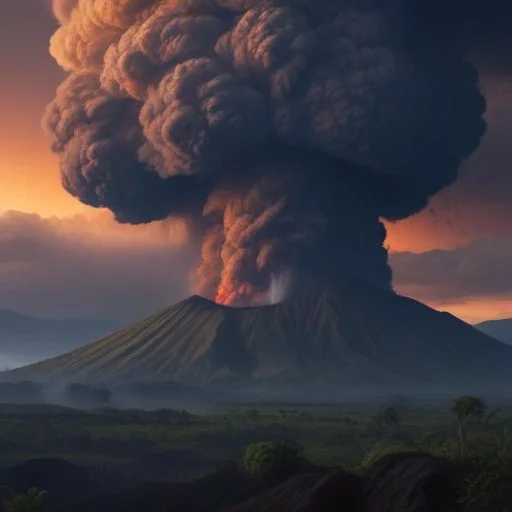
The eruption of Mount Tambora was not an isolated event, but rather the culmination of a series of seismic activities that had been building up in the region. In the months leading up to the eruption, the local population had reported a series of earthquakes and steam venting from the volcano's summit. However, the sheer scale and ferocity of the eruption caught everyone off guard.
The eruption of Mount Tambora began with a massive explosion that could be heard and felt hundreds of miles away. The volcano spewed forth a towering column of ash, rocks, and toxic gases that rose high into the atmosphere, blocking out sunlight and affecting the climate of the entire region. The explosive force of the eruption was so powerful that it blew away the top third of the volcano, creating a caldera that would eventually collapse in on itself.
The eruption of Mount Tambora had far-reaching consequences that extended far beyond the immediate region. The massive amounts of ash and aerosols released into the atmosphere cooled the planet, causing a global climate anomaly known as the "Year Without a Summer." The effects of the eruption were felt as far away as Europe and North America, where crop failures and unseasonable weather patterns led to widespread famine and disease.
The eruption of Mount Tambora was one of the deadliest volcanic eruptions in recorded history, claiming the lives of an estimated 71,000 people. The local population was devastated, with entire villages being buried under ash and pyroclastic flows. The eruption also had a profound impact on the regional economy, causing widespread poverty and displacement.
The eruption of Mount Tambora served as a stark reminder of the awe-inspiring power of nature. It also led to significant advances in the field of volcanology, as scientists sought to understand the underlying causes of such catastrophic events. Today, Mount Tambora stands as a testament to the fury of the Earth's natural forces, a powerful reminder of the importance of respecting and understanding the natural world.
The eruption of Mount Tambora serves as a powerful reminder of the awe-inspiring power of nature. It is a testament to the importance of respecting and understanding the natural world, and a warning of the devastating consequences that can result when we fail to do so.
The eruption of Mount Tambora had a profound impact on the environment, causing widespread deforestation and landslides in the surrounding area. The massive amounts of ash and aerosols released into the atmosphere also affected global climate patterns, leading to a significant decrease in global temperatures.
The effects of the eruption were felt as far away as the Arctic Circle, where the ash fall was still visible in the ice cores years later. The environmental impact of the eruption was a stark reminder of the devastating consequences of natural disasters on the natural world.
The eruption of Mount Tambora had a profound impact on the cultural landscape of the region. The disaster led to a significant shift in the social and economic structures of the local communities, with many people forced to flee their homes and seek refuge in other areas.
The eruption also had a profound impact on the art and literature of the time, with many artists and writers drawing inspiration from the disaster. The eruption of Mount Tambora serves as a powerful reminder of the human spirit and its ability to persevere in the face of adversity.
The eruption of Mount Tambora led to significant social change in the region, with many people forced to adapt to new ways of living. The disaster led to a breakdown in traditional social structures, with many people forced to fend for themselves in the aftermath of the eruption.
The eruption also led to a significant increase in poverty and displacement, with many people forced to flee their homes and seek refuge in other areas. The social change brought about by the eruption of Mount Tambora serves as a powerful reminder of the devastating consequences of natural disasters on human societies.
In the years leading up to the eruption, Mount Tambora was showing signs of increasing activity. The local population had reported a series of earthquakes and steam venting from the volcano's summit, but the sheer scale and ferocity of the eruption caught everyone off guard.
The eruption was a gradual process, with the volcano showing signs of increased activity for several days before the main event. On the evening of April 10, 1815, the volcano finally erupted, sending a massive column of ash and rock into the atmosphere.
The eruption of Mount Tambora led to significant advances in the field of volcanology, as scientists sought to understand the underlying causes of such catastrophic events. The eruption led to the development of new technologies and techniques for monitoring volcanic activity, including the use of seismographs and volcanometers.
The eruption also led to a greater understanding of the global climate system, with scientists recognizing the impact of volcanic eruptions on global climate patterns. The technological advances brought about by the eruption of Mount Tambora have had a lasting impact on our ability to predict and prepare for natural disasters.