


Nadia Comăneci's name is synonymous with perfection, and it all began on July 18, 1976, when she became the first person in Olympic Games history to score a perfect 10 in gymnastics at the Montreal Summer Olympics. This monumental achievement catapulted the Romanian gymnast into the record books, leaving a lasting impact on the world of gymnastics and beyond.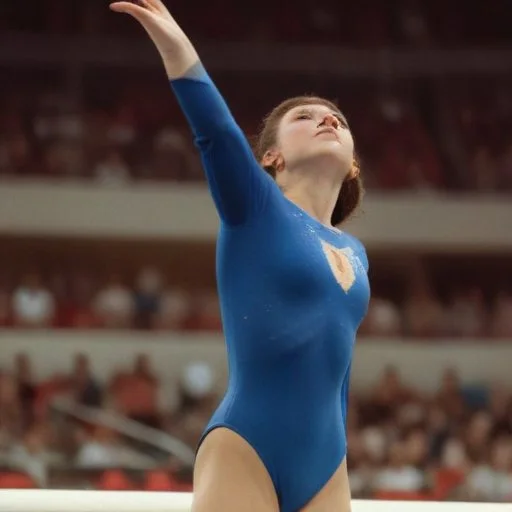
In the early 1970s, gymnastics was still a relatively new Olympic sport, with the first Olympic Games featuring gymnastics taking place in 1896. The scoring system, which ranged from 0 to 10, was introduced in 1924. However, during the 1972 Munich Olympics, the scoring system was tweaked to allow for more precise scoring, making a perfect 10 theoretically possible. But no one had ever achieved it – until Nadia Comăneci came along.
Born on November 12, 1961, in Onești, Romania, Nadia Comăneci began training in gymnastics at the age of six. Under the guidance of her coaches, Béla and Márta Károlyi, Comăneci's natural talent and dedication propelled her to the top of the Romanian national team. At just 13 years old, she won the 1975 European Women's Artistic Gymnastics Championships, setting the stage for her Olympic debut.
Comăneci's perfect 10 not only made her an overnight sensation but also redefined the boundaries of athletic excellence. The International Gymnastics Federation (FIG) soon followed suit, introducing new rules to increase the difficulty and complexity of routines, further pushing the limits of human achievement. Comăneci's historic moment also inspired a generation of gymnasts, sparking a global interest in the sport.
Comăneci's achievement transcended the world of sports, becoming a cultural phenomenon. She was hailed as a national hero in Romania, and her success sparked a wave of Romanian pride. The media frenzy surrounding her achievement made her an instant celebrity, with Comăneci gracing the covers of international publications and appearing on popular TV shows.
"The scoreboard flashed 1.00, and I thought it was a mistake." – Nadia Comăneci, on her initial reaction to scoring a perfect 10
Comăneci's achievement is often compared to Bob Beamon's record-shattering long jump at the 1968 Mexico City Olympics, which also redefined the boundaries of human achievement. Both feats share a common thread – pushing the limits of what was thought possible, inspiring generations to come.
In recognition of her historic achievement, Comăneci was awarded the Olympic Order in 1984. She has also been inducted into the International Gymnastics Hall of Fame and the Romanian Sports Hall of Fame.
Nadia Comăneci's perfect 10 has left an indelible mark on the world of gymnastics and beyond. She continues to inspire and motivate young athletes, serving as a global ambassador for the sport. Her record-breaking achievement serves as a testament to the power of dedication, hard work, and pushing beyond perceived limits.
The aftermath of Nadia Comăneci's perfect 10 was a cultural phenomenon that transcended the world of sports. In Romania, she was hailed as a national hero, and her success sparked a wave of Romanian pride. The country's communist government saw her achievement as a way to promote national unity and solidarity, and Comăneci's image was plastered on billboards and posters across the country.
Comăneci's achievement also had a profound impact on the global cultural landscape. She was an overnight sensation, with her picture appearing on the covers of international publications such as Time and Newsweek. She was also a popular guest on TV shows, including The Johnny Carson Show and 60 Minutes. Her fame even inspired a popular Romanian folk song, "Nadia, Nadia," which became a hit across Eastern Europe.

Nadia Comăneci's coaches, Béla and Márta Károlyi, played a crucial role in her development as a gymnast. The Károlyis were renowned coaches who had defected from Hungary to Romania in the 1960s. They were known for their tough, demanding training methods, which pushed their gymnasts to their limits.
Béla Károlyi, in particular, was a strict disciplinarian who believed in the importance of hard work and dedication. He was also a master of psychological manipulation, often using mind games to motivate his gymnasts. Under the Károlyis' guidance, Comăneci flourished, and her perfectionism and dedication earned her the nickname "The Golden Girl of Romanian Gymnastics."
Nadia Comăneci's achievement is often compared to Bob Beamon's record-shattering long jump at the 1968 Mexico City Olympics. Both feats redefined the boundaries of human achievement, inspiring generations of athletes to push themselves to new heights.
Both Comăneci and Beamon's achievements also shared a common thread – they were both aided by advances in technology. The introduction of electronic scoreboards and timing systems allowed for more precise measurements, making it possible for athletes to achieve previously unthinkable feats. However, while Beamon's record was set in a relatively new event, Comăneci's perfect 10 was achieved in a sport that had been part of the Olympic program since 1896.
Historians have long debated the significance of Nadia Comăneci's perfect 10 in the context of the Cold War era. Some argue that her achievement was a powerful symbol of Eastern Bloc superiority, proof that communist countries could produce athletes who could compete with the best in the world.
Others see Comăneci's achievement as a testament to the power of sport to transcend political boundaries. At a time when the world was divided into ideological blocs, Comăneci's perfect 10 showed that athletic excellence knew no borders. Her achievement inspired a generation of gymnasts from around the world, regardless of their political affiliation.
The introduction of electronic scoreboards and timing systems at the 1976 Montreal Olympics played a crucial role in Nadia Comăneci's perfect 10. The electronic scoreboard allowed for more precise scoring, eliminating human error and allowing judges to award scores with greater accuracy.
The technology also allowed for the instantaneous display of scores, creating a sense of drama and tension that added to the excitement of the competition. The scoreboard's flashing "10.0" was an iconic image that etched itself into the collective memory of the sporting world.