


The Battle of Eylau is renowned for being one of the bloodiest and most brutal battles of the Napoleonic Wars, with estimates suggesting over 40,000 casualties on both sides. It's a testament to Napoleon's tactical prowess that his outnumbered forces emerged victorious on that fateful day in February 1807.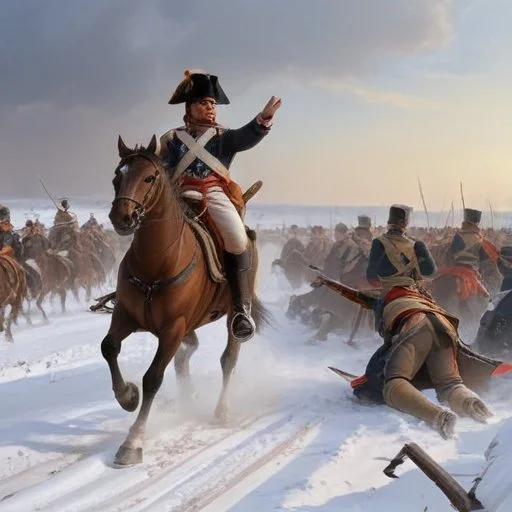
In the wake of his triumphant conquest of Prussia in 1806, Napoleon turned his attention to Russia, intent on expanding his empire further east. However, the Russian army, led by General Bennigsen, had other plans, and Napoleon soon found himself facing a formidable coalition of Russian and Prussian forces.
February 7-8, 1807: The French army, led by Napoleon, clashed with the coalition forces of General Bennigsen and General LEstocq in the snow-covered fields of Eylau, Prussia. The battle raged on for over 12 hours, with both sides suffering heavy losses.
Although the victory was far from decisive, Napoleon's tactical genius and the ferocity of his soldiers won the day, keeping his conquest of Eastern Europe on track. The Battle of Eylau marked a turning point in Napoleon's campaign, as it thwarted the coalition's plans to defeat him and allowed him to maintain his grip on Eastern Europe.
The Battle of Eylau had a profound impact on the cultural and social fabric of Europe. It cemented Napoleon's reputation as a military genius and further galvanized his position as the dominant power in Europe. The brutality and carnage of the battle also fueled growing anti-war sentiment across the continent.
"An army of sheep led by a lion is better than an army of lions led by a sheep." - Napoleon Bonaparte
The Battle of Eylau was met with widespread shock and horror across Europe, with many condemning the brutality and senseless slaughter of the battle. The high casualties on both sides sparked a heated debate about the morality and justification of war.
According to eyewitness accounts, Napoleon was seen riding through the midst of the battle, urging his troops forward and directing the artillery fire. Despite being outnumbered, his presence and leadership inspired his soldiers to fight on, ultimately securing their victory.
The Battle of Eylau set the stage for Napoleon's future conquests, including his invasion of Russia in 1812. The battle also paved the way for the reorganization of the French army and the development of new military tactics that would shape the course of European history.
The bravery and sacrifice of the soldiers who fought at Eylau serve as a testament to the power of human resilience and determination. The battle's outcome was far from certain, but Napoleon's unwavering confidence and leadership inspired his troops to fight against seemingly insurmountable odds.
The Battle of Eylau remains an enduring testament to Napoleon's military genius and the ferocity of his soldiers. Despite the passage of time, the battle's significance continues to captivate and inspire historians, military strategists, and enthusiasts alike.
The Battle of Eylau was a testament to Napoleon's ability to adapt to harsh winter conditions. The French army was well-equipped with winter gear, including fur-lined coats and warm boots, which proved to be a decisive advantage over the Russian and Prussian forces. Additionally, Napoleon's soldiers were trained to fight in snowy conditions, which allowed them to navigate the treacherous terrain with ease.
The battle was also marked by a series of clever tactical maneuvers by Napoleon. He employed a "feign and strike" strategy, where he pretended to retreat, only to launch a surprise attack on the coalition forces. This tactic caught the enemy off guard, allowing the French army to gain the upper hand.
Despite being outnumbered, the French army's superior training and equipment allowed them to hold their ground against the coalition forces. Napoleon's leadership and tactical prowess ultimately secured the victory, cementing his reputation as a military genius.

General Bennigsen: The Russian General Who Almost Defeated Napoleon
General Levin August von Bennigsen was a seasoned Russian general who played a crucial role in the Battle of Eylau. He was known for his bravery and tactical skills, which earned him the respect of his troops and the fear of his enemies.
Bennigsen's decision to engage Napoleon's forces at Eylau was a bold move, given the French army's reputation for invincibility. However, he was confident in his troops' abilities and believed that a decisive victory would give them the momentum they needed to drive the French out of Russia.
Although Bennigsen's forces were ultimately defeated, his leadership and strategic thinking earned him recognition as one of the most skilled generals of his time.
The Battle of Eylau had a profound impact on European culture, particularly in the realm of literature and art. The brutality and carnage of the battle inspired a generation of Romantic writers and artists, who saw it as a symbol of the senseless destruction of war.
The battle also had a significant impact on the development of military music, with many composers creating works inspired by the event. The "Eylau March," for example, became a popular tune throughout Europe, symbolizing the bravery and sacrifice of the soldiers who fought and died at Eylau.
In addition, the Battle of Eylau influenced the way people thought about war and its consequences. It marked a turning point in the way people viewed the glorification of war, with many beginning to question the morality of military conflict.

The Battle of Eylau is often compared to the Battle of Austerlitz, another pivotal conflict in Napoleon's campaign. While both battles showcased Napoleon's tactical genius, they differed significantly in terms of terrain and troop deployment.
Austerlitz, fought on a dry and open plain, allowed Napoleon to employ his signature cavalry charges and sweeping artillery maneuvers. In contrast, the snowy terrain of Eylau forced Napoleon to adapt his tactics, relying on infantry and artillery to hold off the coalition forces.
Despite these differences, both battles demonstrated Napoleon's ability to think on his feet and adapt to changing circumstances. His victories at Austerlitz and Eylau cemented his reputation as a master of the battlefield.
The Battle of Eylau took place against the backdrop of a rapidly shifting geopolitical landscape. Napoleon's conquest of Eastern Europe had created a power vacuum, which the Russian and Prussian forces sought to fill.
The battle was also influenced by the complex web of alliances and rivalries that characterized European politics at the time. The Russian and Prussian forces were united in their opposition to Napoleon, but they had competing interests and agendas that threatened to undermine their alliance.
In the end, Napoleon's victory at Eylau allowed him to maintain his grip on Eastern Europe, but it also marked the beginning of a new era of great power rivalry and competition for influence in the region.