


The French Grande Armée's entrance into Moscow on September 14, 1812, marked a pivotal moment in the Napoleonic Wars, a conflict that would leave an indelible scar on European history. It was a day that would forever be remembered as the Fire of Moscow, a catastrophic event that would reduce the city to ashes and signal the beginning of the end for Napoleon's empire.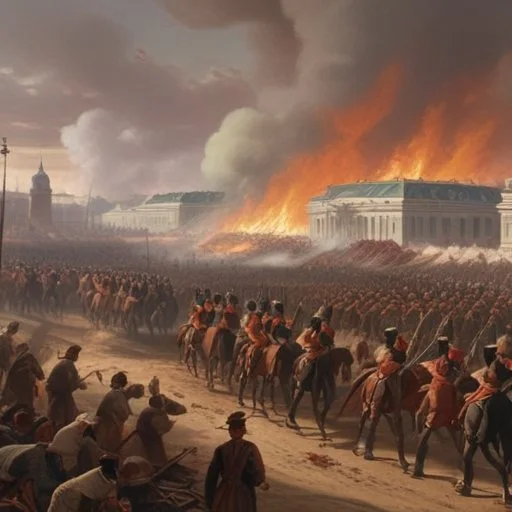
The Napoleonic Wars were a series of conflicts that ravaged Europe from 1803 to 1815. At the heart of the conflict was Napoleon Bonaparte, the French Emperor who sought to expand his empire across the continent. In 1812, Napoleon set his sights on Russia, aiming to defeat the Russian army and secure a crucial victory. The Grande Armée, comprising over 600,000 soldiers, was the largest and most formidable force in Europe, and Napoleon was confident of a swift victory.
Russian Commander General Mikhail Kutuzov, a seasoned veteran of the Russo-Turkish War, was well aware of Napoleon's tactics. Instead of engaging the French in a direct battle, Kutuzov opted for a scorched earth policy, ordering the evacuation of Moscow and leaving the city to its fate. This decision would prove to be a masterstroke, as it would force the French to confront the harsh Russian winter without the support of local supplies.
As the French troops entered Moscow, they were met with an eerie silence. The city was abandoned, its streets empty and still. But it wasn't long before the silence was shattered by the sound of flames. A series of mysterious fires suddenly erupted, engulfing the city in a blaze that would spread rapidly, consuming everything in its path. The French, caught off guard, struggled to contain the inferno, but it was too late. The Fire of Moscow had begun, and it would rage unchecked for days, reducing the city to ashes.
The Fire of Moscow was a devastating blow to the French army, marking a turning point in the Napoleonic Wars. The loss of Moscow, combined with the harsh Russian winter, would ultimately lead to the retreat of the Grande Armée and the downfall of Napoleon's empire. The event would also have a profound impact on the Russian people, who would come to see the fire as a symbol of their nation's resilience and determination.
The Fire of Moscow has had a lasting impact on Russian culture, inspiring countless works of art, literature, and music. The event has been immortalized in Tolstoy's War and Peace, while composers like Tchaikovsky and Mussorgsky have written works inspired by the inferno.
| Date | Event |
|---|---|
| June 24, 1812 | Napoleon's Grande Armée crosses the Neman River, invading Russia. |
| September 14, 1812 | The French enter Moscow, finding the city abandoned by the Russian army. |
| September 15, 1812 | The Fire of Moscow begins, engulfing the city in flames. |
One French soldier, Pierre-François Tissot, wrote in his memoirs: "The flames rose to the height of the buildings, and the air was filled with sparks and burning fragments of wood... It was a terrible sight, and one that I will never forget."
The Fire of Moscow marked a turning point in the Napoleonic Wars, paving the way for the eventual defeat of Napoleon's army. The event would also have a lasting impact on European history, influencing the course of future conflicts and shaping the destiny of nations.
The march on Moscow was a culmination of Napoleon's ambition to expand his empire eastward. The Russian army, led by General Mikhail Kutuzov, had been retreating before the Grande Armée, employing a scorched earth policy that left the French without supplies or shelter. Napoleon's decision to press on into Moscow was driven by his desire to capture the city and force Tsar Alexander I to negotiate a peace treaty. However, the Russian tactics had already set the stage for a catastrophic outcome.
Napoleon's troops, exhausted and hungry, entered Moscow expecting to find a well-stocked city with ample food and supplies. Instead, they found an empty, abandoned city that offered little comfort or relief. The French soldiers, who had marched over 600 miles, were disillusioned and demoralized by the lack of resistance and the eerie silence that greeted them.
The fires that erupted in Moscow on September 15, 1812, marked the beginning of the end for Napoleon's army. The inferno, which lasted for four days, destroyed nearly three-quarters of the city, leaving the French without shelter, food, or supplies. The Grande Armée, once the most powerful military force in Europe, was now a fragmented and exhausted army, struggling to survive in a hostile environment.
General Mikhail Kutuzov, the Russian Commander-in-Chief, was a seasoned veteran of the Russo-Turkish War. Born in 1745, Kutuzov was a member of the noble class and had risen through the ranks of the Russian army to become one of its most respected leaders.
Kutuzov's strategy of retreat and scorched earth tactics was a masterstroke that ultimately led to the defeat of Napoleon's army. His decision to abandon Moscow and leave it to its fate was a bold move that caught the French off guard. Despite being outnumbered and outgunned, Kutuzov's army was able to exploit the weaknesses of the Grande Armée, ultimately forcing Napoleon to retreat.
The Fire of Moscow had a profound impact on Russian culture, inspiring countless works of art, literature, and music. The event has been immortalized in Tolstoy's War and Peace, while composers like Tchaikovsky and Mussorgsky have written works inspired by the inferno.
The fire also had a significant impact on the Russian people, who saw it as a symbol of their nation's resilience and determination. The event marked a turning point in Russian history, symbolizing the country's ability to withstand even the most devastating attacks.
The Napoleonic Wars, including the French invasion of Russia, marked a significant shift in the balance of power in Europe. The defeat of Napoleon's army in Russia led to a decline in French influence and paved the way for the rise of other European powers.
The Fire of Moscow, in particular, had a profound impact on European politics, leading to a re-evaluation of Napoleon's military strategy and the rise of coalition forces opposed to French expansion. The event marked a turning point in the Napoleonic Wars, signaling the beginning of the end for Napoleon's empire.
One of the most significant artifacts from the Fire of Moscow is the diary of Pierre-François Tissot, a French soldier who witnessed the event. Tissot's diary provides a firsthand account of the inferno, offering a unique glimpse into the chaos and destruction that engulfed the city.
Tissot's diary, along with other artifacts from the time, provides valuable insights into the experiences of soldiers on both sides of the conflict. These artifacts offer a unique window into the past, allowing historians to reconstruct the events surrounding the Fire of Moscow with greater accuracy.